Scientist of the Day - Pehr Georg Scheutz

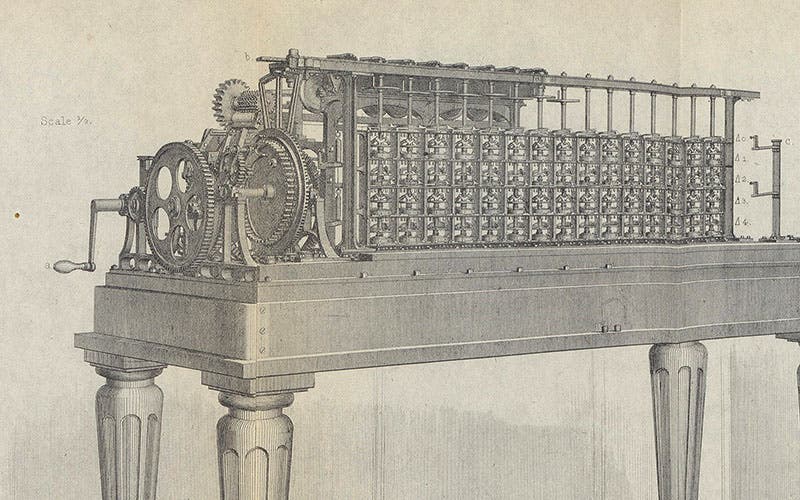
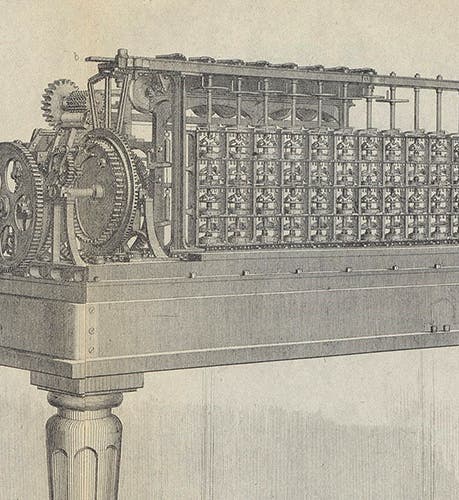
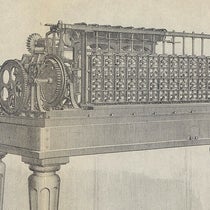
Scheutz difference engine no. 2 at the Dudley Observatory, detail of engraving, Annals of the Dudley Observatory, vol. 1, p. 118, 1866 (Linda Hall Libay)
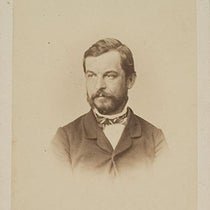
Pehr Georg Scheutz, a Swedish publisher and inventor, died on May 22, 1873, at the age of 87. He was born in Jönköping, south of Stockholm, on Sep. 23, 1785, to an innkeeper. As a child he was interested in technology and languages. He studied at Lund University and eventually secured a law degree. He first achieved success as a publisher in Stockholm, issuing political newspapers, often with translations by himself of material in foreign languages.

Portrait of Pehr Georg Scheutz, unknown source and date, (Wikimedia commons)
Eventually, his interests shifted from politics to technology, and he was galvanized when he first heard that Charles Babbage in England, with the financial backing of the British government, was building a "difference engine," a mechanical calculator that could create such things as tables of logarithms entirely automatically, and without error. Such tables were essential for engineers but were devilish to create by hand and print without mistakes, since every line in such a table was just a string of digits and difficult to proofread.

Title page, Annals of the Dudley Observatory, vol. 1, 1866 (Linda Hall Library)
Scheutz thought that such a calculating engine would be a boon to the Swedish government and wanted to build one of his own. He could find no details about Babbage's difference engine for a decade – Babbage first began seeking support for his project in 1823 – and not until 1834, did any details of Babbage's project appear in print, in the form of an article in the Edinburgh Review. But even this was short on specifics as to how the calculator actually worked, except that it had a lot of toothed gears with digits from 1 to 9, coupled together in massive gear trains. But that was enough for Pehr Georg. He decided to build his own. The Swedish government was not yet interested in helping out with expenses.

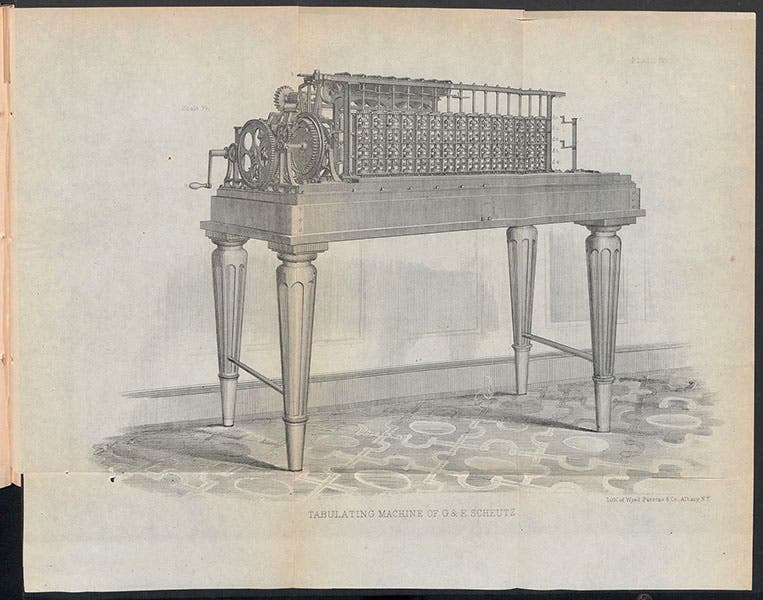
Scheutz difference engine no. 2 at the Dudley Observatory, complete fold-out engraving, Annals of the Dudley Observatory, vol. 1, p. 118, 1866 (Linda Hall Library)
By 1837, Scheutz had finished a design for a difference engine that would not only calculate values of logarithmic and other tables, but would automatically set up the results for printing with stereotype plates. The two major sources of error – human calculations and setting results into type – would be eliminated. He enlisted the aid of his teenage son Edvard, a gifted self-taught machinist, to make all the gears and shafts, and Scheutz engine no. 1 was finished by 1843. It worked quite differently from the Babbage engine, since Georg still had no details as to how that machine was put together. The Scheutz engine cost about a thousand pounds to build, and it worked! Babbage and the British government had spent over 17,000 pounds on their machine, and it was still unfinished, and did NOT work.
Scheutz, father and son, immediately began to build a second and improved engine, this time with the financial backing of the Swedish government, which they completed and displayed at the second world's fair in Paris (the Exposition Universelle) in 1855, where it won a Gold Medal. It was seen there by American astronomer Benjamin Apthorp Gould, who was then appointed head of the new Dudley Observatory in Albany, New York. Gould bought the second Scheutz difference engine and had it shipped to the Dudley Observatory and installed. We have the Annals of the Dudley Observatory in our serials collection, and there, in volume 1 for 1866 (third image), is a fold-out engraving of the Scheutz engine. It is quite something to behold (first and fourth images).

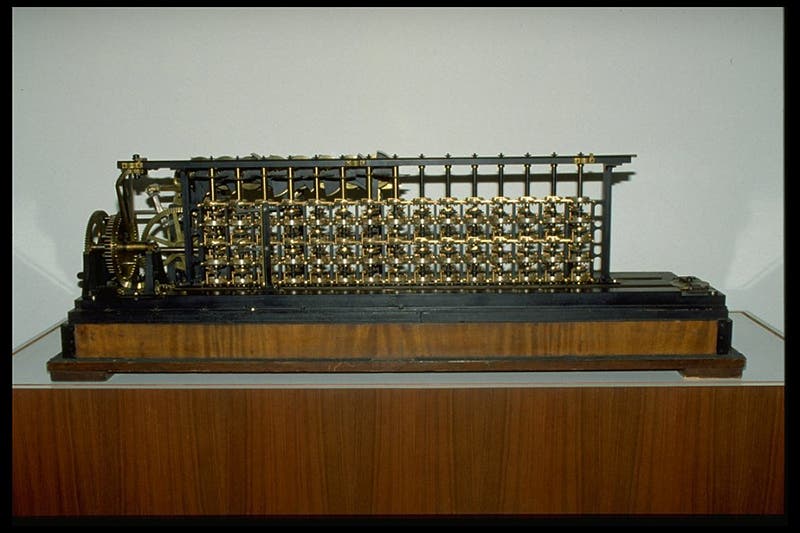
Scheutz engine no. 2, National Museum of American History, Smithsonian Institution (americanhistory.si.edu)
The Dudley engine worked, although not perfectly, and it took them 20 years to get the printing function to operate properly. But they never really used it – astronomers seemed to prefer the old tables, even with all their typos. The calculator was taken down and put into storage, and eventually it ended up in the National Museum of American History at the Smithsonian Institution (fifth and sixth images). It is quite beautiful. The Scheutzs built a third engine, a copy of the second, for the British government in 1859, but it was never put into use, and ended up in the Science Museum, London. You will be hard pressed to find an image on the Science Museum website – they much prefer to showcase the failed effort of Babbage – but you can see a photo of engine no. 3 on the Computer History Museum website. The original engine of 1843 is in storage in the Nordic Museum in Stockholm.
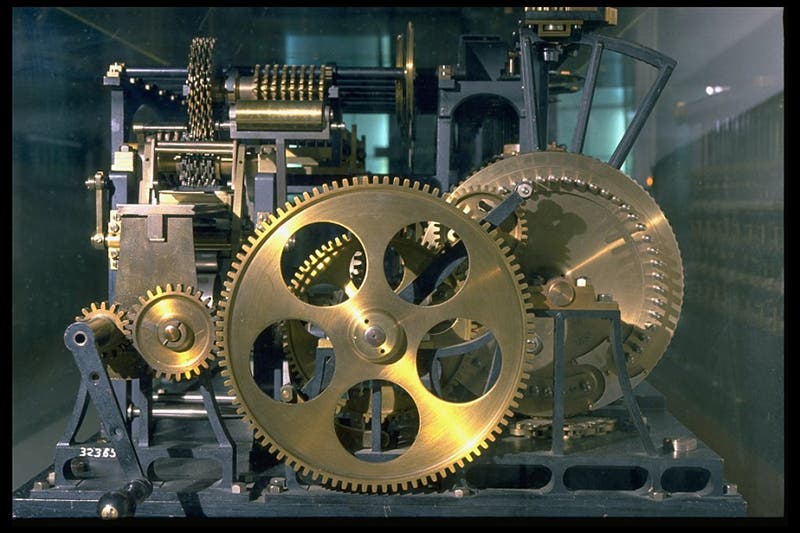
Detail of Scheutz engine no. 2, National Museum of American History, Smithsonian Institution (americanhistory.si.edu)
It is not clear why none of the early difference engines caught on. Babbage’s we can understand, since his engine never worked, but the failure of the Scheutz machines to attract interest is more baffling, since they did work, and could easily have been improved, but no one seems to have really cared. Saying "the time was not yet ripe" does not seem like much of an answer.
There is an excellent book on the difference engines of Babbage and the Scheutzs, Glory and Failure: The Difference Engines of Johannes Müller, Charles Babbage and Georg and Edvard Scheutz, by Michael Lindgren (Linköping, Sweden, 1987). The book was reissued in 1990 by MIT Press, without change. Our library has both editions.
William B. Ashworth, Jr., Consultant for the History of Science, Linda Hall Library and Associate Professor emeritus, Department of History, University of Missouri-Kansas City. Comments or corrections are welcome; please direct to ashworthw@umkc.edu.

![Net for truncated cuboctahedron, an Archimedean solid, Quatuor his suaru[m] Institutionum geometricarum libris (Four Books on Measurement), by Albrecht Dürer, p. 156, 1534 (Linda Hall Library)](https://preview-assets-us-01.kc-usercontent.com:443/9dd25524-761a-000d-d79f-86a5086d4774/05d51aeb-2dd1-4949-880d-ec62209058fd/durer1.jpg?w=210&h=210&auto=format&fit=crop)