Scientist of the Day - George Phillips Bond

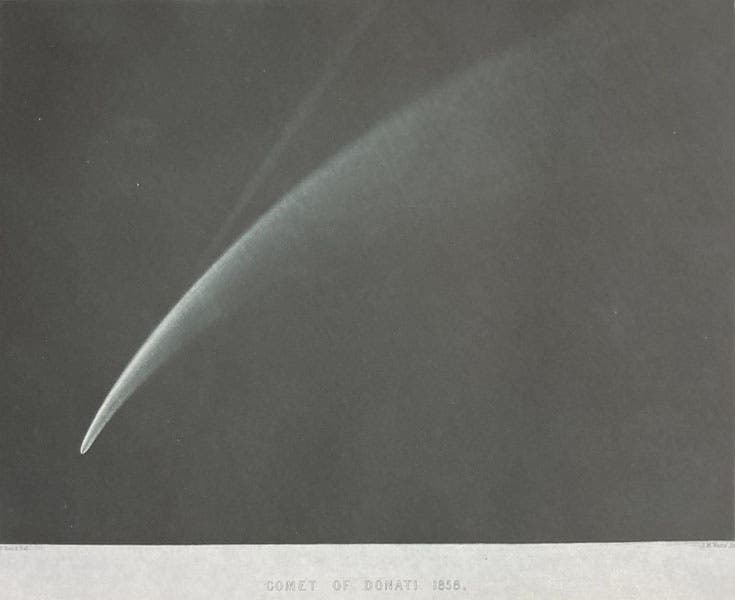
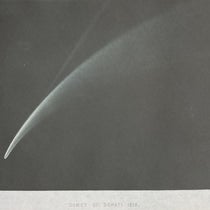
The Great Comet of 1858 (Donati’s Comet), drawing by George Phillips Bond, Annals of the Harvard College Observatory, frontispiece, vol. 3, 1862 (Linda Hall Library)
George Phillips Bond, an American astronomer, was born May 20, 1825, in Dorchester, Mass., now part of Boston. His father, William Cranch Bond, was an avid amateur astronomer who convinced Harvard to let him set up shop on campus as the unpaid university astronomer, supplying his own telescopes. When a prominent comet appeared in the skies in 1843 and attracted wide public interest, Harvard and the older Bond were able to raise funds to found an observatory and purchase a German-made telescope, a Merz & Mahler 15-inch refractor, which was the largest in the United States at the time of its installation in 1847. William was the first Director of Harvard College Observatory. He designed the Observatory building, and the ingenious sliding chair that moved with the telescope, both of which are still in place and can be seen at our post on William Bond, and, in a different view, here (third image).

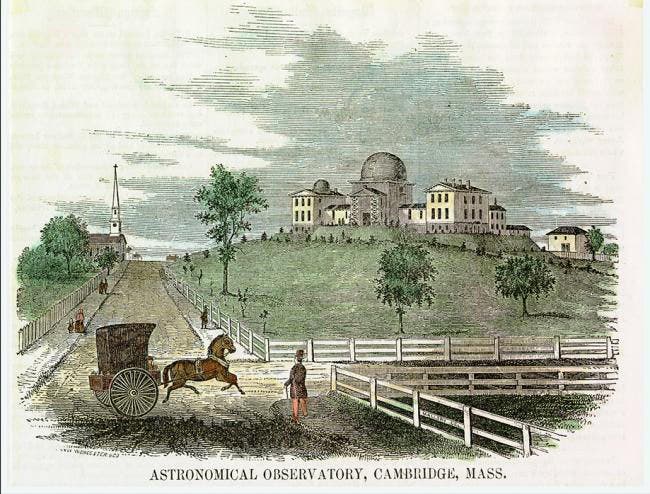
Harvard College Observatory, wood engraving, 1855 (cfa.harvard.edu)

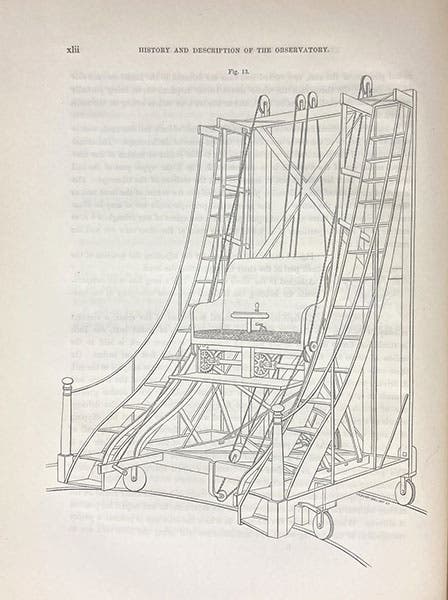
The observing chair at Harvard College Observatory, with the Great Refractor, wood engqving, Annals of the Harvard College Observatory, vol. 1, 1856 (Linda Hall Library)
It is said that son George intended to pursue natural history, but when his older brother, William Jr., died, he felt obligated to switch to astronomy to assist his father. If he was at all reluctant to make the career change, he soon showed himself to be a gifted and forward-looking observer. He was only 22 when the Great Refractor was opened for business, but he took an immediate interest in bringing the newly-invented art of photography into astronomy, encouraging daguerreotypist John Adams Whipple to use the large telescope to photograph not only the Moon, but the stars. The two men took the first daguerreotype of a star, Vega, in 1850, and stellar astronomy was suddenly and fundamentally changed. George was the first great champion of astrophotography for stellar astronomers.

Title page, “Account of the Great Comet of 1858,” by George Phillips Bond, Annals of the Harvard College Observatory, frontispiece, vol. 3, 1862 (Linda Hall Library)
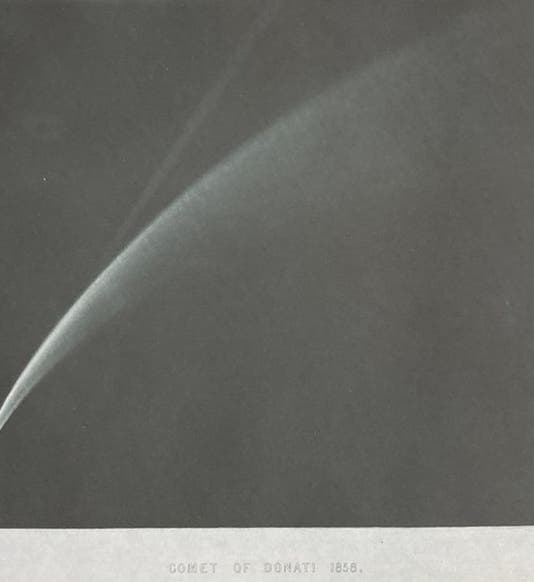
William and George, father and son, worked together for 12 years, discovering Hyperion, a new moon of Saturn, in 1848, and a new inner ring of Saturn, the "crepe ring," in 1850. When an especially brilliant comet came by in 1858, Donati's comet, George studied and drew it on every possible occasion (first image). When the Observatory finally received a bequest that allowed them to publish their results in the Annals of the observatory, George published a 372-page monograph on the Great Comet of 1858, illustrated with 51 plates made from his drawings (fourth image). It was a spectacular contribution to astronomy, and immediately drew the attention of European astronomers to the recent achievements of the upstart Americans.

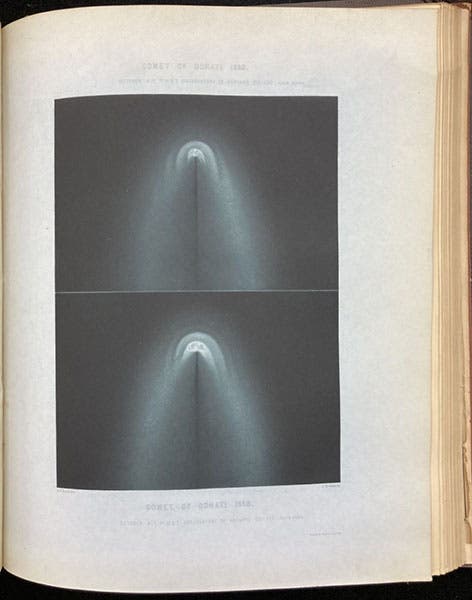
Two views of the head of the Great Comet of 1858, drawings by George Phillips Bond, Annals of the Harvard College Observatory, vol. 3, 1862 (Linda Hall Library)
By the time the monograph on the Great Comet appeared in 1863, George had succeeded his father as the second Director of Harvard College Observatory. William had died in 1859, and a number of prominent scientists, such as Benjamin Gould and Benjamin Pierce, had lobbied strongly for the position, and there was considerable bitterness when young George – he was only 34 years old in 1859 – was chosen over the more seasoned applicants. Almost in retaliation, George was omitted from the list when 50 American scientists were invited to join the new National Academy of Sciences when it was founded by the government in 1863. Many astronomers, especially those in Europe, were outraged that America's most talented and promising astronomer had been excluded from the new Academy. George took the high road and did not publicly complain.

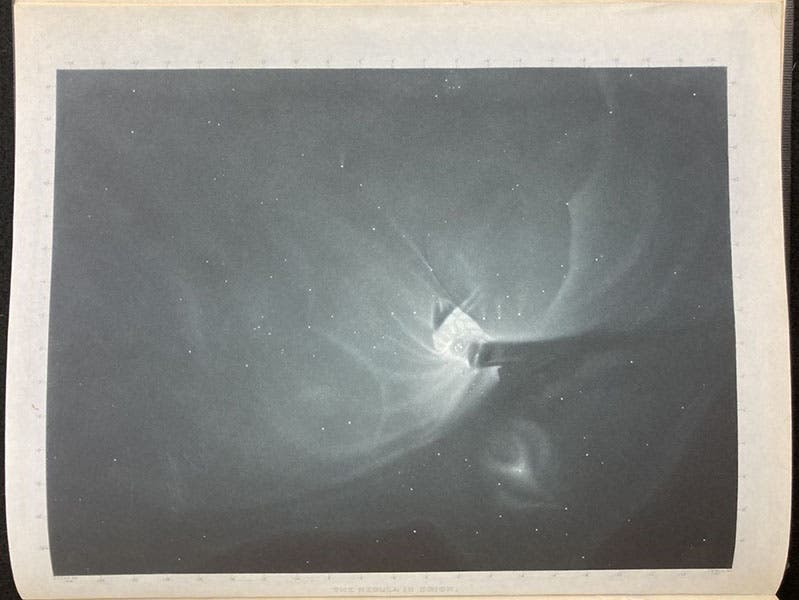
The Great Nebula of Orion, drawing by George Phillips Bond, Annals of the Harvard College Observatory, frontispiece, vol. 5, 1867 (Linda Hall Library)
George had other things to worry about. He was sick and, although he did not know it yet, he was dying of consumption, the 19th-century term for tuberculosis. Consumption was the great killer of intellectuals at the time – about one in four people who died in early adulthood in the 19th century were victims of tuberculosis.
George spent the time he had left preparing a study on the Great Nebula in Orion and its associated stars. His study would be finished by an assistant and published in 1867 in volume 5 of the Annals, with a beautiful frontispiece showing one of George's drawings (sixth image). Photographic emulsions were not yet sensitive enough to record images of wispy comets and nebulae – these had to be drawn at the telescope.

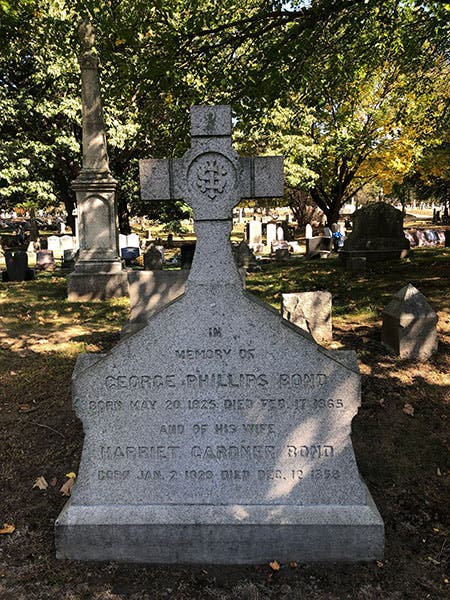
Gravestone of George Phillips Bond, died Feb. 17, 1865, Mount Auburn Cemetery, Cambridge, Mass. (findagave.com)
George died of consumption on Feb. 17, 1865. He was just 39 years old. He was buried in Mount Auburn Cemetery in Cambridge (last image). Oddly, no portrait of George Phillips Bond survives, or is even known to have been made.
William B. Ashworth, Jr., Consultant for the History of Science, Linda Hall Library and Associate Professor emeritus, Department of History, University of Missouri-Kansas City. Comments or corrections are welcome; please direct to ashworthw@umkc.edu.