Scientist of the Day - Wilhelm Hofmeister
.jpg#/media/File:Wilhelm_Hofmeister_(HeidICON_28826).jpg)
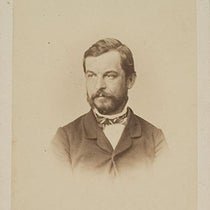
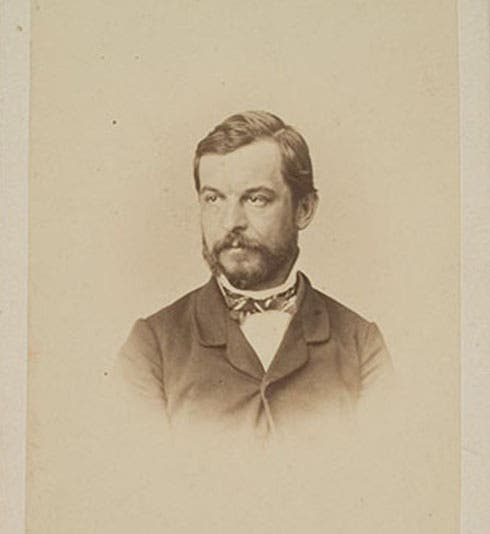
Portrait of Wilhelm Hofmeister, carte de visite, undated (Wikimedia commons)
Wilhelm Hofmeister, a German botanist, was born on May 18, 1824, in Leipzig in Saxony. He had no formal higher education, instead serving as an apprentice to a music publisher, which was his father's business. At some time in his youth, he became interested in plant biology, and he used to get up at 4:00 AM each morning to study plant structure before going to work. He made a number of important discoveries pursuing what was initially a hobby, some so fundamental that Hofmeister was called, by his biographer, the equal of Darwin and Mendel, which is perhaps an extreme claim, but Hofmeister was a remarkable botanist, and he certainly had a harder row to hoe than his more famous contemporaries.

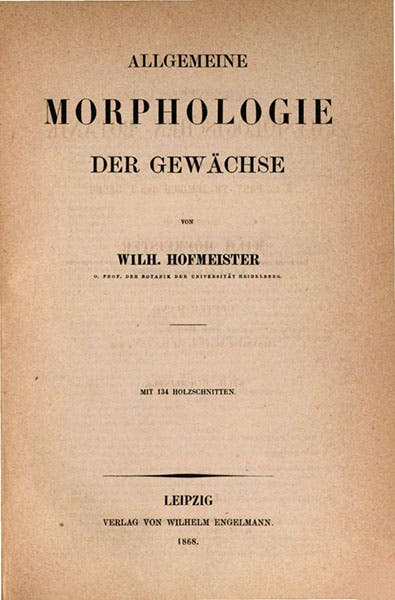
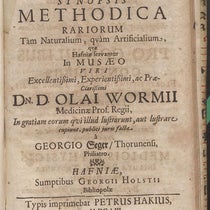
Title page, Allgemeine Morphologie der Gewächse, by Wilhelm Hofmeister, 1868, Bavarian State Library, Munich (digitale-sammlungen.de)
Hofmeister's first major discovery came when he was just 27 years old and still working in the music publishing business. He discovered what is called the "alternation of generations" in plants, whereby all plants produce a generation of asexual spores, which in turn give rise to a generation of sexually reproduced gametes. It is quite amazing that he observed this in 1851, before any of his well-established professional colleagues. When the announcement was quickly confirmed, Hofmeister suddenly had a reputation, and even though he had no undergraduate or graduate training, he was hired as a professor of botany in 1862 by the University of Heidelberg.

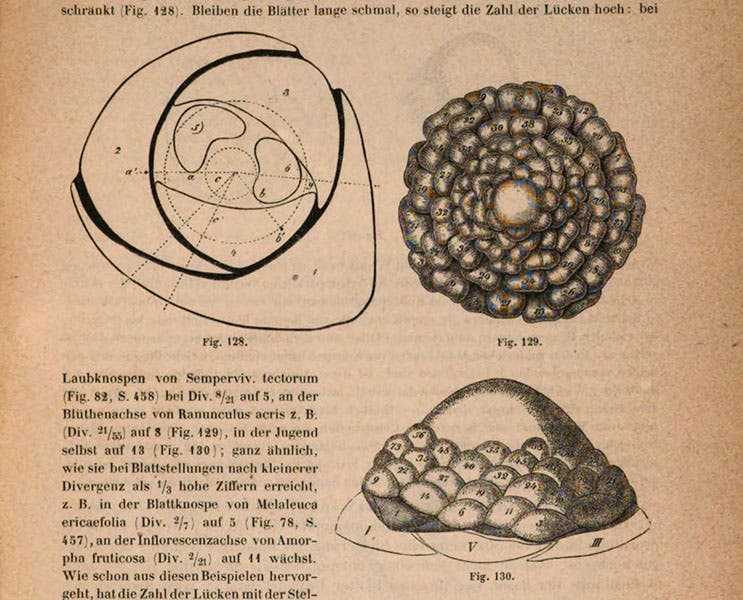
New buds, numbered in order of appearance, around the apical meristem of a plant, diagrams in Allgemeine Morphologie der Gewächse, by Wilhelm Hofmeister, p. 493, 1868, Bavarian State Library, Munich (digitale-sammlungen.de)
Hofmeister continued to make major discoveries, and he published two important books in 1867 and 1868, Die Lehre von der Pflanzenzelle (The Study of the Plant Cell, 1867), followed by Allgemeine Morphologie der Gewächse (General Morphology of Plants, 1868). We own the first book, on plant cells, but not the second, on plant growth, which is unfortunate, because the second book delves into eveyone’s favorite aspect of plant growth, the fact that the Fibonacci sequence – 1, 1, 2, 3, 5, 8, 13, 21, 34, 55... – pops up many times in plant structure , from the arrangement of seeds in the head of a sunflower (fourth image) to the spacing of leaves as a plant grows. Botanists wondered how plants know the advantages of Fibonacci spacing. In his 1868 book, Hofmeister made a detailed study of the apical meristem in plants, which is the tiny dot at the end of a stem around which all growth takes place. Microscopic buds appear in sequence around the meristem, which become stems and leaves, and which Hofmeister carefully mapped and numbered as they appeared, and showed as drawings in his 1868 book (third image). He discovered a simple principle: the next bud always appears in the space that is the greatest distance from all existing buds. This is now known as “Hofmeister's rule,” and it turns out that if plant growth follows such a rule, it will automatically generate a Fibonacci sequence. The plant doesn't have to know geometry after all!

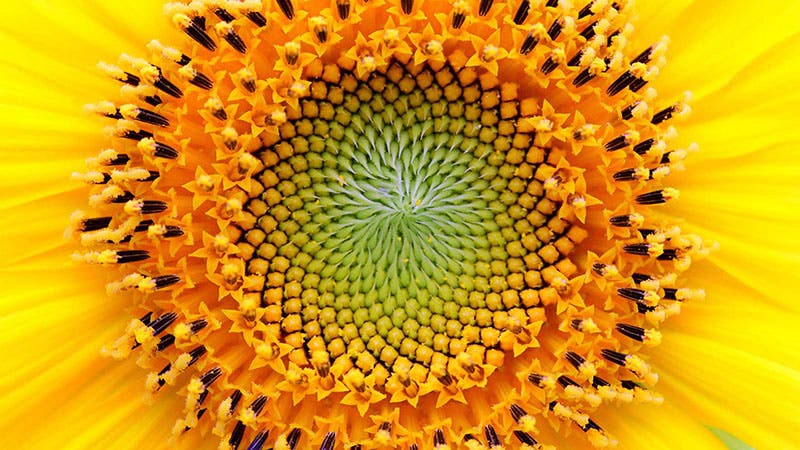
Sunflower head, with developing seeds arranged in Fibonacci spirals, modern photograph (mentalfloss.com)
There is a excellent discussion of the Fibonacci sequence as it appears in the plant kingdom in a new book: Do Plants Know Math?: Unwinding the Story of Plant Spirals, from Leonardo da Vinci to Now, by Stéphane Douady, Jacques Dumais, Christophe Golé, and Nancy Pick (2024), which has an excellent chapter on Hofmeister, with reproductions of his diagrams juxtaposed to modern Fibonacci diagrams. Since we do not have Hofmeister’s 1868 book, I drew our images here (second and third images) from an online version at the Bavarian State Library in Munich.
Hofmeister did not have a happy personal life, losing his wife and seven of his nine children before he himself suffered several strokes and died in 1877 at the age of 52. It took another fifty years before his accomplishments were widely recognized by botanists, although he is still not as well-known as he should be. I have been unable to find the location of his grave.
William B. Ashworth, Jr., Consultant for the History of Science, Linda Hall Library and Associate Professor emeritus, Department of History, University of Missouri-Kansas City. Comments or corrections are welcome; please direct to ashworthw@umkc.edu.