Scientist of the Day - Ole Worm

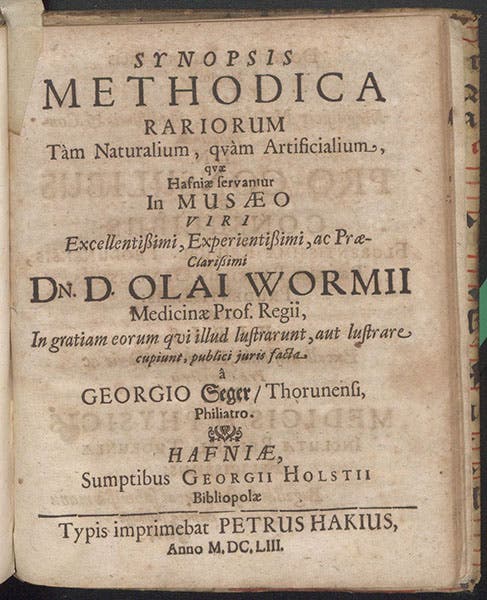
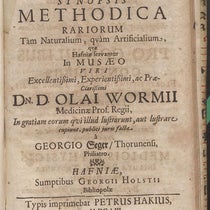
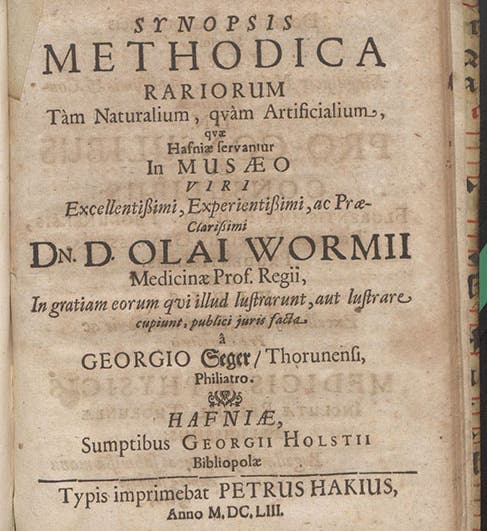
Title page, Synopsis methodica rariorum tàm naturalium, qvàm artificialium, qvæ Hafniæ servantur in Musaeo ... Olai Wormii, by Georg Seger, 1653 (Linda Hall Library)
Ole Worm, a Danish physician, naturalist, antiquarian, and collector, was born in Aarhus on May 13, 1588. Worm studied at Basel in Switzerland and Marburg in Germany, before returning to Copenhagen, where he taught at the university for the rest of his life. He is best known for his collection of naturalia and artificiosa, his Museum Wormianum, which was described in a book of that title, published in 1655, just after Worm's death in 1654.

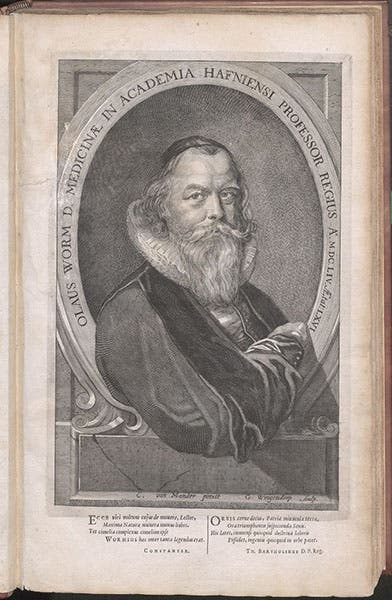
Portrait of Ole Worm, second engraved frontispiece, Museum Wormianum, by Ole Worm, 1655 (Linda Hall Library)
The 1655 catalog is quite well known, illustrated with numerous engravings and woodcuts, and opening with a frontispiece that shows his Wunderkammer (wonder-room) packed with his collections. We discussed the 1655 book in an earlier post, and we show the frontispiece again in this post (third image).

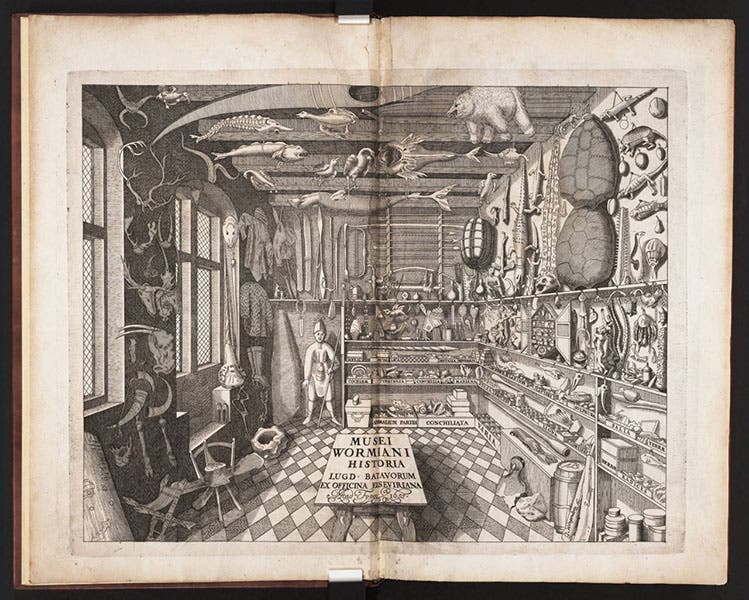
Ole Worm’s museum in Copenhagen, engraved frontispiece, Museum Wormianum, by Ole Worm, 1655 (Linda Hall Library)
The Museum Wormianum is a rare book, but not a scarce one. A catalog of Worm's collection that IS scarce is the book we are going to discuss today, the Synopsis methodica rariorum, compiled by Georg Seger and published in 1653, when Worm was still alive. We recently acquired this book (first image), and it is, on first glance, much less appealing than the Museum Wormianum, because it is just a list, without any illustrations, although it is organized. We show here a sample page (fourth image).

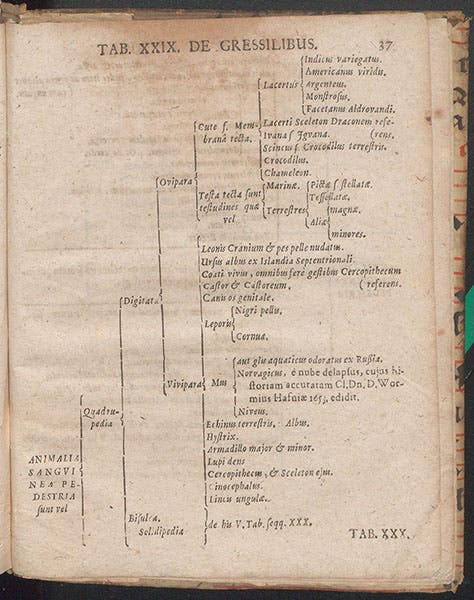
Page describing the coati and other quadrupeds in Ole Worm’s museum, Synopsis methodica rariorum in Musaeo ... Olai Wormii, by Georg Seger, p. 37, 1653 (Linda Hall Library)
We have several catalogs of other collections that are like this, unillustrated lists, and they are usually not much fun to look through, since we cannot picture the objects described. But Seger's list is different, because we can see the objects – we just have to look in the other book. I found it rather enjoyable to read through Seger's list and recognize objects by his description. For example, Worm was proud of the artifacts he had acquired from Greenland, including a kayak that he hung from the ceiling of his Wunderkammer, and Seger described it succinctly: Artificiosa gronlandica navicula (fifth image).

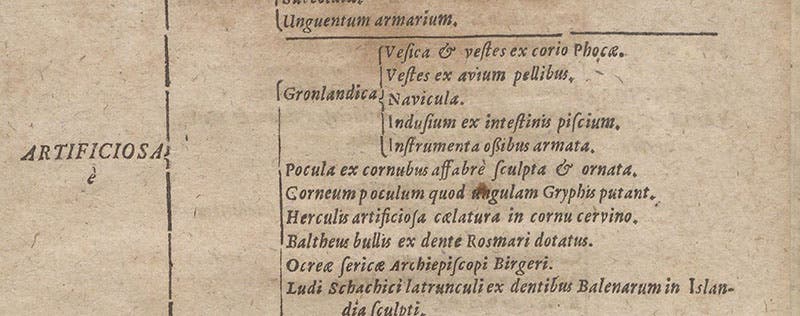
Description of the kayak in Ole Worm’s museum, Synopsis methodica rariorum in Musaeo ... Olai Wormii, by Georg Seger, detail of p. 43, 1653 (Linda Hall Library)
Worm was also proud of what he thought was a coati, of which he had a live specimen (it was in fact a raccoon, but no one yet realized that there were two coati-like species in the Americas). Seger called it Coati vivus – a living coati. We show the entire page (fourth image) and a detail of the center, where you should be able to make out Coati vivus (sixth image). You can see an engraving of the coati from the Musaeum of 1655 at out first post on Worm. The same page lists, near the bottom, a hystrix (porcupine) and a larger and smaller Armadillo.

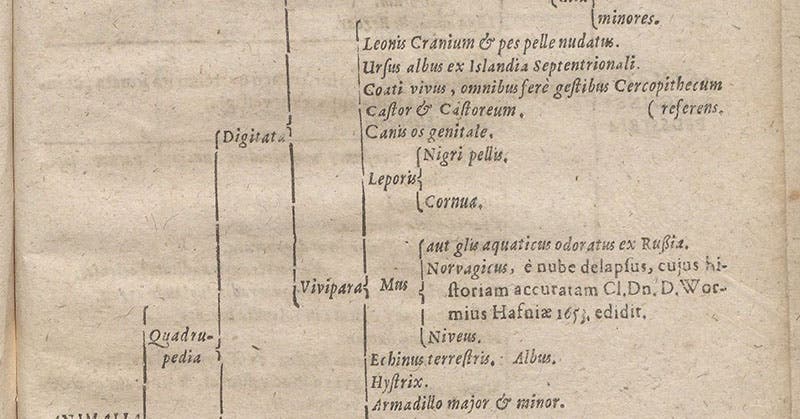
Description of the coati in Ole Worm’s museum, Synopsis methodica rariorum in Musaeo ... Olai Wormii, by Georg Seger, detail of p. 37, 1653 (Linda Hall Library)
Another live specimen that Worm possessed was a great auk, and he depicted it with its own engraving, which we also included in our first post. Seger calls it: Alka ex insulis Feroensibus, auk from the Faroe Islands (seventh image). He did not describe it as vivus, so perhaps it had died since Worm made his engraving.

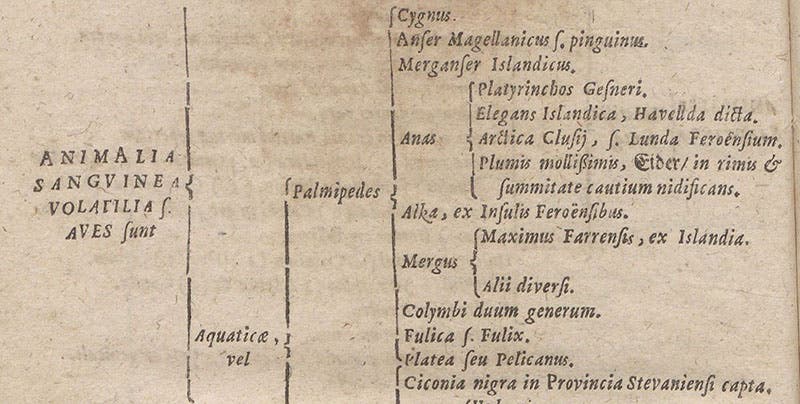
Description of the great auk in Ole Worm’s museum, Synopsis methodica rariorum in Musaeo ... Olai Wormii, by Georg Seger, detail of p. 36, 1653 (Linda Hall Library)
One of the most unusual items in Worm's museum was a section of a small tree that had grown around the lower jaw of a horse. It can be seen near the very center of the engraved frontispiece of 1655 (third image). Seger described it as; Mandibula equi inferior trunco quercino, a lower jaw of a horse in the trunk of a small oak.

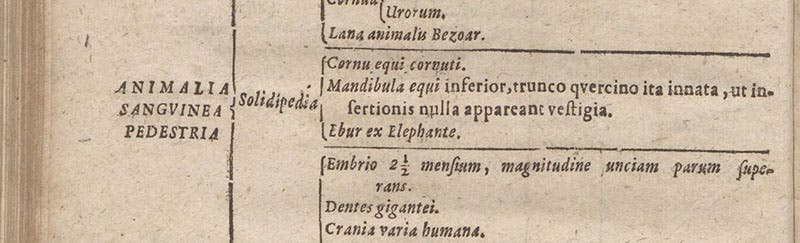
Description of the horse-jaw caught in an oak tree, in Ole Worm’s museum, Synopsis methodica rariorum in Musaeo ... Olai Wormii, by Georg Seger, detail of p. 38, 1653 (Linda Hall Library)
This curiousity survives to the present day, in the Copenhagen Museum of Natural History – the only object in Worm’s Museum that can still be identified with certainty. We showed a recent photo of it in our previous post on Worm. Worm also made a separate woodcut of his horse-jaw, which we have never shown before, so we include it here (last image).

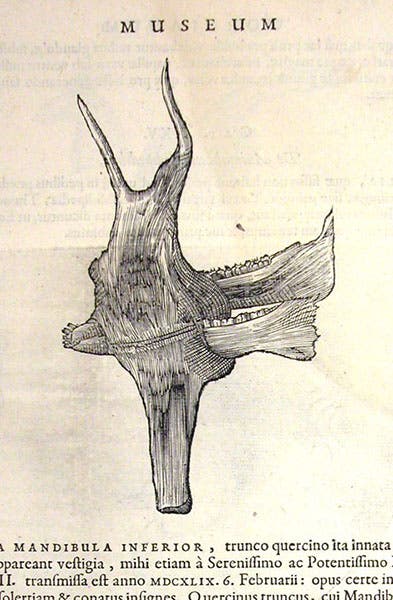
Horse-jaw caught in a small oak tree, woodcut, Museum Wormianum, by Ole Worm, 1655 (Linda Hall Library)
I do not expect that this post will turn many of you into fans of Seger's book. It is not a very attractive specimen of the art of printing. But we are happy to have it, the only description of Worm's collection made while Worm was alive, and presumably with his blessing. I just wish we knew more about Seger.
William B. Ashworth, Jr., Consultant for the History of Science, Linda Hall Library and Associate Professor emeritus, Department of History, University of Missouri-Kansas City. Comments or corrections are welcome; please direct to ashworthw@umkc.edu.