Scientist of the Day - Paul Nash

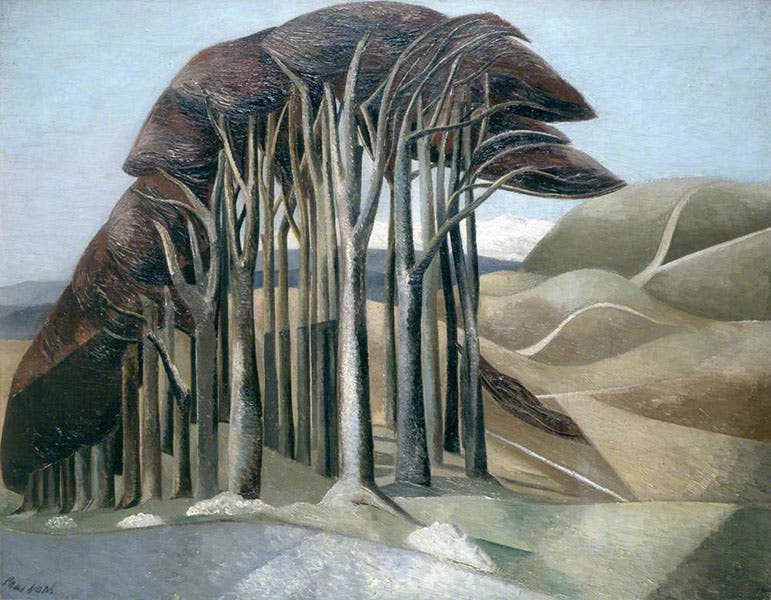
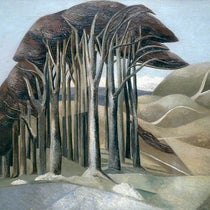
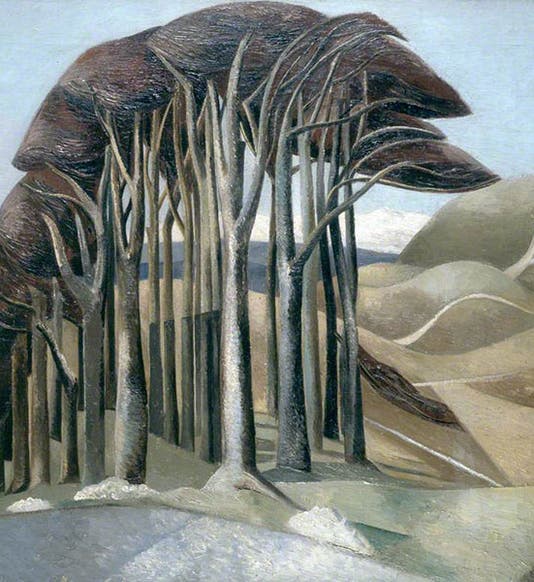
Wood on the Downs, oil on canvas, by Paul Nash, 1929, Aberdeen Archives, Gallery & Museums (artuk.org)
Paul Nash, an English landscape artist, was born on May 11, 1889, in Kensington in London. He grew up in the shires surrounding London and was drawn to sketching landscapes, such as the Wittingham Clumps in Oxford (first image). He spent only a year in art school before England entered the First World War, and Nash found himself on the front in Belgium. For a lover of landscapes, it was a difficult time, as trees and all other signs of life except mud were obliterated by shellfire, to say nothing of the cost in human lives. Nash spent a year in 1918 as Britain’s Official War Artist, and many of his sketches and paintings are in the Imperial War Museum in London, a sobering testament to the hell that Nash and millions of other soldiers on both sides went through (second and third images).

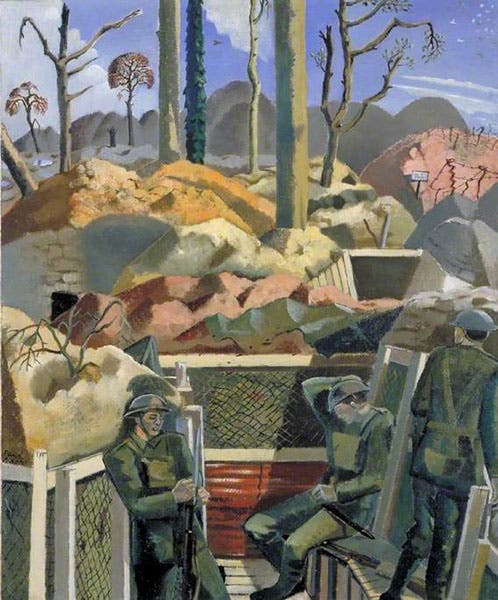
Spring in the Trenches, Ridge Wood, oil on canvas, by Paul Nash, 1917-18, Imperial War Museums (artuk.org)

The Menin Road, oil on canvas, by Paul Nash, 1919, Imperial War Museums (Wikimedia commons)
In the 1920s , Nash struggled mentally, as did most veterans, and he returned to landscape art, with increasing elements of surrealism and abstraction. Somewhere in there, he discovered antiquities, because when he was given the opportunity in 1931 by the Curwen Press to illustrate any book he wanted, he chose Thomas Browne’s Hydriotaphia, or Urne-Buriall, a meditation on death, graves, pyres, and the fleetingness of fame and time, first published in 1658, along with the Garden of Cyrus. I have no idea why Nash chose this book, which has always been one of my favorites, a shining example of Baroque English prose at its most glorious, but it seems unlikely to have been at the top of the list of a battle-scarred war artist who had yet to encounter any ruins of antiquity. But Curwen Pess agreed with the choice, and Nash created 32 watercolors of burial urns, sepulchers, and ruins (as well as quincuncial gardens for the Garden of Cyrus). The book was published in 1932, and it is just wonderful, from the reproductions I have seen (fourth, fifth, and sixth images).

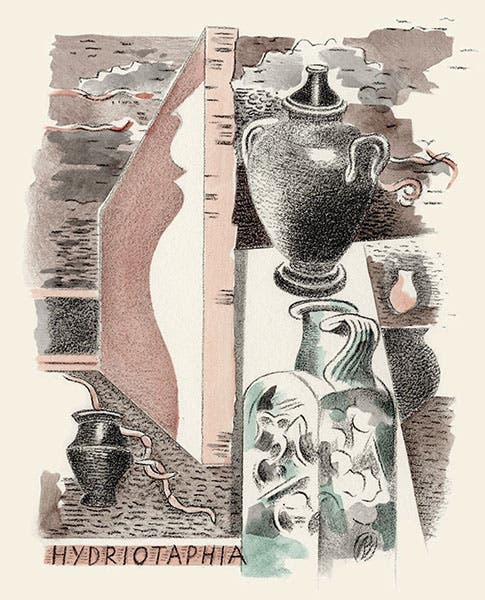
Frontispiece to Hydriotaphia: Urne Buriall, by Thomas Browne, pochoir hand-colored print from a watercolor by Paul Nash, in Urne Buriall and the Garden of Cyrus, printed by Curwen Press, 1932, copy for sale by Goldmark Art (goldmarkart.com)

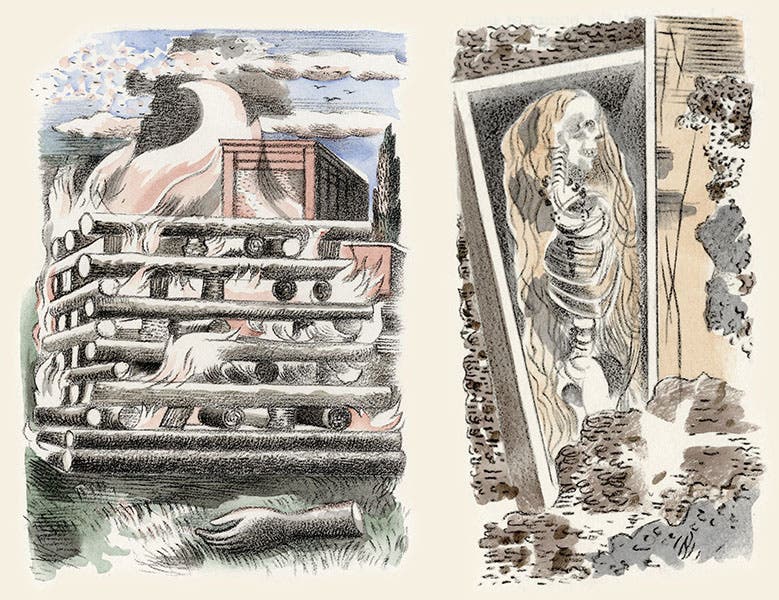
Funeral pyre, pochoir hand-colored print from a watercolor by Paul Nash, in Urne Buriall and the Garden of Cyrus, by Thomas Browne, printed by Curwen Press, 1932, copy for sale by Goldmark Art (goldmarkart.com)

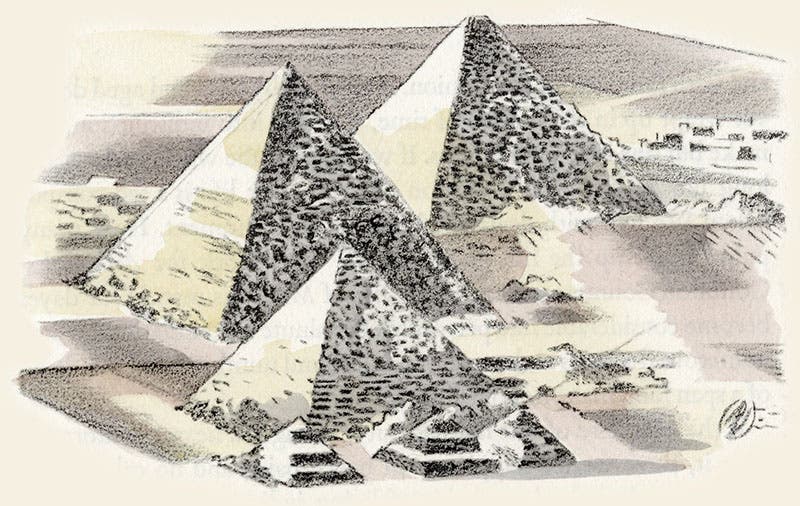
Pyramids, pochoir hand-colored print from a watercolor by Paul Nash, in Urne Buriall and the Garden of Cyrus, by Thomas Browne, printed by Curwen Press, 1932, copy for sale by Goldmark Art (goldmarkart.com)
I lobbied for some years for the Library to acquire a copy of Nash's version of Browne, but because of Nash’s stature as a prominent English artist, and because of the beauty of the book, it has always been priced out of the reach of a history of science library, and besides, hardly anyone but me thinks that Thomas Browne and his musings about time and antiquities are at all relevant to the scientific revolution of the 17th century. So I gave up. But I would love to turn the pages of a Nash Urne-Buriall someday.

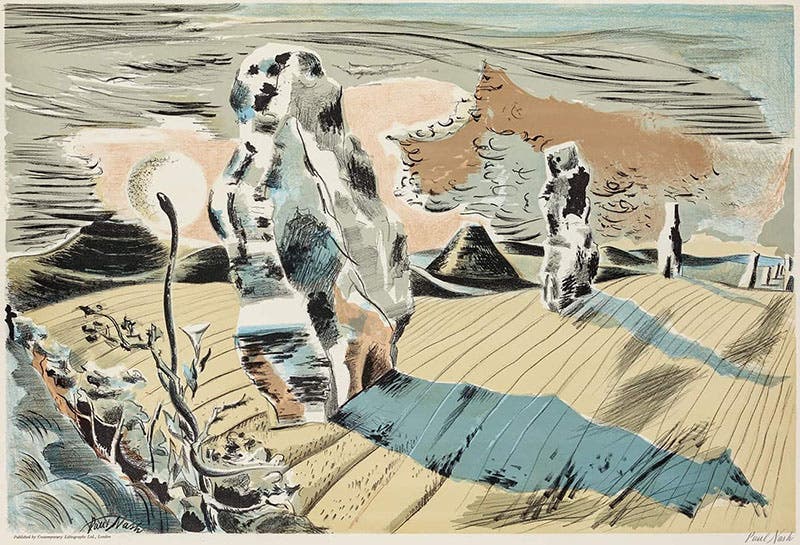
Avebury: Landscape of the Megaliths, lithograph, by Paul Nash, 1937, sold by Gerrish Fine Art Co. (gerrishfineart.com)
Interestingly, after he illustrated the Urne Buriall, Nash discovered his own antiquities, in the form of the stone circle at Avebury, where ancient megaliths and modern trees, copses, and farms were perfectly melded into one seamless landscape. He drew from it many times in his paintings of the late 1930s (seventh and eighth images).

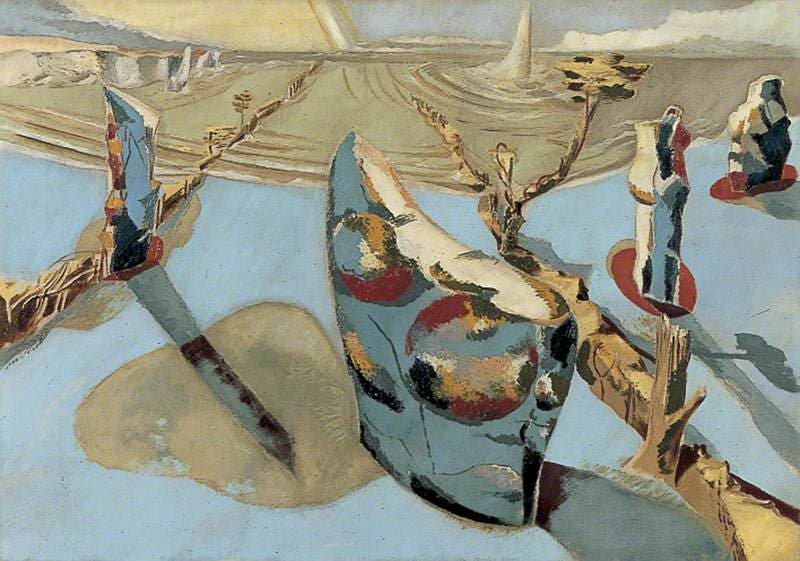
Circle of the Monoliths, oil on canvas, by Paul Nash, 1937-38, Leeds Art Gallery (artuk.org)
Nash suffered from asthma and died from complications in 1946, after enduring a second World War. His painting Sunflower Eclipsing the Sun (1945; last image) is one of the finest autobiographical odes and intimations of mortality that I have ever encountered.

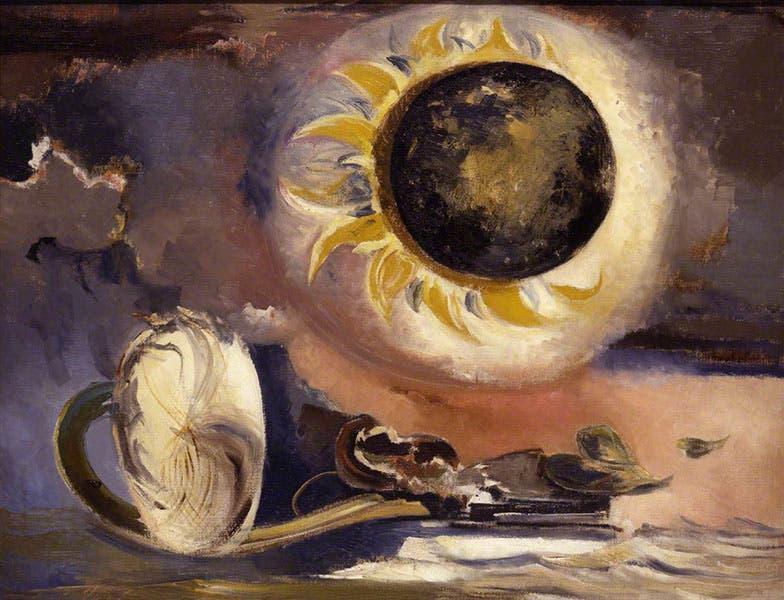
Eclipse of the Sunflower, oil on canvas, by John Nash, 1945, British Council Collection (artuk.org)
If you are not familiar with Nash, I recommend that you check out a book like Paul Nash: Masterpieces of Art, by Michael Kerrigan (2018), which contains dozens of full-page reproductions of Nash's art, in chronological order, with little commentary, and go through Nash's artistic output, from war to peace to war again, so you can appreciate what was, for Nash, the restorative power of landscapes, especially ancient ones.
William B. Ashworth, Jr., Consultant for the History of Science, Linda Hall Library and Associate Professor emeritus, Department of History, University of Missouri-Kansas City. Comments or corrections are welcome; please direct to ashworthw@umkc.edu.