Scientist of the Day - Sigmund Freud

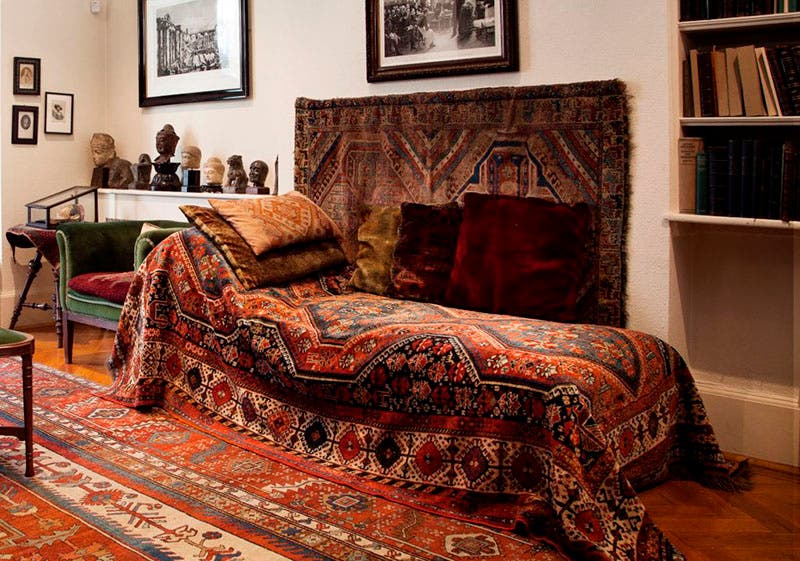
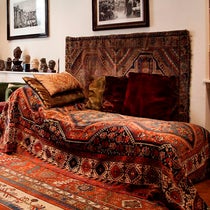
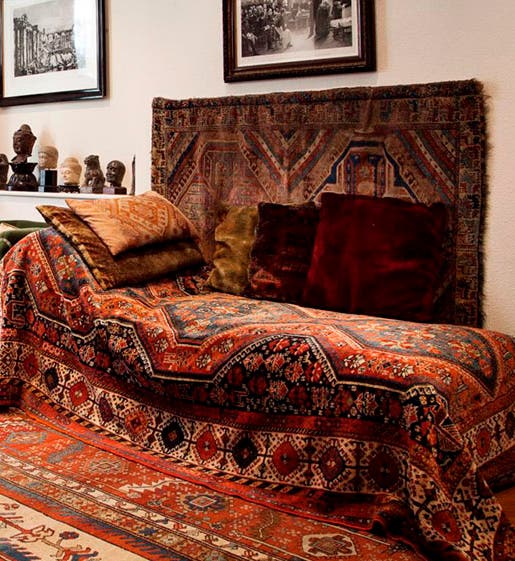
Sigmund Freud’s original psychoanalytic couch, with its Qashqa'i Shekarlu wool carpet, on display in the Freud Museum, London (freud.org.uk)
Sigmund Freud, an Austrian physician and the father of psychoanalysis, was born in Freiberg, Moravia, on May 6, 1856. Since I am not sympathetic to the scientific basis of psychoanalysis, we will focus our attention today on the single most famous object Freud bequeathed to the world, the psychoanalyst's couch. The original Freudian couch survives today and is on display in his London house, now the Freud Museum, at 20 Maresfield Gardens in Hampstead, London. The centerpiece of the Museum is Freud's consulting room; and pride of place in that space is given to Freud's couch.

Sigmund Freud statue in Hampstead, London (Wikimedia commons)
The couch on display is not just a couch, it is THE couch, the swooning sofa that Freud was given in 1890 by one of his patients, Madame Benvenisti. Freud found that it worked well as a platform for psychoanalysis; subjects lying on it were unable to see Freud or anything else in the room, and were accordingly alone with their thoughts and more willing to free-associate. Indeed, psychoanalysis may have been conceived on this very couch. Freud preferred to cover the couch with Persian carpets, finally settling on one that was given to him by his cousin, an antique dealer; it was a Qashqa'i Shekarlu wool rug, woven by nomadic peoples of central Iran (Qashqa'i is also spelled Qashqai, Qashgai, Kashgai, Gashgai, and several other ways). Nearly all of Freud's patients for decades lay on that carpet, on that couch, and conjured up their dreams and fears for Freud to interpret. This would include the Wolf Man, a Russian emigre whose dream of being threatened by wolves in a tree outside his bedroom was ascribed by Freud to a repressed childhood memory of having observed his parents in sexual congress. It would also include his own daughter Anna, who understandably had a few problems growing up in Vienna as the youngest child of the father of psychoanalysis.
Sigmund Freud’s consulting room, complete with his couch, desk, custom-made chair and collection of objects (khazairugs.com)
The couch resided in Freud's office in his house in Vienna for many years, where it shared the space with Freud's desk, almost hidden from view by dozens of small Greek and Roman statuettes; Freud's chair, custom made for the good doctor so that he could drape his legs over the arms; and Freud's books, which fought with other antiquities for space on the wall-length bank of bookshelves. However, in 1938, Austria fell to Hitler's Nazis, and Freud, a Jew, was forced to seek refuge elsewhere. He fled to London, with lots of help from his former clients. It was not your typical flight; whereas many left Austria with what they could carry in a suitcase, Freud managed to bring with him his books (and bookcases), his desk, his chair, and his couch, with its Quashqa’i carpet covering and all its embedded memories. He took up residence in Hampstead and promptly recreated his Vienna consulting room down to the last statuette. The same couch and carpet that once held the Wolf Man now provided a psychic refuge for Oedipal Londoners. But only for a little more than a year. Freud had long suffered from cancer of the throat, brought on by his smoking, and it had spread to his jaw. With the help of his physician and perhaps his daughter, he overdosed on morphine in the fall of 1939 and ended his suffering.

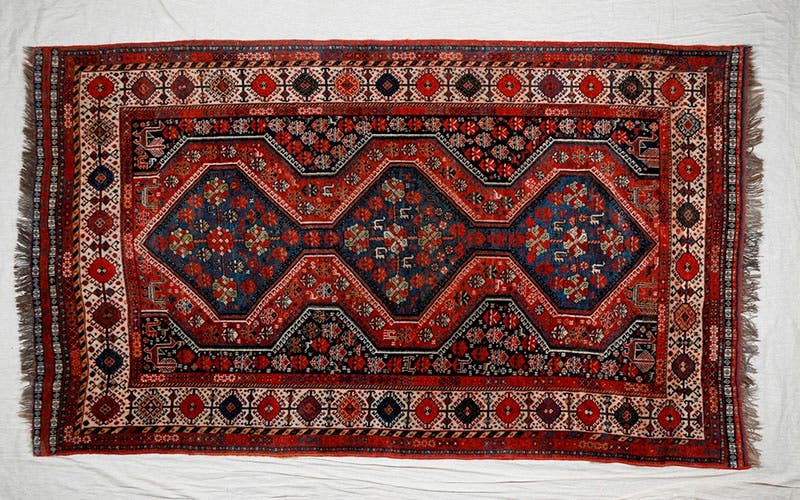
The Qashqa'i Shekarlu wool carpet that covered Freud’s couch in Vienna, and still covers it today, in the Freud Museum, London (freud.org.uk)
Anna continued to live in the house for another forty-three years, preserving her father's books, collectibles, and the couch, and ensuring that after her death a museum was established, with Sigmund Freud's consulting room intact and very much as it had been. The Freud Museum seems to have carried out its mission very well. Several years ago they managed to wring £5000 out of concerned donors to restore the couch, which had begun to develop a split personality of its own. It has apparently been returned to good health. And just last year, the Museum allowed two artists/would-be forensic scientists to come in and analyze the carpet, extracting all sorts of dust and mites and DNA that they somehow turned into an exhibition. I don’t know if the Wolf Man’s exfoliated skin cells were among the treasures they recovered, and I don’t think I want to know.

Freud’s couch without its coverings, Freud Museum, London (source unknown)
If you enjoy visiting historic places such as the Freud Museum, and you are often a mite skeptical about or critical of the objects you see in such places, you might enjoy a wonderful account by an academic of his visits to five historic literary sites in England. The tourist was Simon Goldhill, a professor of ancient Greek culture at Cambridge, and his book, breezily brief, is called Freud's Couch, Scott's Buttocks, Bronte's Grave (2011), where, on pp. 103-122, you will find a delightful recounting of Goldhill’s visit to the Freud Museum. He manages insightfully to pinpoint the reasons for the Freud Museum’s success, and for the failure of such historic museums as the Shakespeare Birthplace Trust in Stratford on Avon.
_in_2024.jpg#/media/File:Freud_Museum_(Couch_and_Office)_in_2024.jpg)
Another view of Freud’s consulting room, with couch and desk, Freud Museum, Hampstead, London (Wikimedia commons)
Many years ago, I wrote a series of posts called 100 Objects in the History of Science, where I discussed the present-day whereabouts of such things as Nicolas-Joseph Cugnot’s steam-powered car of 1770, or the original Megalosaurus jaw found by William Buckland in 1816, and when I was about halfway through, Dava Sobel suggested I include Freud's couch, of whose present-day location I was then unaware. I did, and today's post has been spun off from that, my single foray into psychoanalytic journalism.
William B. Ashworth, Jr., Consultant for the History of Science, Linda Hall Library and Associate Professor emeritus, Department of History, University of Missouri-Kansas City. Comments or corrections are welcome; please direct to ashworthw@umkc.edu.