Scientist of the Day - William Kingdon Clifford
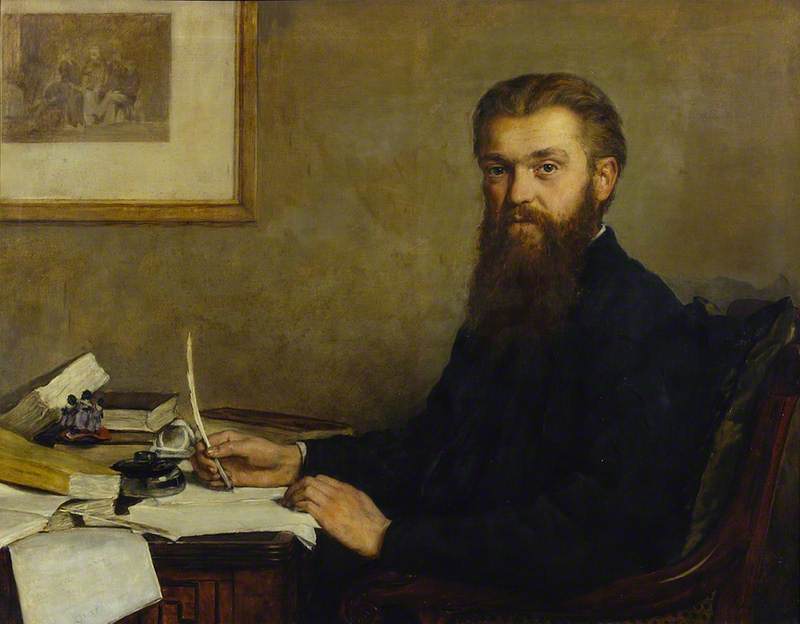
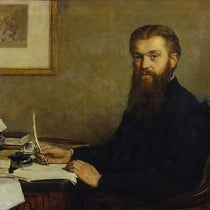
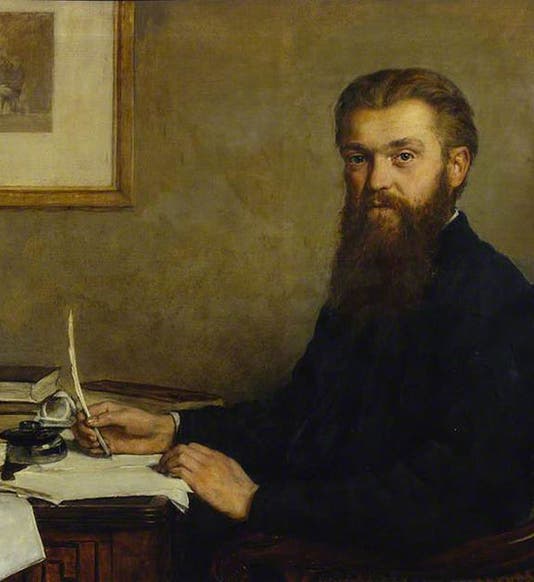
Portrait of William Kingdon Clifford, oil on canvas, by John Collie, 1878, Collection of the Royal Society of London (artuk.org)
William Kingdon Clifford, an English mathematician, was born May 4, 1845, in Exeter, Devonshire. He attended King's College, London, and then Trinity College, Cambridge, where he was Second Wrangler in the Tripos, which astonished his friends, since he did not study for the exam. He became a fellow at Trinity, and then professor at University College, London. This last move reflected his growing disenchantment with organized religion.

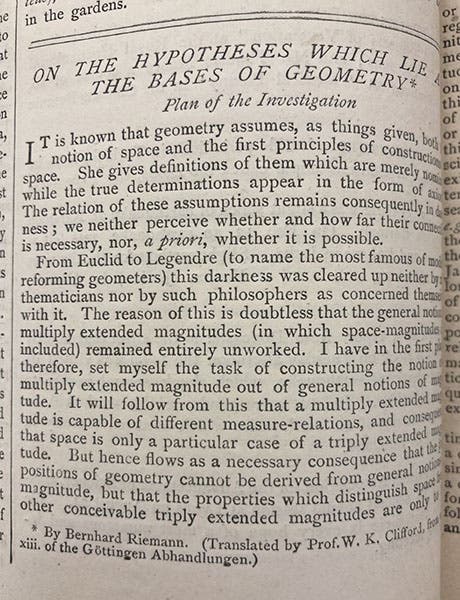
First paragraph, “On the hypotheses which lie at the bases of geometry,” by Bernard Riemann, trans. by William Kingdon Clifford, Nature, May 1, 1873, vol. 8, p. 14 (Linda Hall LIbrary)
Clifford was a popular speaker on a variety of subjects, including ethics and the history of society and social behavior, but his special expertise was mathematics, especially geometry, and more especially, the non-Euclidean geometries that sprang up after mid-century, upon the urging of Carl Gauss. Clifford was especially taken with the geometry of Bernhard Riemann, who worked out a geometry of curved space as an alternative to the flat space of Euclidean geometry. Riemann wrote in German and was unknown in England until Clifford translated a portion of Riemann’s 1854 paper into English and published it in Nature in 1873 (second image). Clifford went on to argue that if space is curved, perhaps mass and motion are just the results of small-scale perturbations in this curved space. In suggesting this, Clifford was anticipating, by 40 years, Albert Einstein's general relativity of 1916, where Einstein made gravitation a result of the curvature of a space described by Riemannian geometry. We say "anticipated" because there is no indication that Einstein ever heard of Clifford.

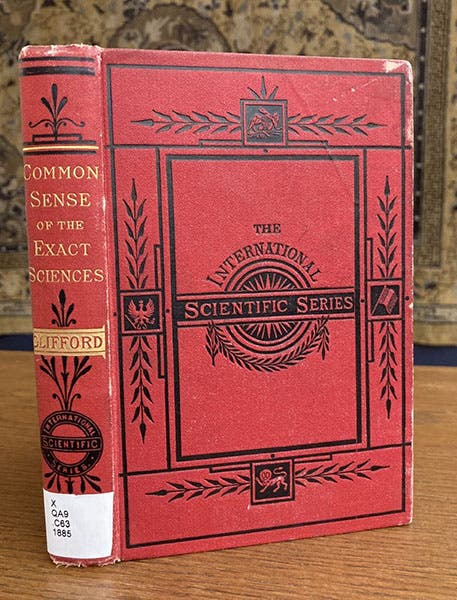
Front cover, The Common Sense of the Exact Sciences, by William Kingdon Clifford, International Scientific Series, 1885 (Linda Hall Library)
Clifford wrote one book for the general public, The Common Sense of the Exact Sciences, which was full of novel insights, such as curved space, but long before it was published, Clifford began having health problems, related to incipient tuberculosis. He took leaves of absence to spend time in Mediterranean climes, which helped in the short run, but not long-term. He had several relapses, and then died in Madeira on Mar. 3, 1879. He was but 33 years old. His book was put into final form by a friend and published in the International Scientific Series in 1885, joining books by John Tyndall, Hebert Spencer, and Edward Youmans, all of which we have in our collections (third image).
Perhaps Clifford's most successful non-scientific achievement was securing a series of sittings with an up-and-coming portrait painter, John Collier, then but 28 years old. His portrait of Clifford is stunning (first image) and is in the collection of the Royal Society of London, so perhaps they commissioned it on behalf of their new member. Three years later, Collier would create our finest portrait of Charles Darwin, which you can see at this post on Darwin, and he would later give us compelling portraits of James Joule, John Lubbock, and his father-in-law (twice-over), Thomas Huxley.

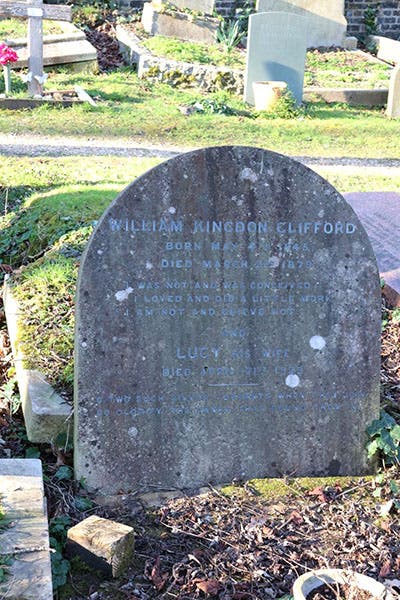
Gravestone of William Kingdon Clifford, died Mar. 3,1879, Highgate Cemetery, North London (findagrave.com)
Clifford's remains were returned to England, and he was buried in Highgate Cemetery in North London, where Michael Faraday already resided, and where Herbert Spencer would later be laid to rest. Clifford’s wife, Lucy, herself quite a painter and novelist, joined him there in 1929.
William B. Ashworth, Jr., Consultant for the History of Science, Linda Hall Library and Associate Professor emeritus, Department of History, University of Missouri-Kansas City. Comments or corrections are welcome; please direct to ashworthw@umkc.edu.