Scientist of the Day - Sally Ride

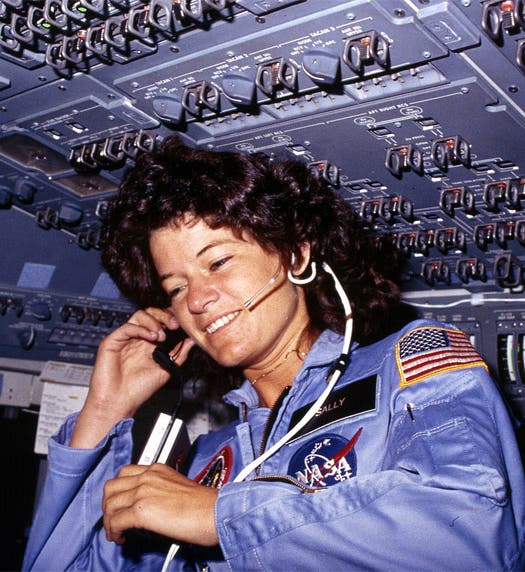
Astronaut Sally Ride aboard Challenger as part of STS-7, June 1983 (Wikimedia commons)
Sally Kristen Ride, an American astronaut and physicist, was born in Los Angeles on May 26, 1951. She was the first and probably the best-known American woman in space. Ride attended Stanford University, receiving her PhD in physics in 1978, and was accepted into NASA's eighth group of astronauts, the first new collection of astronaut candidates in 11 years, and known as the TFNK (Thirty-Five New Kids). Group 8 was necessitated by the beginning of the Space Shuttle program, and was the first to include women (5 of the 35).

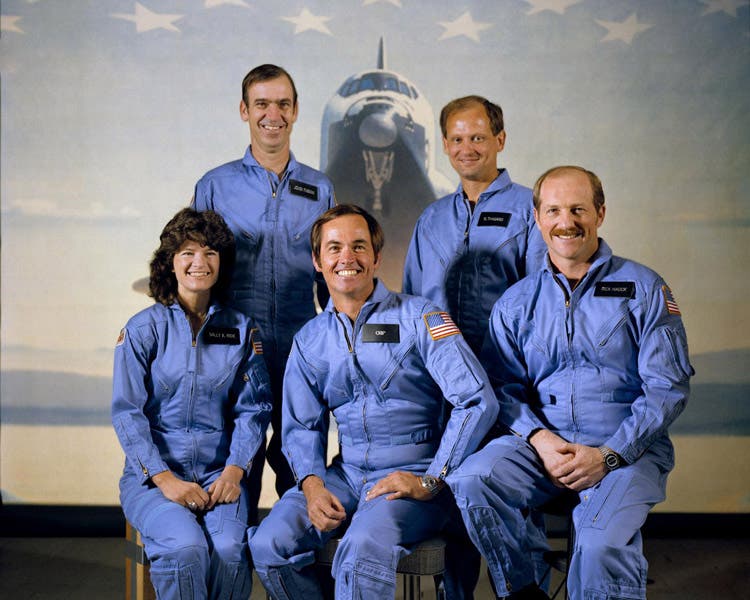
The crew of STS-7 Challenger, including Sally Ride, the first American woman to go into space official crew portrait (nasa.gov)
Ride served as capsule communicator (CapCom) for the second and third Shuttle flights, and helped develop the robotic arm of the Shuttle while she waited for her own flight. She was chosen as a mission specialist for STS-7, the seventh Shuttle mission, which launched aboard Challenger on June 18, 1983, making Ride the first American woman in space, and evoking dozens of "Ride, Sally, Ride!" headlines throughout the United States. Since mission specialists were normally the ones who operated the robotic arm that helped remove payloads from the Shuttle cargo bay, she may have been one of the first astronauts to help develop a piece of equipment for space flight and then operate that equipment in orbit.

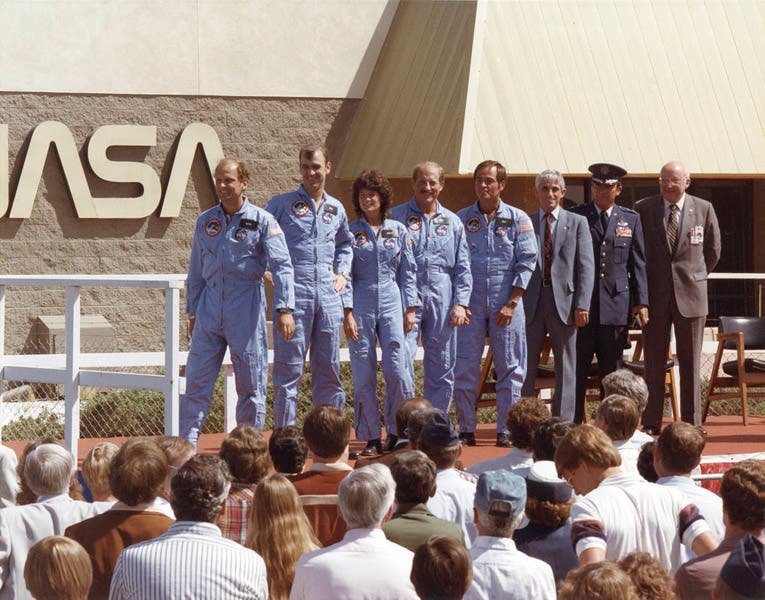
The crew of STS-7 Challenger, including Sally Ride, being welcomed at the Dryden Flight Research Center, 1983, now the Neil A. Armstrong Flight Research Center (nasa.gov)
Sally Ride made her second Shuttle flight aboard Challenger as part of STS-41-G, which was the thirteenth flight of the Shuttle (I do not know what was responsible for the inflation of the mission numbers). STS-41-G was launched on Oct. 5, 1984, and returned to Earth on Oct. 13.

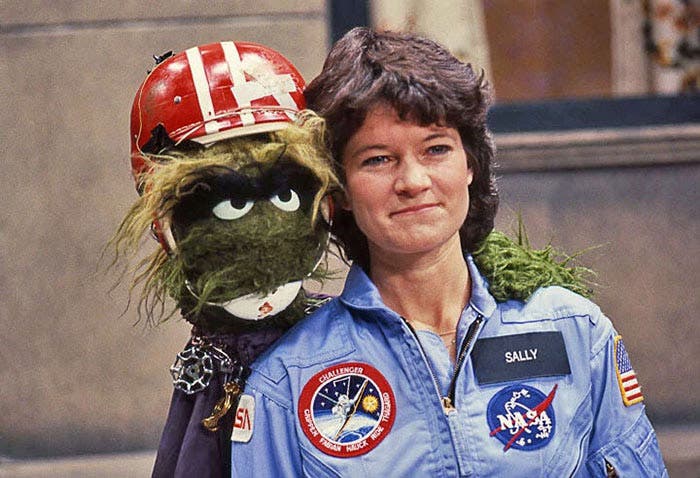
Sally Ride on a segment of Sesame Street, 1984 (today.ucsd.edu)
Ride was assigned to a third Shuttle mission, but life changed dramatically at NASA when the Shuttle Challenger exploded after launch in 1986, killing all 7 crew members onboard. Ride was assigned to the Rogers Commission that investigated the Challenger disaster, and it is said that Ride was the one who first suggested stiffening of the O-rings in the cold as the probable cause of the explosion (even though Richard Feynman later got the credit). When it was clear that there would be no more Shuttle missions for a few years, Ride resigned and took a position at the University of California at San Diego. She also divorced her astronaut husband of five years and began a relationship with a woman tennis player whom she had known since childhood, a partnership that would last until Ride's death in 2012. Since Ride was an intensely private person and never discussed her personal life with the press or anyone else, it was not until after her death (in her obituary, in fact) that it was revealed that she had been the first known LGBT person in space.

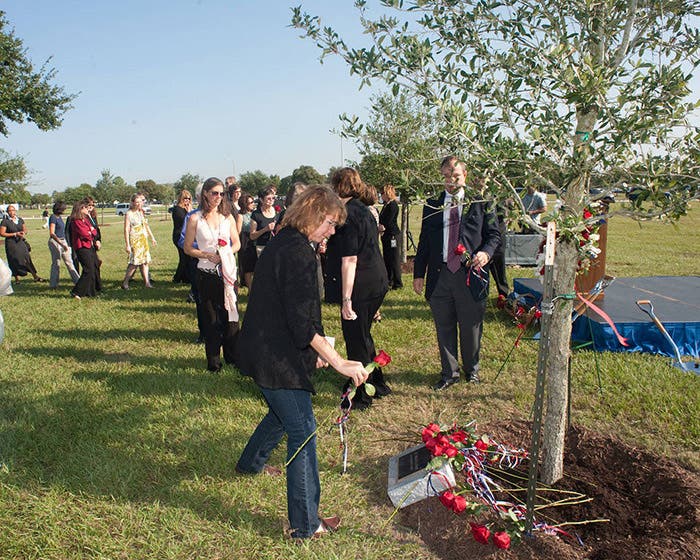
A ceremony attended by fellow astronauts at a tree planted in honor of Sally Ride in Astronaut Memorial Grove, Johnson Space Flight Center, Houston (today.ucsd.edu)
Ride may have had her greatest impact as a motivational speaker for young people, showing them what a woman can accomplish even in a sexist society, if she set her mind and energies to the task. Sally Ride spoke at our Library in 1996, and I took my daughter Rachel, who was 11 years old at the time, to hear her. Rachel was transfixed by Ride's self-told tale of accomplishment. Later that fall, for a school project involving admirable Americans, she dressed up as Sally Ride, and while neither Rachel nor I can trace actual cause and effect, Rachel did major in the sciences and now practices as an intensive-care pediatric physician. We both give Sally Ride partial credit for this chain of events.

Sally Ride on the reverse of an American Women quarter, first series, issued 2022 (Wikimedia commons)
Ride died of pancreatic cancer (which she also did not reveal to the public) on July 23, 2012. Her ashes were interred at Woodlawn Memorial Cemetery in Santa Monica. In 2022, she was one of the first women to be honored in the American Women quarters program (last image).
William B. Ashworth, Jr., Consultant for the History of Science, Linda Hall Library and Associate Professor emeritus, Department of History, University of Missouri-Kansas City. Comments or corrections are welcome; please direct to ashworthw@umkc.edu.

![Net for truncated cuboctahedron, an Archimedean solid, Quatuor his suaru[m] Institutionum geometricarum libris (Four Books on Measurement), by Albrecht Dürer, p. 156, 1534 (Linda Hall Library)](https://preview-assets-us-01.kc-usercontent.com:443/9dd25524-761a-000d-d79f-86a5086d4774/05d51aeb-2dd1-4949-880d-ec62209058fd/durer1.jpg?w=210&h=210&auto=format&fit=crop)