Scientist of the Day - Pierre Duhem

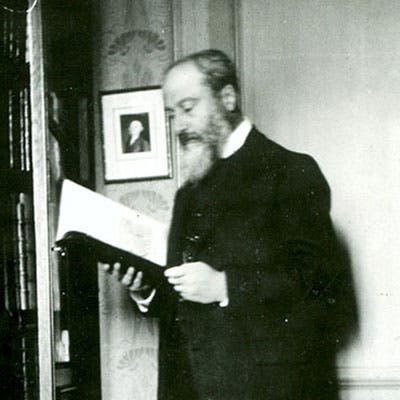
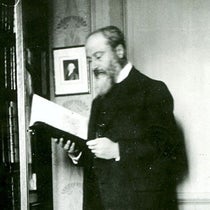
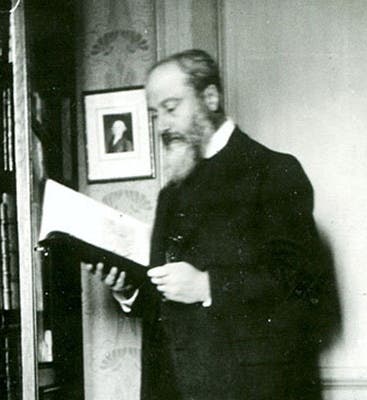
Portrait of Pierre Duhem, photograph, undated (museogalileo.it)
Pierre Duhem, a French theoretical physicist, and historian and philosopher of science, was born June 9, 1861, in Paris, near Montmartre. He studied at the École normale supérieure; earned his doctorate, with some difficulty, at the University of Paris; and secured a professorship at the University of Bordeaux, where he spent most of his career.
Duhem was a devout Catholic, and a conservative one. This may explain his fondness for the High Middle Ages, the golden era of the Church fathers and saints, Thomas Aquinas and Albertus Magnus. In his study of the science of motion – statics and kinematics – he found that it all began, not with Galileo, but with Nicole Oresme and Jean Buridan in 14th-century France. He also had interesting views on the role of theory and hypothesis in science, which we will explain by way of example.

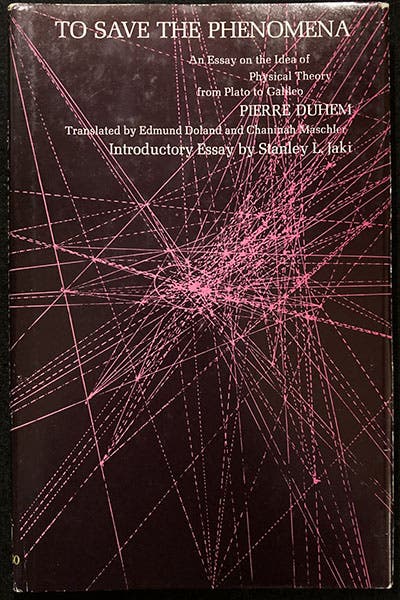
Dust jacket, To Save the Phenomena: An Essay on the Idea of Physical Theory from Plato to Galileo, by Pierre Duhem, tr. by Edmund Doland and Chaninah Maschler, 1969 (author’s copy)
In 1908, Duhem published a book, To Save the Phenomena, in which he made a remarkable claim. In 1616, a Roman cardinal, Roberto Bellarmine, had advised Galileo that he was on shaky ground with his declarations (made in several letters) that the Copernican system is true and supported by evidence, and he advised Galileo to just explain observed phenomena and refrain from making claims about the true system of the world. Nevertheless, Galileo wrote his Dialogue on the Two Chief Systems of the World (1632) in which, between the lines, he maintained that the Copernican system was demonstrably true. For this, Galileo was summoned before the Inquisition by Pope Urban VIII and forced to recant his views.
Duhem argued in To Save the Phenomena that, epistemologically, Bellarmine and Urban VIII were right, and Galileo was wrong. Duhem said that Galileo misunderstood the relationship between phenomena and explanatory theory. We can study the world, and order it with a variety of explanatory models, and invoke entities to help in the explanations, but we can make no claims about the reality of those entities or the truth of our hypotheses. To say the Copernican system works is not the same as saying the Copernican system is true. Duhem was using Galileo as an object lesson for his own time, when physicists and chemists were talking about atoms and molecules as if they had been demonstrated to exist, when in truth atoms and molecules were really just hypothetical inferences that had never been observed. Duhem's philosophical stance is known as instrumentalism, which maintains that scientists should restrict themselves to predicting phenomena and avoid making claims about ultimate reality. Instrumentalists and the opposing camp, known as realists, have been debating the matter ever since.
Duhem wrote quite a few books on this topic, including Les origines de la statique (1905-06); La théorie physique: son objet, et sa structure (The Aim and Structure of Physical Theory, 1906), and Essai sur la notion de théorie physique de Platon à Galilée (1908), most of which were translated into English in the 1950s and 1960s, when the study of medieval science in this country was revitalized. We show the dust jackets of several editions of Duhem translations that are still available in print. We have most of Duhem’s works in our Library, both original editions and translations, with the odd exception of the first French edition of To Save the Phenomena, perhaps because the first words of the French edition, “To save the Phenomena,” are in Greek. It might be that we have this book after all, but early cataloguers could not figure out how to transliterate the title, so it was never catalogued.

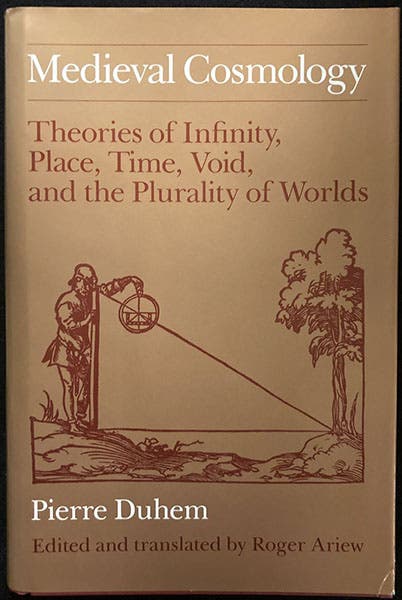
Dust jacket, Medieval Cosmology: Theories of Infinity, Place, Time, Void, and the Plurality of Worlds, by Pierre Duhem, tr. by Roge Ariew, 1985 (author’s copy)
Duhem is now regarded mostly as a historian and philosopher of science, but he always thought of himself as a theoretical physicist, and when he had a chance to apply for the chair of history of science at the Collège de France in Paris, he refused – he wanted to teach physics, not history. Since he had backed the wrong horse with his rejection of atoms and molecules as real entities, that was not going to happen.
Duhem died of heart problems on Sep. 14, 1916, at the age of 55. I could not find the location of his grave. There are very few portraits that survive, from which we selected the small snapshot we show here. The good portraits you find if you search for “Pierre Duhem” depict the American Josiah Willard Gibbs, not Duhem. I do not know how that misidentification got started.
William B. Ashworth, Jr., Consultant for the History of Science, Linda Hall Library and Associate Professor emeritus, Department of History, University of Missouri-Kansas City. Comments or corrections are welcome; please direct to ashworthw@umkc.edu.