Scientist of the Day - Pier Luigi Nervi

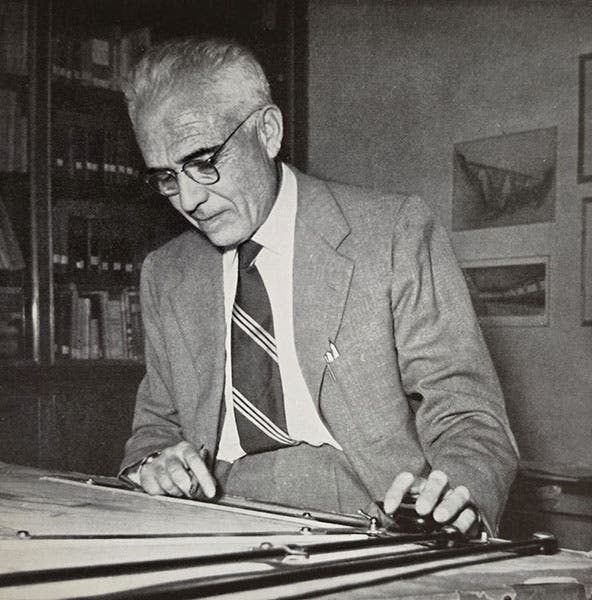
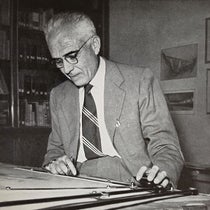
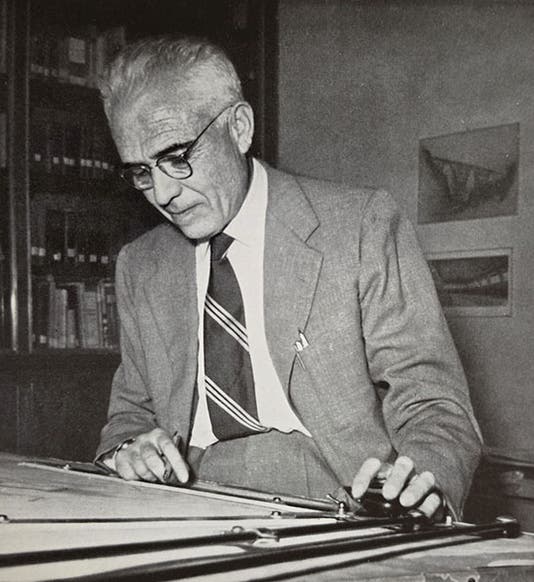
Portrait of Pier Luigi Nervi at work, The Works of Pier Luigi Nervi, by Ernesto Rogers, 1957 (author’s copy)
Pier Luigi Nervi was born June 21, 1891, and lived to age 87. Nervi worked as an engineer/architect and builder, from the 1930’s to the 1970’s, with a majority of his projects in Italy, though he had many others in Australia, Europe, Africa, South America, the U.S. and Canada. He was simultaneously skilled in three fields: as a structural engineer working at the highest and most abstract levels of structural theory; as a visual artist whose use of modern building materials aimed at a new, classic beauty; and as an entrepreneur, whose construction firm built his designs into economical, functional buildings.

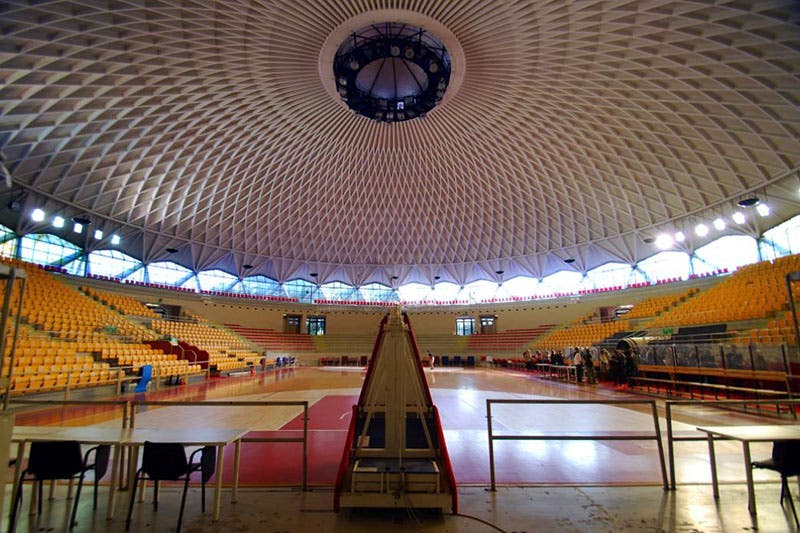
Palazzetto del Sport, Rome, Italy, designed by Pier Luigi Nervi, and built by his construction firm, Nervi & Bertoli (author’s files)
Nervi forms the third of my triumvirate of the best structural designers in Italian history. Filippo Brunelleschi and Guarino Guarini are the other two members of that special group, and both have been featured in earlier posts (though the Brunelleschi post was more on his visual design innovations and not his structural and mechanical prowess). Those two men created daring structural solutions in the 15th and 17th centuries, respectively, while Nervi was the only one of the three to have available a scientific structural theory to achieve solutions unavailable in those earlier eras. The earlier engineers were working without substantial scientific evidence about the strength of materials and certainly without any substantive theory of how buildings stand. But Nervi, being a man of the 20th century could avail himself of the great advances in structural theory of the two centuries before him, which allowed him, for example, to design/build the remarkable space and structure of the Palazzetto del Sport in Rome (second image). The use of repeatable, prefabricated forms in reinforced concrete creates a rather organic-looking floral pattern over this space. (An architect, Annibale Vitellozzi, is credited as a co-designer on this sports stadium, but I haven’t been able to determine his role compared to the primary structural design of Nervi.)
As a young man (in the 1920s/30s), Nervi’s special interest in the new field of aeronautics led him to focus on the problems of how to economically create immense enclosures (hangars) for aircraft. We show (third image) an example of his early vision, in a hangar built in Orvieto, Italy, in 1935. This illustrates his pioneering use of prefabricated, repeating elements to form an elegant series of forms in reinforced concrete. He established a construction firm to better implement his radical ideas. Within that firm, he developed a research department to experiment with various prefabricated methods and types of concrete construction to test their limits. This successful experimentation allowed him to provide unprecedented spans and spaces for sports events, warehouses, convention halls and many other types.

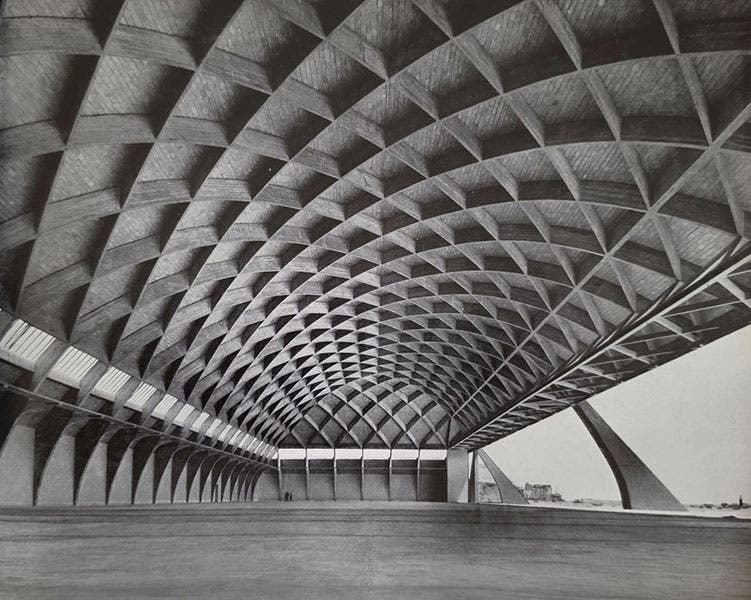
Airplane hangar, Orvieto, Italy, designed by Pier Luigi Nervi (and built by his construction firm Nervi & Bertoli), Architectural Record, November 1938 (author’s copy)
His experiments, in turn, allowed him to lower costs for large spans, which helped convince clients and governments to implement his designs. Architects and engineers frequently limit their roles in construction to design and supervision, but some, like Nervi, revert to the classical, “master builder” approach in history that keeps all parts of the building process under the control of the architect/engineer. Nervi, I believe, found this approach a necessity, since in that way he did not have to convince any builders that his radical methods would work.
One major innovation was his pioneering work using ferrocement (ferrocemento in Italian: ferro = iron). This idea is an elaboration of the basic discovery in the 19th century that steel could be included inside concrete to provide a vastly stronger finished product, called reinforced concrete. Including reinforcing bars is possible because concrete and steel have virtually identical expansion/contraction behavior under temperature changes. Unreinforced concrete has great compressive strength, but lousy tensile (bending) strength, so reinforced concrete allowed significantly greater building spans. Reinforced concrete uses large steel rods, usually between ½” and 1” in diameter, to achieve its great spans, and the thick concrete around it makes such structures very heavy. Ferrocement, by contrast, is light and thin. It was conceived and patented in the 19th century as a variant of reinforced concrete, but was largely neglected until Nervi. He reinvigorated the concept of ferrocement because he saw that, by using new shapes and methods, this lighter material could span greater distances at less cost. Two features distinguish ferrocement: a) thin wire mesh is used instead of thick steel rods, and b) ferrocement combines cement and sand and water, whereas reinforced concrete has various sized large stones (aggregate). The result is that ferrocement can be formed and poured in much thinner shapes than reinforced concrete.

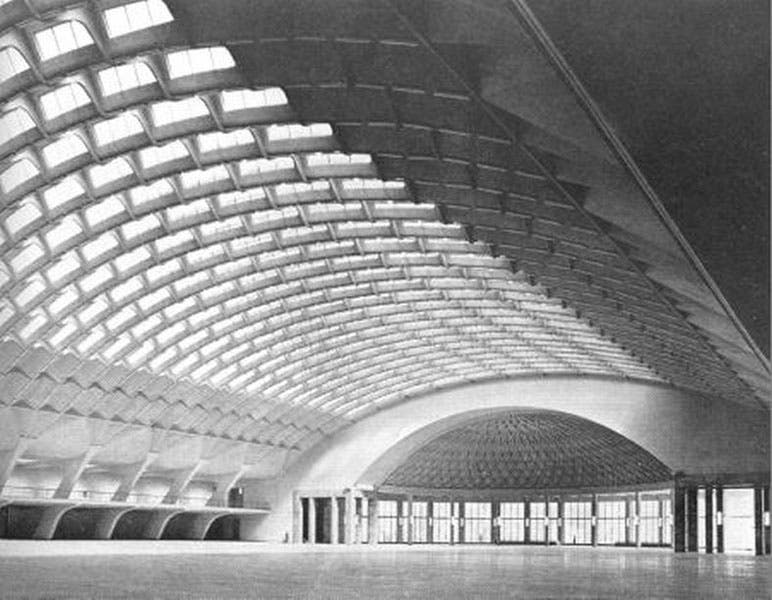
Palazzo delle Esposizioni (Exhibition Hall B), Turin Italy, designed by Pier Luigi Nervi (and built by his construction firm Nervi & Bertoli) (laboratorionervi.polimi.it)
Nervi realized that by adding another “ingredient” – geometry – to ferrocement, he could amplify the strength of this thinner concrete. He shaped the ferrocement into three-dimensional geometrical forms that by virtue of that geometry were inherently stronger than reinforced concrete. One might call this a principle of gaining strength through shape alone. Imagine the inherent floppiness of a piece of paper having little structural capacity, but then, once folded into various geometrical shapes, the paper is able to stand on its own and support some objects or fly through the air in controlled flight.
We show two views (fourth and fifth images) of a convention center in Turin, Italy, which he created by using repetitive forms to shape the ferrocement into thin, deep beam-like elements that are airy, such that the soaring roof can be largely infilled with glass running in multiple directions. The ferrocement is only a few inches thick in most parts, yet because of its folded geometry, it can span remarkable distances without any intermediate supports. Using reinforced concrete, by contrast, requires much thicker and heavier structural elements.

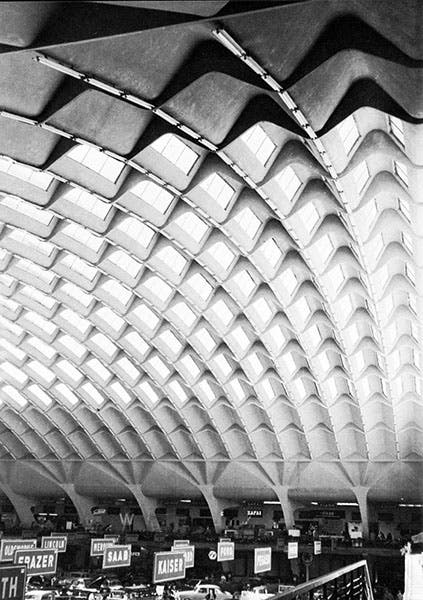
Historic image of occupied Palazzo delle Esposizioni (Exhibition Hall B), Turin, Italy, designed by Pier Luigi Nervi (and built by his construction firm Nervi & Bertoli), Arkkitehti-lehti (Architect magazine of Finland) (betoni.com)
Nervi grasped the central idea in structural design that geometry is a core concept. One must pay attention carefully to the shapes of the structural elements themselves (steel I-beams, concrete columns, etc.) and to the relationships among such elements, to create a successful (non-falling down) structure that is also economical. The relationships of the forces and strength of materials are all determined by the geometry of the structural elements to each other. Put metaphorically, structural engineers worship at the altar of geometry. This point was driven home to me by the structural engineer who worked with my architectural firm for forty years (Paul Gugliotta), who was a protégé of Nervi. Paul occasionally blurted out, when we were trying to solve an architectural/structural problem, “Geometry is all”. I never asked Paul if this dictum came from Nervi himself or was only how Paul summarized Nervi’s approach. In any case, it was a way of grounding our thinking, so that we were focusing on the spatial properties of the materials at hand and then enlisting the mathematics of the mechanics of materials to come to a practical answer for ensuring the building will stand. Of course, geometry isn’t literally the only consideration – the “all” – but geometrical considerations are ubiquitous and always must be carefully acknowledged.

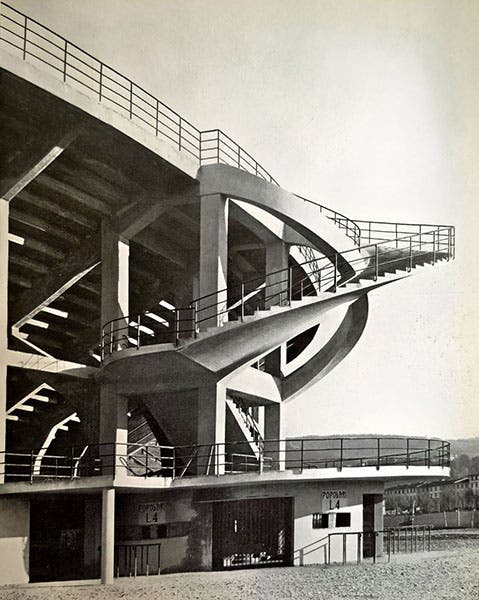
Giovanni Berta Stadium, cantilevered spiral stair, Florence, Italy, designed by Pier Luigi Nervi (and built by his construction firm Nervi & Bertoli), The Works of Pier Luigi Nervi, by Ernesto Rogers, 1957 (author’s copy)
Despite Nevi’s success in engineering, design and construction, ferrocement hasn’t become the primary method of long-span concrete construction. In post-WWII Italy, the low cost of labor made this more labor-intensive method very economical, but in the past half-century, labor has been taking up a larger portion of construction costs, so ferrocement has lost favor in most buildings.
In the building arts, Nervi was a rare “triple threat”, akin to some famous sports stars. He excelled in structure, architecture and construction. His design process focused on creating visual structural elements that would be efficient and economical. His designs focused on creating a sense of awe for those who experienced his buildings, as in this dramatic cantilevered curved stair structure. And his third major skill as an entrepreneur, who managed to successfully get his vision completed, by being the builder himself.
John Gillis is an architect in practice in New York and Kansas City. He is the author of Tidings of Joy and Comfort: Romanticism and Realism in Architecture, and Art in One Lesson. Comments or corrections are welcome; please direct to ashworthw@umkc.edu.