Scientist of the Day - Carlo Pellegrini

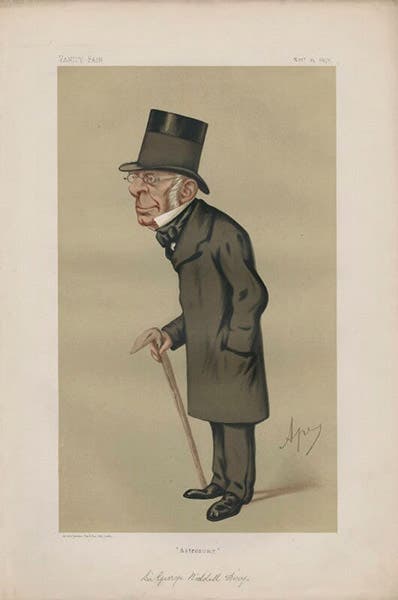
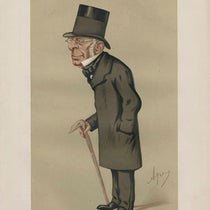
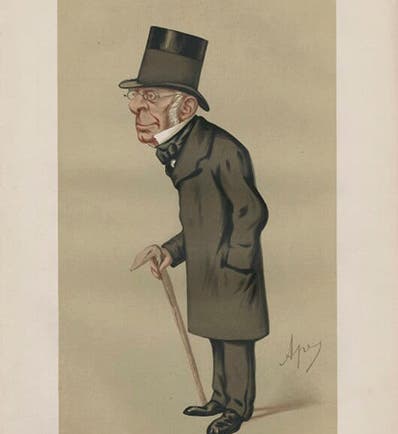
George Biddell Airy, “Astronomy,” chromolithograph caricature by “Ape” (Carlo Pellegrini), Vanity Fair, Nov. 13, 1875, National Portrait Gallery, London (npg.org.uk)
Carlo Pellegrini, an Italian/English painter, was born Mar. 25, 1839, in Capua, Campania, in southern Italy. He started painting portraits when he was young, and at the age of 25, he moved to England to seek his artistic fortune. He was lucky, in that he met Thomas Bowles, publisher of Vanity Fair, who was looking for a caricaturist to draw for the magazine, and Pellegrini was willing to make the move from portraits to caricatures. One of his very first efforts, in January 1869, was of Benjamin Disraeli. It was an immediate success, and Pellegrini never looked back. He would be the principal caricaturist for Vanity Fair for 20 years, until 1889.

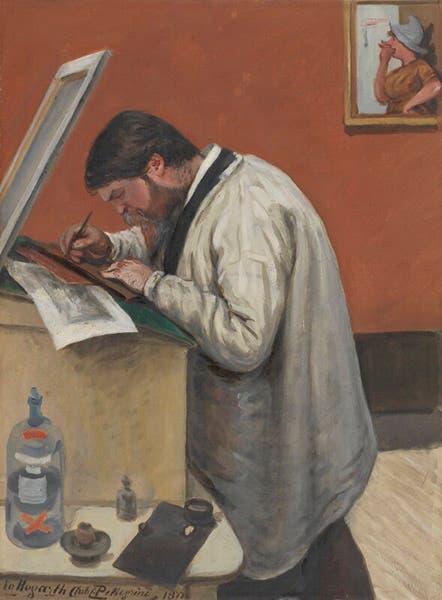
Self-portrait of Carlo Pellegrini, oil and possibly gouache, 1877, National Portrait Gallery, London (npg.org.uk)
A caricaturist required a pen name, and Pellegrini initially used “Singe,” which soon morphed into its English equivalent, “Ape.” Most of his subjects were political figures, such as Disraeli, or clerics, or peers, but occasionally he targeted a scientist. Most historians of science recognize Pellegrini’s work, if not his name, because of separate drawings he did of Thomas H. Huxley (1871, third image) and Bishop Samuel Wilberforce (1869, fourth image). These two men had engaged in a famous debate at Oxford in 1860 about Charles Darwin's recently published Origin of Species (1859), and the two Pellegrini caricatures are often used to illustrate modern accounts of the encounter, even though Pellegrini probably knew nothing about it.

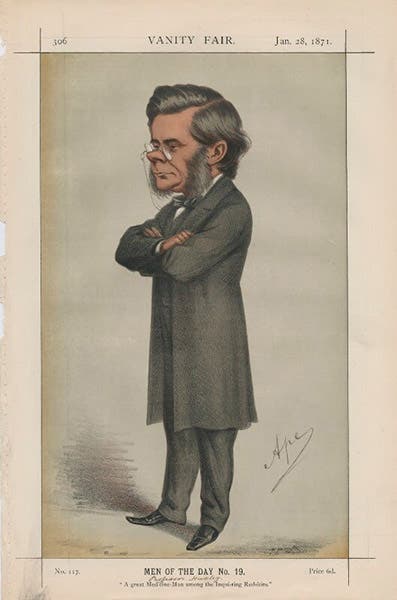
Thomas Henry Huxley, chromolithograph caricature by “Ape” (Carlo Pellegrini), Vanity Fair, Jan. 28, 1871, National Portrait Gallery, London (npg.org.uk)

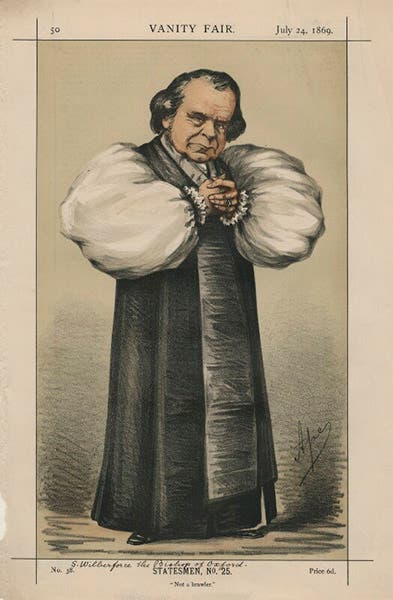
Samuel Wilberforce, chromolithograph caricature by “Ape” (Carlo Pellegrini), Vanity Fair, July 24, 1869, National Portrait Gallery, London (npg.org.uk)
But Pellegrini took aim at other Victorian scientists. Roderick Murchison was, with Charles Lyell, one of the best-known geologists in Great Britain, discoverer of the Silurian System, director of the Geological Survey, and a gentleman to boot, and Pellegrini's chromolithograph portrait appeared in 1870, when Murchison was 78 years old (fifth image).

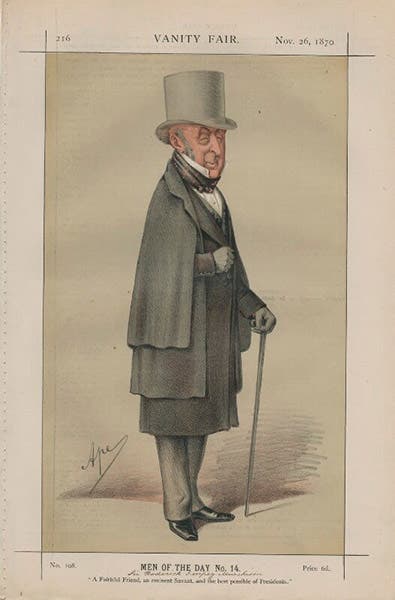
Roderick Impey Murchison, chromolithograph caricature by “Ape” (Carlo Pellegrini), Vanity Fair, Nov. 16, 1870, National Portrait Gallery, London (npg.org.uk)
William Cavendish was blue blood through and through, the 7th Duke of Devonshire, and not himself a scientist. But he did have one of England's great 18th-century scientists, Henry Cavendish, in his family tree, and in 1874, in his capacity as Chancellor of Cambridge University, he established the Cavendish Lab as the home for the physics department at Cambridge, with James Clerk Maxwell as its first director. The atom was essentially unraveled at the Cavendish Lab over the course of the next sixty years, by the likes of J. J. Thomson and Ernest Rutherford. I don't know the exact day when the Cavendish was established, so I don't know if the publication of Pellegrini's caricature (sixth image) on June 4, 1874, was just before or just after the fact. It was good timing, nevertheless.

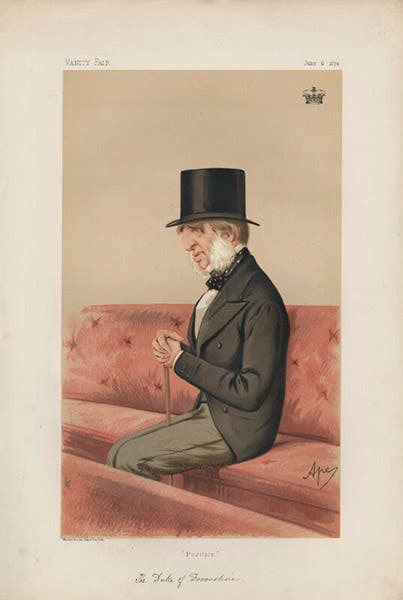
William Cavendish, 7th Duke of Devonshire, chromolithograph caricature by “Ape” (Carlo Pellegrini), Vanity Fair, June 6, 1874, National Portrait Gallery, London (npg.org.uk)
Pellegrini drew George Biddell Airy in 1875 (first image). Airy was the Astronomer Royal of England and had been since 1836. In the late 1840s, he was slightly notorious as the man who failed to discover the 8th planet, Neptune, in 1846, after its position had been (supposedly) predicted by a junior astronomer, John Couch Adams. But by 1874, that was by-the-board, and Airy was known for establishing the Greenwich meridian and for determining the density of the Earth. Ten years after his caricature was published in Vanity Fair, his representatives would succeed in convincing a world congress that the Greenwich meridian should be the international meridian.

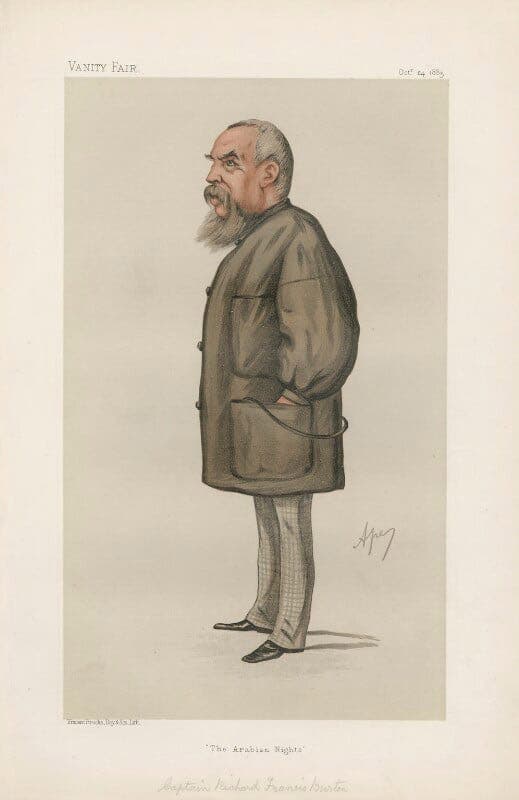
Richard Burton, chromolithograph caricature by “Ape” (Carlo Pellegrini), Vanity Fair, Oct. 24, 1885, National Portrait Gallery, London (npg.org.uk)
We have not yet written a post on Richard Burton, one of the contenders in the 1860s for the title “discoverer of the source of the Nile.” Pellegrini's fabulous portrait of Burton from 1885 should provide some incentive to put Burton on the waiting list for Scientist of the Day (seventh image).
If you are at all a fan of the Victorian art of caricature, you are probably familiar with the work of the other great Vanity Fair artist, Leslie Ward, who drew under the pen name "Spy." We wrote a piece on Ward once, where we looked at the scientists whom he occasionally drew. Ward did his first work for Vanity Fair in 1873, when Pellegrini took a break. But he could never displace Pellegrini as lead caricaturist until Pellegrini retired in 1889.

Portrait of Carlo Pellegrini, watercolor, oil and pastel on paper, by Edgar Degas, 1876, National Gallery, London (Wikimedia commons)
Pellegrini was quite the man-about-town, and openly homosexual at a time when that was not easy, as Oscar Wilde could have told you. Pellegrini died young, at age 49, having essentially smoked himself to death. But he was one of the few Victorians to have his portrait painted by Edgar Degas. It is such a spritely painting that we are happy to make it the last image on this page.
Nearly all of the chromolithographs that Pelligrini did for Vanity Fair are in the National Portrait Gallery (NPG) in London, as well as hundreds of watercolors from which the prints were made. We used the NPG website exclusively as the source for our images here, because it is convenient and useful for me, and for readers and viewers who want to follow up on their own.
William B. Ashworth, Jr., Consultant for the History of Science, Linda Hall Library and Associate Professor emeritus, Department of History, University of Missouri-Kansas City. Comments or corrections are welcome; please direct to ashworthw@umkc.edu.