Scientist of the Day - James Wilson

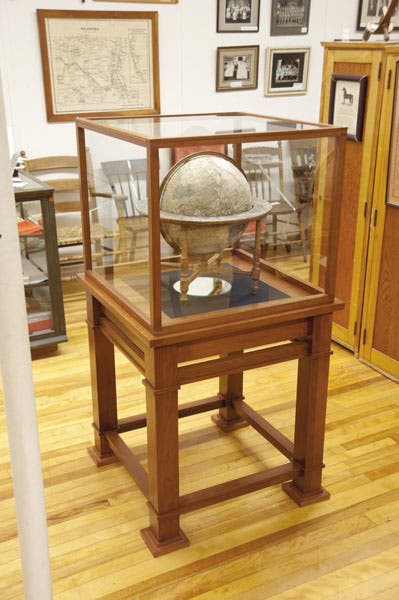
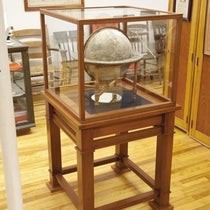
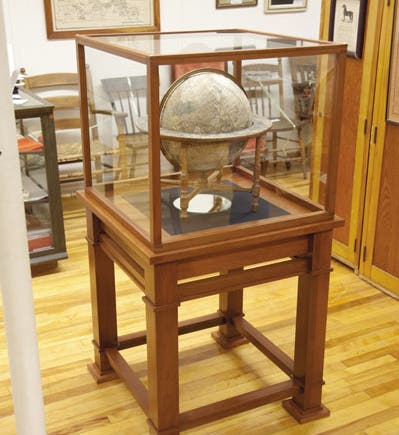
1810 terrestrial globe, by James Wilson, restored, in the Bradford Historical Society Museum, Bradford, Vermont, photo by Larry Coffin (larrycoffin.blogspot.com)
James Wilson, an early American artisan and globe maker, died Mar. 26, 1855, at the age of 92. He was born in Londonderry, New Hampshire, which is south of Manchester, on Mar. 27, 1763, into a farming family, and he trained as a blacksmith. When he was 32, he moved to Bradford, Vermont, which is just across the New Hampshire state line, west of the White Mountains, right on the Connecticut River, where he decided to become a globe-maker. It is not clear where this idea came from. It is said that on the way to Bradford, he stopped in Hannover and saw a pair of globes (terrestrial and celestial) at Dartmouth College, and decided he wanted to make a pair just like that.

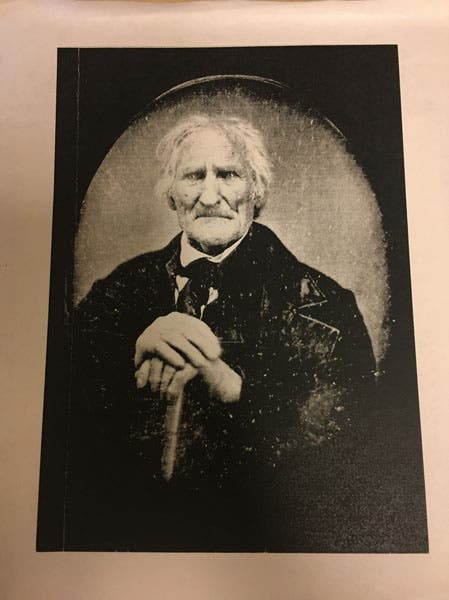
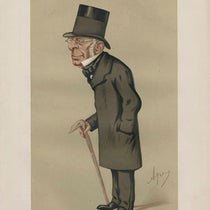
Portrait of James Wilson, daguerreotype, ca. 1850, age 87, reproduced in the Burlington Free Press (burlingtonfreepress.com)
There were no globe makers in the United States in 1800, nor any available books on globe-making, so it was a hard road. His first globes were shaped from solid wood with surface features drawn on in ink, so there was a lot to learn. He bought a set of the third edition of the Encyclopedia Britannia, still being issued, and learned geography and map projections from that. It is said that he made it all the way south to New Haven, on foot, to learn the art of engraving. Presumably he supported his wife and family by farming or smithing while he learned his new trade.

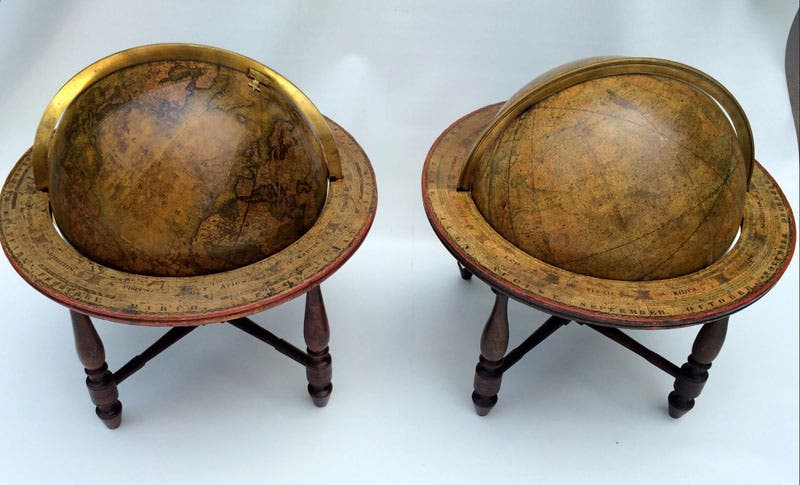
1825 (terrestrial) and 1831 (celestial) globe pair by James Wilson & Sons, offered for sale by Omniterrum (omniterrum.com)
It took him 15 years, but by 1810, he was turning out his first saleable globes from a factory in Bradford. He started with 11-inch globes, and moved up to 13-inch, as orders started to come in. Since there was no competition, the globes sold well, even in cosmopolitan areas like Boston.

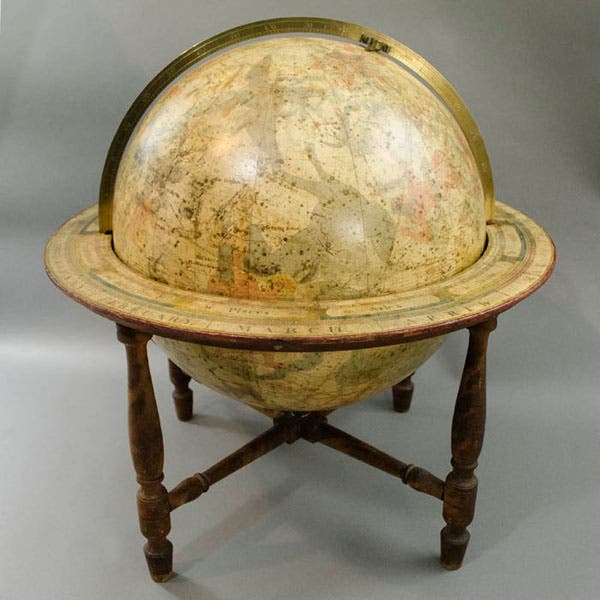
A 13-inch celestial globe, by James Wilson, 1812, offered by Geoge Glazer (georgeglazer.com)
It is rather amazing, when you think about it, that Wilson was able to master all the skills you need to make a globe. The metalwork probably came easy, and the woodworking, but engraving and printing a set of gores that will mate perfectly when glued onto a spherical form is not an easy task. Yet it is apparent, from the surviving specimens, that he taught himself well. Wilson’s sons, now in their early 20s, were brought into the business as it flourished in the 1810s, and a second production plant was opened in Albany, when the factory in Bradford was unable to keep up with demand.

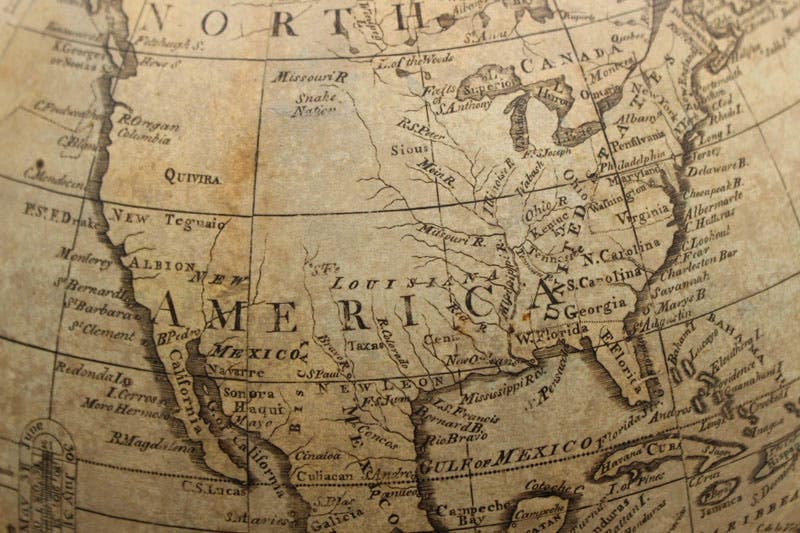
Detail of United States on an 1811 Wilson globe, Silver Special Collections, University of Vermont, Burlington Free Press photograph (burlingtonfreepress.com)
Since Wilson was the first American globe-maker, his globes are very collectible. Quite a few single terrestrial globes, and a modest number of globe pairs, survive in museums around New England, and there is one in the National Museum of American History in Washington, D.C., and a pair in the Metropolitan Museum of Art in NYC, and probably quite a few others that I have not run across in museums across the country. I hope I hear from some of these other owners.

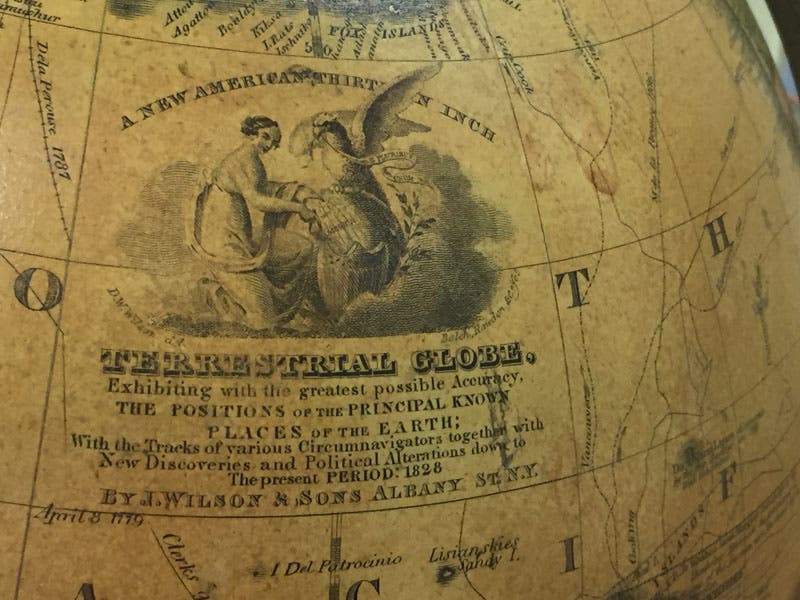
The legend on a 13-inch terrestrial globe made by James Wilson & Sons, 1828, in Albany, Library of Congress (blogs.loc.gov)
I have never seen a Wilson globe, so I have no idea how accurate they were. I am especially curious about the celestial globes, for I have difficulty imagining how even the most curious and skillful farmer would go about gathering information about star positions and magnitudes, except by copying an imported globe, such as the one at Dartmouth, or others he could have found at Yale or Harvard. But just because I cannot imagine the process does not mean that Wilson did not find one. He seems to have been a remarkable man.
The Bradford Historical Society Museum, unsurprisingly, owns a few Wilson globes, including one of 1810, thought to be the first year of production, and in 2010, the Museum marked the bicentennial by restoring their 1810 original (first image). I have only photos to go by, but it looks a little over-restored, as if it were made yesterday. I hope that is not the case, and it probably is not.
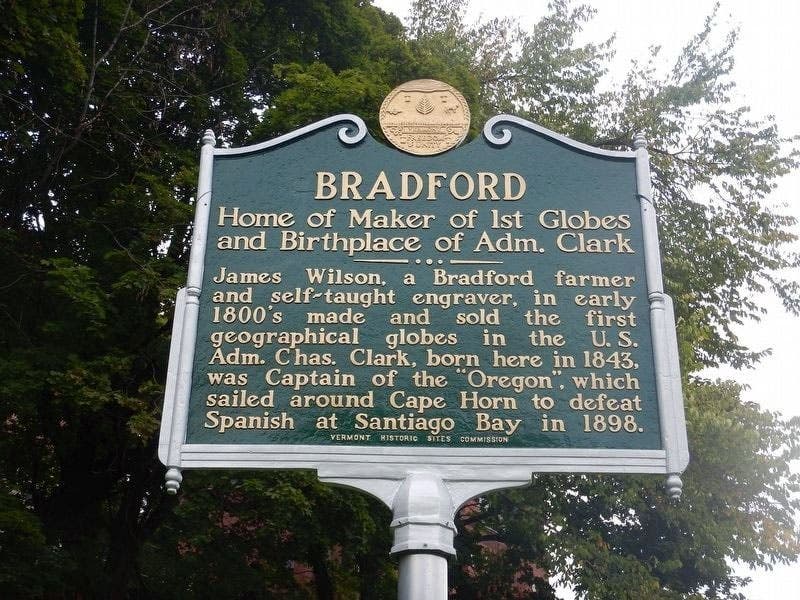
Historical marker in Bradford, Vermont, which James Wilson has to share with an Admiral in the U.S. Navy (hmdb.org)
My former colleague at the Library here, Benjamin Gross, used to make an annual trip to the White Mountains, and if he were still here, I would ask him to take a side trip this summer to Bradford to check on the globes there. I do not know if he has that latitude in his new position at the Ransom Center in Austin, but I will ask. It would be nice to have a follow-up report from a historian who has seen a pair of Wilson globes face to face.
The only photograph I have seen of Wilson is the one I show here, when he was very old. But then, he was 76 when photography was invented.
William B. Ashworth, Jr., Consultant for the History of Science, Linda Hall Library and Associate Professor emeritus, Department of History, University of Missouri-Kansas City. Comments or corrections are welcome; please direct to ashworthw@umkc.edu.