Scientist of the Day - Pope Leo XIII

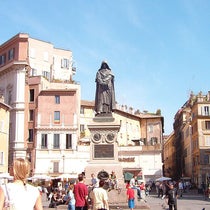
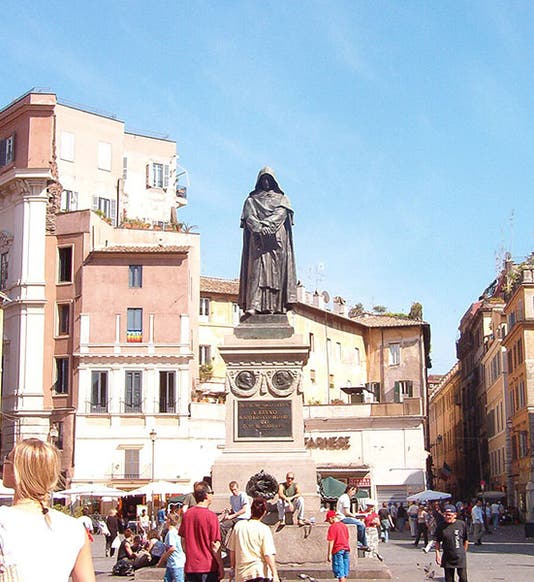
Statue of Giordano Bruno, sculpted by Ettore Ferrari, Campo de’ Fiori, Rome, 1889 (Wikimedia commons)
On Apr. 20, 1884, Pope Leo XIII issued a papal encyclical known as Humanum genus. Its purpose was to denounce Freemasonry, the members of which he called "partisans of evil." Freemasons believed in public education, the sovereignty of the people, the separation of church and state, and other such dangerous and heretical ideas, and the encyclical reiterated that Catholics were forbidden to join the Freemasons.

Portrait of Pope Leo XIII, who issued the papal encyclical, Humanum genus, in 1884 (Wikimedia commons)
What does Pope Leo XIII’s encyclical have to do with anything, especially scientific anniversaries? Quite a bit, actually. Many Freemasons were profoundly irritated at this Papal interference in their lives, and this was particularly true in Rome, a hotbed of Freemasonry in the late 19th century. It wasn't so very long before that Roman citizens had been limited in the amount of outrage they could express toward the Papacy, because Rome was part of the Papal States and under the jurisdiction of the Pope. But in 1870, as part of the Italian unification movement, the Papacy lost the Papal States entirely to the Kingdom of Italy, all except for Vatican City. The Pope no longer had a say in what happened in the streets of Rome. Pope Leo XIII was apparently not fully aware of that when he issued his encyclical in 1884.

Another view of the statue of Giordano Bruno, showing his face, sculpted by Ettore Ferrari, Campo de’ Fiori, Rome, 1889 (Wikimedia commons)
In retaliation for the encyclical, the Freemasons of Rome commissioned a bronze statue of that notorious free-thinker Giordano Bruno, from the noted Italian sculptor Ettore Ferrari (himself a Freemason). Giordano Bruno had been anathema to the Catholic Church since the first charges of heresy were drawn up against the young Dominican renegade in 1576, and the antipathy did not abate when Bruno was condemned by the Inquisition and burned at the stake in the Campo de’ Fiori in Rome in 1600. His books were placed on the Index of Forbidden Books, and no statues, portraits, or memorials of any kind were permitted anywhere in the Papal States. Bruno almost disappeared from the historical record, and would have, were it not that states unsympathetic to the Vatican, such as Venice and Naples, kept his memory alive, along with some of his writings. But before 1889, you would have found no sign anywhere in Rome that Bruno had ever existed.

Plaque on the base of the statue of Bruno, showing him defiant before the Inquisition, sculpted by Ettore Ferrari, Campo de’ Fiori, Rome, 1889 (Wikimedia commons)
Ettore Ferrari carried out his commission, and within a few years he had fashioned a heroic (larger than life-size) bronze full-body statue of Bruno. It was erected in 1889 in the center of the Campo de’ Fiori, at the very site where Bruno had been burned to death by the Church nearly 300 years before. The statue is still there (first image). It faces north, and since Bruno’s head is covered by a cowl, his features are continually in shadow, making him look more like Darth Vader than a Catholic martyr. With a little repositioning, it is possible to see Bruno’s face (third image). Not that it matters, for the face is quite generic, since neither Ferrari nor anyone else knew what Bruno actually looked like.
_-_Foto_Giovanni_Dall%27Orto,_6-Apr-2008.jpg#/media/File:6665_-_Roma_-_Ettore_Ferrari,_Monumento_a_Giordano_Bruno_(1889)_-_Foto_Giovanni_Dall'Orto,_6-Apr-2008.jpg)
Another plaque on the base below the statue of Bruno, showing him being burned at the stake in 1600, sculpted by Ettore Ferrari, Campo de’ Fiori, Rome, 1889 (Wikimedia commons)
Ferrari also cast three bronze reliefs that were set into the base of the monument, on the back and the two sides. We show two of the plaques – one that depicts Bruno standing before the Inquisition, proudly defiant, like a good Freemason (fourth image), and another that shows him being burned at the stake, on this exact spot (fifth image). At the top of the base, on each side, just above the plaques, Ferrari placed two large portrait medallions, 8 in all. These depict such historical figures as Michael Servetus and Lucilio Vanini, both of whom were burned at the stake; Tommaso Campanella and Petrus Ramus, both of whom were imprisoned for their religious views; and Paolo Sarpi, who defied a papal interdict on Venice in 1607 and escaped Papal-directed assassination. We show the portraits of Sarpi and Campanella, which are above the title plaque on the front of the statue (sixth image). Ferrari and the Freemasons were giving it to the Pope with both barrels. Ferrari must have been unaware, or didn’t care, that Servetus was burned at the stake by John Calvin, not by the Catholic Inquisition.
_-_Foto_Giovanni_Dall%27Orto,_6-Apr-2008.jpg#/media/File:6651_-_Roma_-_Ettore_Ferrari,_Monumento_a_Giordano_Bruno_(1889)_-_Foto_Giovanni_Dall'Orto,_6-Apr-2008.jpg)
Portrait medallions of Paolo Sarpi (left) and Tommaso Campanella (right), two scholars targeted by the Church, sculpted by Ettore Ferrari, above the title plaque on the base of the statue of Bruno, Campo de’ Fiori, Rome, 1889 (Wikimedia commons)
So Pope Leo XIII’s encyclical did indeed set in motion a chain of events that led to finally giving Giordano Bruno a place in the Sun, even if it warms only his backside. We now recognize Bruno as not only an early Copernican (sort of), but a cosmological visionary, believing as he did in a plurality of inhabited worlds, an infinite universe, and the non-privileged status of the Earth. It is nice that there is one place on this earth where we can pay our respects, thanks to the imprudence of Pope Leo XIII. But should you journey there to do that, be aware of one thing – most of the time, the Campo de’ Fiori looks like our last image (below). I am sure that suits the bronze Bruno just fine.

Typical activity on market days at the Campo de’ Fiori, Rome, which the bronze Bruno watches over (Wikimedia commons)
William B. Ashworth, Jr., Consultant for the History of Science, Linda Hall Library and Associate Professor emeritus, Department of History, University of Missouri-Kansas City. Comments or corrections are welcome; please direct to ashworthw@umkc.edu.