Scientist of the Day - Robert T. Bakker

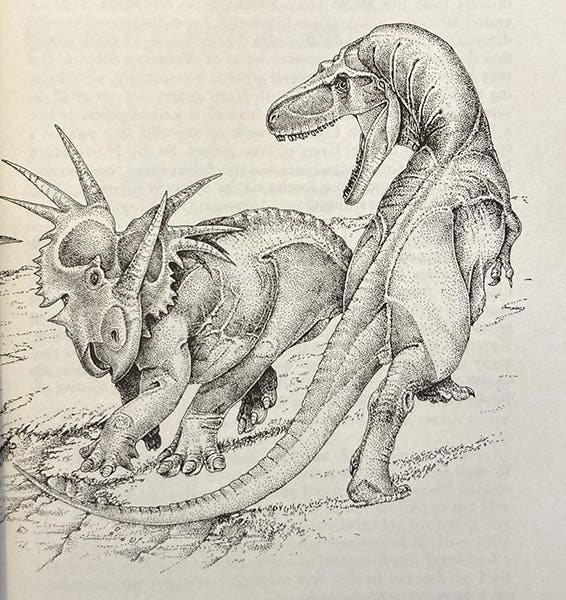
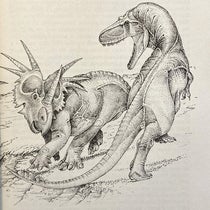
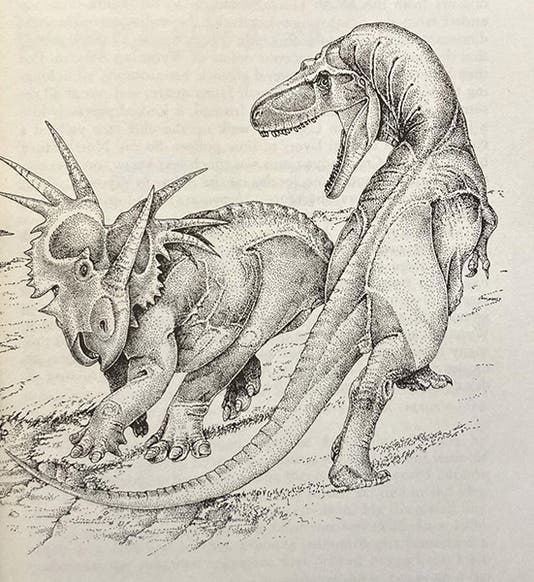
Albertosaurus attacking a Styracosaurus, drawing by Robert Bakker, in his The Dinosaur Heresies: New Theories Unlocking the Mystery of the Dinosaurs and their Extinction, p. 123, 1986 (author’s copy)
Robert T. Bakker, an American vertebrate paleontologist, was born Mar. 24, 1945, in New Jersey. He had his first "dinosaur moment," so he recalls, in 1953, when he read the Sep. 7, 1953, issue of Life Magazine, with a section of a dinosaur mural on the cover and the rest of it inside on a large foldout. The original mural, 110 feet long and painted in fresco by Rudolph Zallinger, is in the Peabody Museum at Yale University. So it was perhaps not coincidence that Bakker studied vertebrate paleontology at Yale, with John Ostrom.
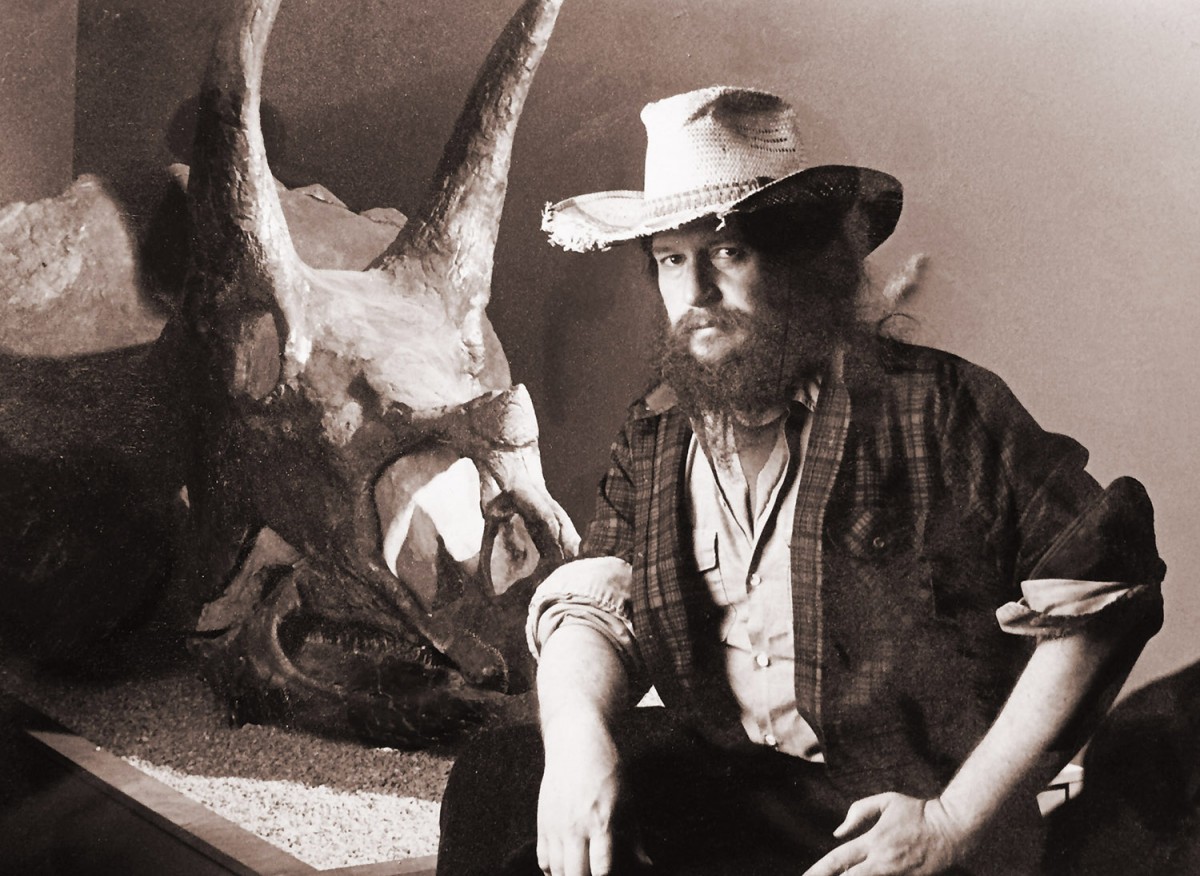
Portrait photograph of Robert Bakker, by Martin Natvig, 1985, for the jacket flap of The Dinosaur Heresies (paleonerds.com)
Ostrom discovered specimens of Deinonychus, a small theropod predator, in the mid-1960s and described his "terrible-claw" dinosaur in a monograph in 1969. Young Bakker drew the frontispiece, a life restoration of Deinonychus (third image). This marked the beginning of a "dinosaur renaissance," when paleontologists began to discard the old view of dinosaurs as cold-blooded, slow-moving reptiles, suggesting instead that at least some dinosaurs were active, warm-blooded predators and ancestral to modern birds. Bakker's Deinonychus is up on one toe, running flat out, with its talons upraised and ready to slash. This was no Zallinger dinosaur, and it provided an appropriate conclusion to our 1996 exhibition on dinosaur illustration, Paper Dinosaurs, 1824-1969.

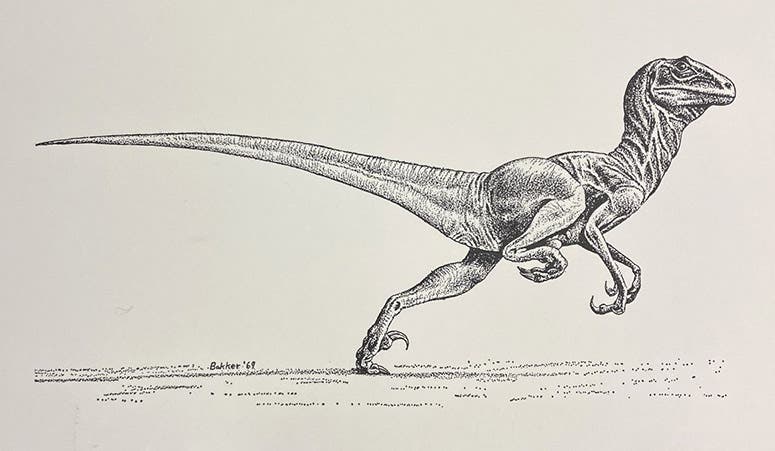
Frontispiece, Deinonychus antirrhopus, drawing by Robert Bakker, Bulletin of the Peabody Museum of Natural History, Yale University, no. 30, 1969 (Linda Hall Library)
Six years later, Bakker was asked by the editors of Scientific American to write an article about this new view of dinosaurs, and Bakker obliged with "Dinosaur Renaissance" for the April 1975 issue. I remember receiving it, as I was trying to write my doctoral dissertation and frantically in need of distraction, and Bakker’s article certainly provided that (as did Martin Gardner’s April Fool’s version of his “Mathematical Games” column, with an unforgettable drawing of Leonardo da Vinci presenting his latest invention, the flush toilet).

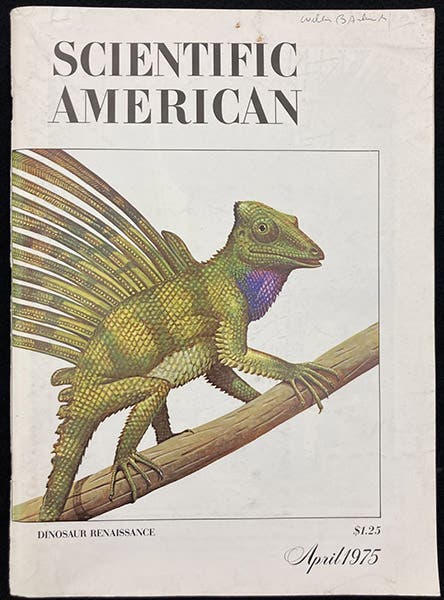
Front cover, Scientific American, vol. 232, no. 4, April 1975 issue, announcing the article, “Dinosaur Renaissance,” by Robert T. Bakker, pp. 58-78 (author’s copy)
Bakker's principal argument for endothermy (warm-bloodedness) in dinosaurs was new to me, and was drawn from predator/prey biomass ratios. Warm-blooded predators need to eat about ten times as much as cold-blooded ones, to maintain their body temperature, and between late Permian and late Triassic times, the predator/prey biomass ratio for dinosaurs, as determined from fossil beds, dropped from 40% to 4%. It seemed evident, to Bakker, that dinosaurs were endothermic.

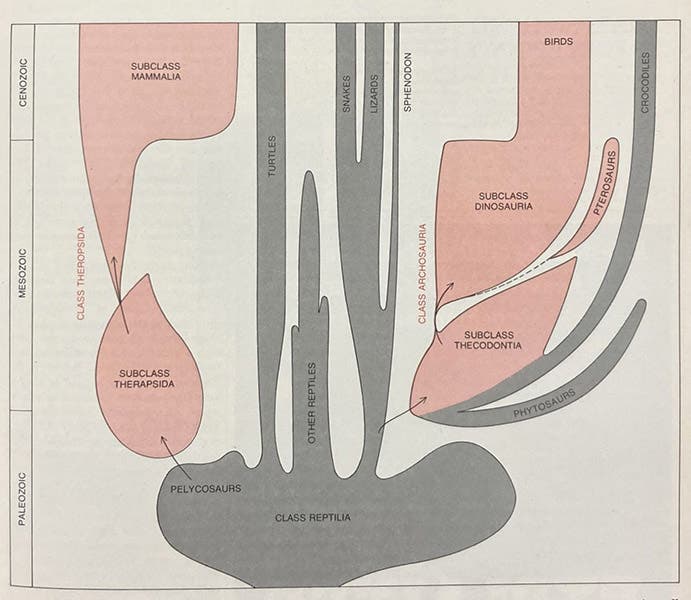
Spindle diagram of vertebrate evolution, with warm-blooded animals (endotherms) in red, including dinosaurs, birds, and mammals, “Dinosaur Renaissance,” by Robert T. Bakker, Scientific American, vol. 232, no. 4, April 1975, p. 77 (author’s copy)
Bakker also argued, in the same short article, that birds evolved from dinosaurs, not a new argument, but still a minority opinion in 1975, and unbacked, until Bakker, by any biometric arguments. In a diagram of vertebrate evolution, on the next-to-last page of the article, everything in red is endothermic, including birds, dinosaurs, mammals, and their immediate predecessors.

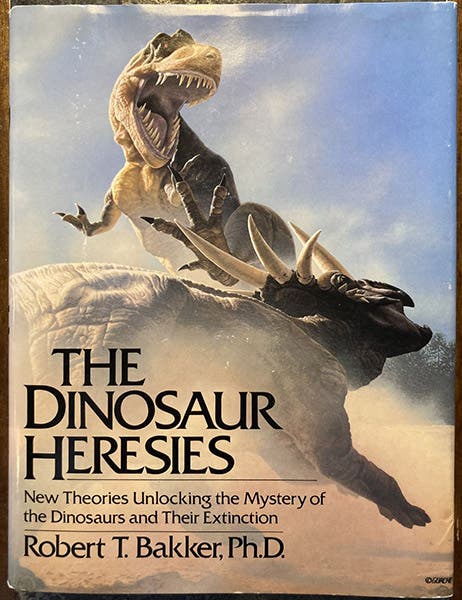
Dust jacket, with cover art by John Gurche, The Dinosaur Heresies: New Theories Unlocking the Mystery of the Dinosaurs and their Extinction, by Robert T. Bakker, William Morrow, 1986 (author’s copy)
Eleven years later, Bakker published his only book (if we don't count Raptor Red, a work of fiction), called The Dinosaur Heresies (1986). The book makes the same arguments as the Scientific American article, in more detail, of course, but with one important addition: it contains drawings, scores of them, by Bakker himself. Not since Charles Knight had anyone drawn such exciting, animated dinosaurs, and they make the point about dinosaur endothermy much more dramatically than graphs of predator/prey ratios (first, seventh, and eighth images). For some reason, the publishers (Morrow) chose to use a painting by John Gurche on the dust jacket. It is a great painting, and I love John Gurche (born in Kansas City), but the cover illustration should have been a Bakker drawing.

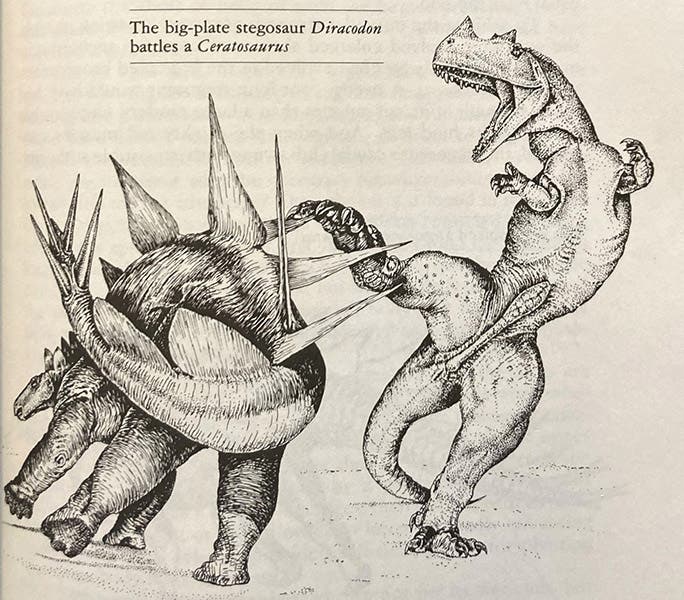
Diracodon battling a Ceratosaurus, drawing by Robert Bakker, in his The Dinosaur Heresies: New Theories Unlocking the Mystery of the Dinosaurs and their Extinction, p. 227, 1986 (author’s copy)

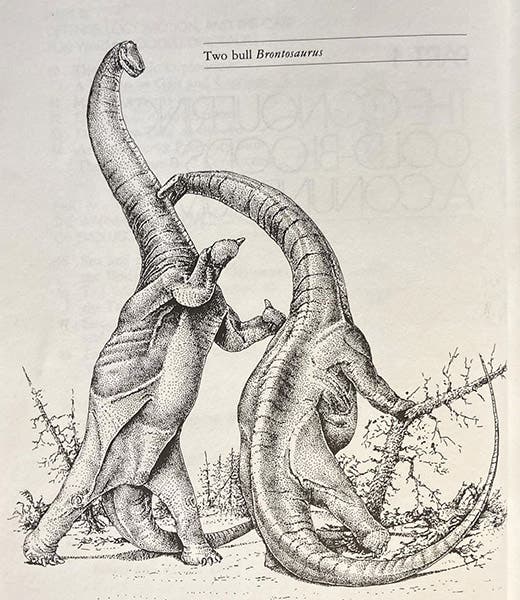
Two bull Brontosaurus, drawing by Robert Bakker, in his The Dinosaur Heresies: New Theories Unlocking the Mystery of the Dinosaurs and their Extinction, p. 14, 1986 (author’s copy)
Bakker has always been something of an enfant terrible in invertebrate paleontology, with his shaggy beard and omnipresent battered Stetson, and has moved from institution to institution over the years, but of late he has been curator of paleontology at the Houston Museum of Natural Science and seems to be thriving there, at the age of 81. More power to him!
William B. Ashworth, Jr., Consultant for the History of Science, Linda Hall Library and Associate Professor emeritus, Department of History, University of Missouri-Kansas City. Comments or corrections are welcome; please direct to ashworthw@umkc.edu.