Scientist of the Day - Wernher von Braun

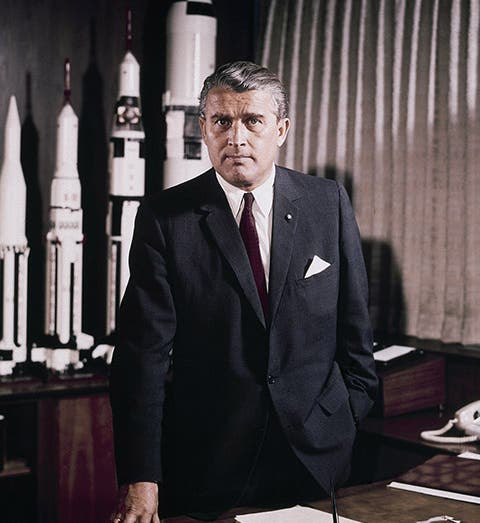
Wernher von Braun in his office at the Marshall Space Flight Center, Huntsville, Alabama, photograph, 1964 (Wikimedia commons)
Wernher von Braun, a German rocket and aerospace engineer, was born Mar. 23, 1912, in Wirsitz, then part of Prussia, now in Poland. While in secondary school, he discovered a book by Hermann Oberth, Die Rakete zu den Planetenräumen (The Rocket into Planetary Space, 1923), a seminal work on rocketry (which has eluded all our attempts to acquire it), and von Braun was hooked on rockets for life. He was too young to be a part of the first German rocket community, which included Willy Ley, Walter Hohmann, and Guido von Piquet, and published the short lived journal Die Rakete (1927-29), which we do have, but by the early 1930s, he was part of that group and was building and firing off his own rockets. For his PhD in Berlin, he developed a liquid-fuel rocket, the A-2, which was the ancestor of the A-4, better known in the west as the V-2.

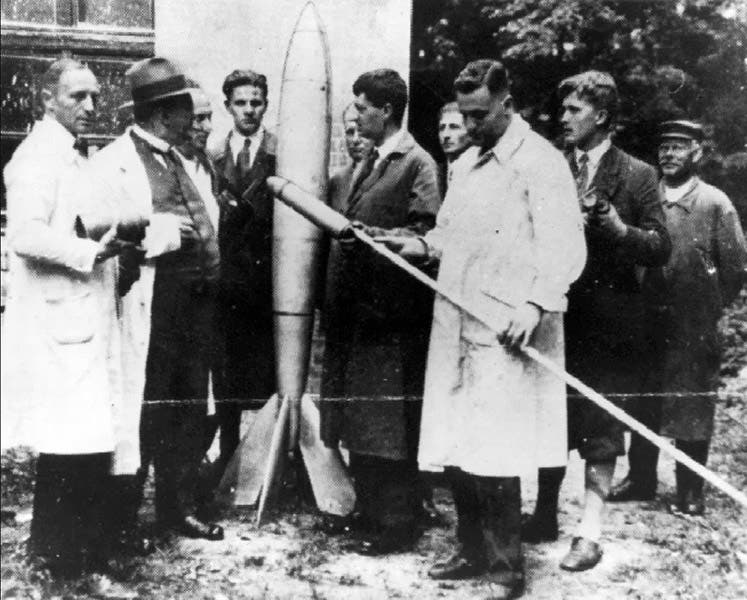
Wernher von Braun, second from right, with a group of rocket enthusiasts, Germany, early 1930s, NASA photograph (nasa.gov)
By the time von Braun received his PhD in 1934, Hitler had come to power, and the Nazis fully supported the advancement of rocketry. Von Braun's work was supported, and in turn, he joined the Nazi party in 1937, and was established at the research facility at Peenemünde by 1939. Von Braun's connection with the Nazi party is a controversial subject for historians. Von Braun later maintained that membership was necessary for the work he was doing, that had he refused it, he would have lost his job, and possibly his life. However, many historians think he was more zealous than he needed to have been. Whatever the case, von Braun designed the A-4 liquid fuel rocket, fired it into space (the first rocket to go into space), and his group began producing enough of them, now called V-2s, to rain them down on London and Antwerp in 1944. The V-2s were built by slave labor in a factory at Peenemünde under horrible conditions of which von Braun must have been aware.

V-2 rocket with engine on display at the Cosmosphere, Hutchinson, Kansas (Wikimedia commons)
When the War turned in 1945 and Europe was invaded by Allied forces, von Braun and his team of rocket scientists and engineers managed to make their way to a part of Germany where they could surrender to the American army, rather than the Soviet forces, and in an operation known as Operation Paperclip, von Braun and his team were whisked out of Europe and taken to Fort Bliss, Texas, interviewed, and eventually put to work developing rockets for the U.S. military. It took a while, but von Braun showed himself to be the cream of the crop, and he designed several rockets for the Army and Navy. He came into the public eye in the early 1950s, when he collaborated with space artist Chesley Bonestell on several articles and a book to make the case to the public that humans should go into space, to the Moon and to Mars.

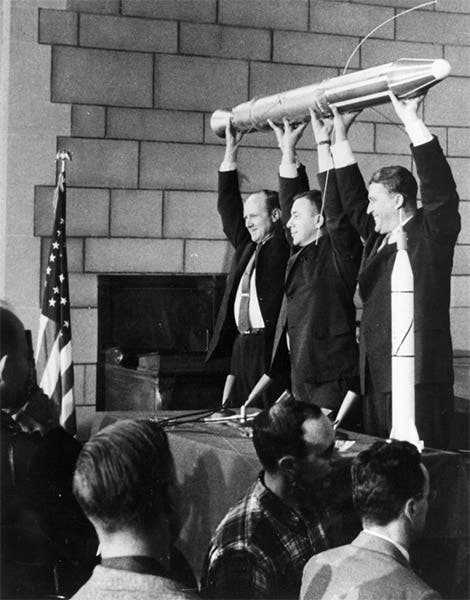
Wernher von Braun (right) with William Pickering and James van Allen, holding a replica of Explorer 1 that was rocketed into orbit on Jan. 31, 1958, NASA photograph (nasa.gov)
The crisis that arose after the Soviets put Sputnik into orbit in October of 1957 only accelerated von Braun's advancement. He had been at the Redstone Arsenal outside Huntsville, Alabama, since 1950, working with the U.S. Army, and he had developed a rocket known as the Redstone, which gave rise to the Jupiter-C. In the furious U.S. attempt to launch a satellite of their own after Sputnik, the first success was Explorer 1, which was sent into space by the Juno-1 rocket, a modified Jupiter-C, and von Braun was very much a visible part of the launch team (fourth image).
.jpg#/media/File:Wernher_von_Braun_(0201422).jpg)
Wernher von Braun at the working end of a Saturn V rocket, with five F-1 engines, unused first stage at Marshall Space Flight Center, Huntsville, Alabama, photograph, early 1970s (Wikimedia commons)
In 1960, the newly formed NASA established the Marshall Space Flight Center at Huntsville, and von Braun was put in charge. When President Kennedy mandated in 1961 and 1962 that we send a man to the Moon and bring him back by 1970, von Braun designed the rocket to accomplish this task, the massive Saturn V, which was up to the task of carrying nine teams of astronauts, the Apollo missions, to the Moon between 1967 and 1972, and launching our first space station, Skylab, as a bonus. He posed late in life at the business end of an unused Saturn V rocket that was on display in Huntsville, so you can see how enormous those Saturn V rockets were (last image).
After the success of the Apollo missions, von Braun was excited by the prospect of a manned mission to Mars, but when both NASA and the public lost interest in manned space flight in the early 1970s, Von Braun grew disillusioned and resigned his post at Marshall. He died of cancer on June 16, 1977, and was buried in a modest grave in Ivy Hill Cemetery in Alexandria, Virginia.
William B. Ashworth, Jr., Consultant for the History of Science, Linda Hall Library and Associate Professor emeritus, Department of History, University of Missouri-Kansas City. Comments or corrections are welcome; please direct to ashworthw@umkc.edu.