Scientist of the Day - Aratus of Soli

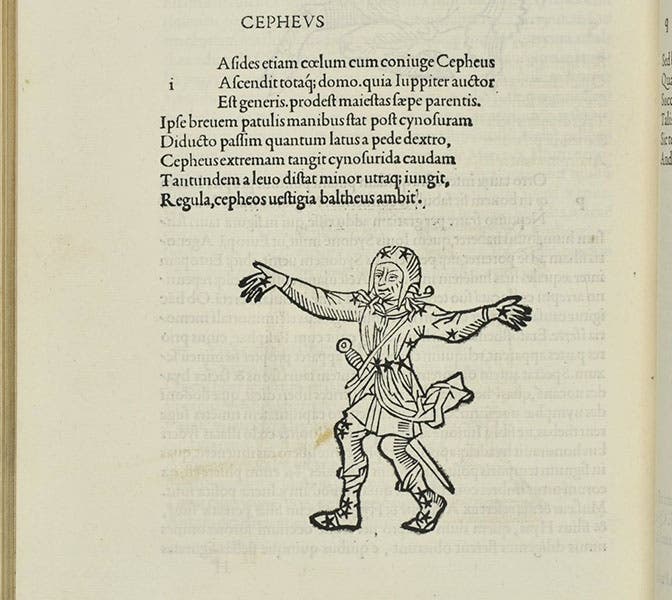
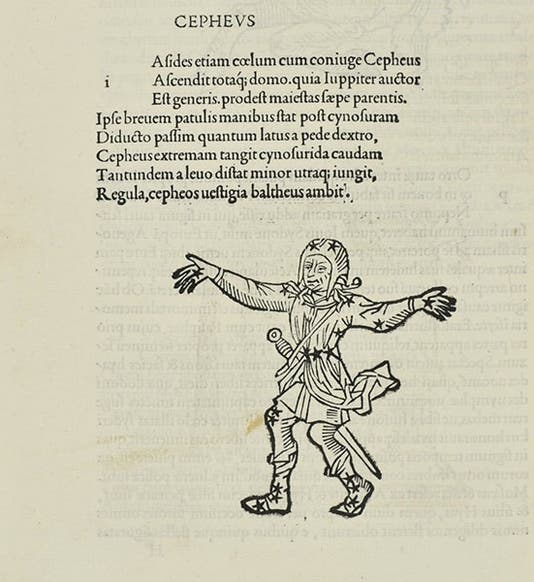
The constellation Cepheus, woodcut in Matheseos Liber, by Firmicus Maternus et al., including Aratus of Soli, 1499 (The Linda Hall)
Aratus of Soli, a Greek astronomical poet, lived from about 315 BCE to about 240 BCE. Soli was a town in Cilicia, on the southern coast of Anatolia (modern Turkey). Aratus spent much of his life at the Macedonian court. He is known primarily for a single work, the Phenomena, a long poem about the constellations. It was a rewriting in verse form of a lost work of Eudoxus of Cnidus. The Phenomena of Aratus and the De astronomia of Hyginus were the two primary ancient sources on the constellations, and they were both printed in the early Renaissance. These were the primary vehicles for the first images of constellations when Ptolemaic astronomy was revived by Regiomontanus and his successors in the late 15th century. The modern star atlas was born from the pages of Aratus and Hyginus.

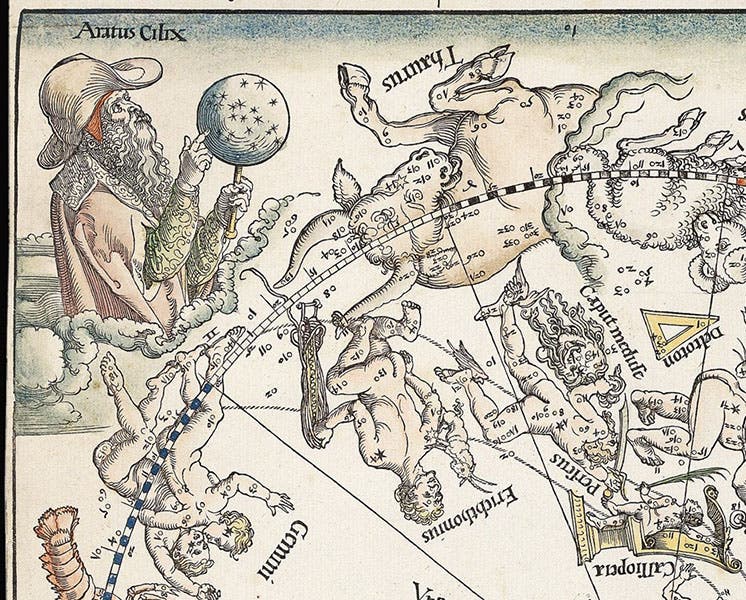
Imagined portrait of Aratus of Soli, Imagines Coeli Septentrionales (northern celestial hemisphere), woodcut by Albrecht Dürer et al., 1515, offered and sold by Daniel Crouch Rare Books (crouchrarebooks.com)
But before we look at constellation images, we should remind ourselves that the Phenomena is a descriptive poem in words, not images. To give you a sense of the poem, here is a short extract, which sacrifices in translation the verse form:
Cepheus himself is set behind the Bear Cynosura, like to one that stretches out both his hands. From her tail tip to both his feet stretched a measure equal to that from foot to foot. But a little aside from his belt, look to find the first coil of the mighty Dragon.
Eastward his hapless wife, Cassiopeia, gleaming when by night the Moon is full, wheels with her scanty stars. For few and alternate stars adorn her, which expressly mark her form with lines of light. Like the key of a twofold door barred within, wherewith men striking shoot back the bolts, so singly set shine her stars. But from her shoulders so faint she stretches a fathom’s length. Thou would’st say she was sorrowing over her daughter [Andromeda] (Loeb Classical Library translation).
You will note that there is no description of the positions of the individual stars that make up the constellations. You would have to consult the star catalog in Ptolemy’s Almagest to find that information.
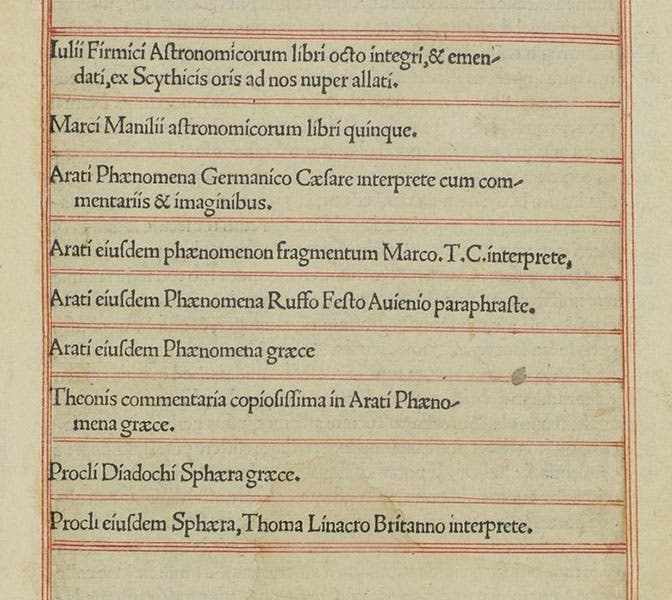
Detail of table of contents, showing four entries for the Phenomena of Aratus, in Matheseos Liber, by Firmicus Maternus et al., 1499 (The Linda Hall)
The Phenomena of Aratus was very popular in the ancient world and was translated into Latin at least three times, once by Cicero. There is an 9th-century manuscript in Leiden, the Arataea, with 35 hand-painted constellation images that are just gorgeous, and many other unillustrated manuscripts in both Greek and Latin that came down to the Renaissance, so it was easy enough to print, when printed copies were called for. The first printing (editio princeps) was in 1499, in a collection of works, titled Matheseos Liber, headed by a treatise by Firmicus Maternus, and printed by Aldus Mantuius. On the table of contents (an unusual feature in an incunabulum), you can see that it contains the three ancient Latin translations and the original Greek text (third image).

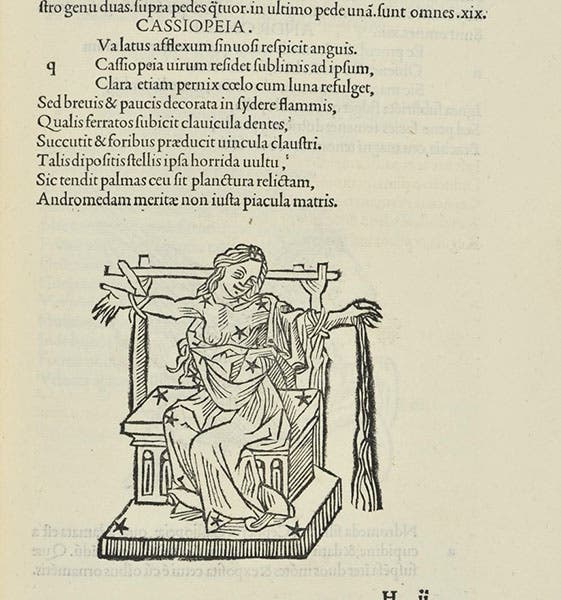
The constellation Cassiopeia, woodcut in Matheseos Liber, by Firmicus Maternus et al., including Aratus of Soli, 1499 (The Linda Hall)
The 1499 Phenomena is illustrated with charming woodcuts. Since we quoted the section on Cepheus and Cassiopeia, we show those two, and an additional view of Leo, this time full-page. Aldus copied the woodcuts that had appeared in the 1482 edition of Hyginus, and they are indeed hard to beat.

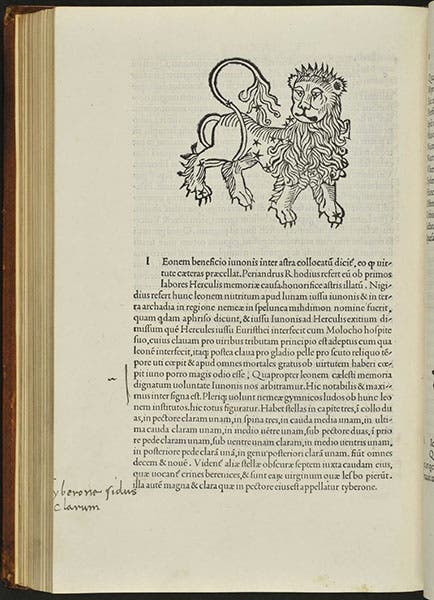
The constellation Leo, full page with woodcut, Matheseos Liber, by Firmicus Maternus et al., including Aratus of Soli, 1499 (The Linda Hall)
We have several other editions of Aratus in our collections, but we leap ahead to the edition of Hugo Grotius, published in 1600, probably the most successful printing of Aratus ever, since the constellation engravings were based on the illuminations in the Leiden Arataea. We wrote an entire post on Grotius and his Arateorum, so here we show just one of his engravings, that of Taurus (last image). The engravings in Grotius were copied in turn for Johann Bayer's Uranometria (1603). And that is how we get from Aratus to the birth of the star atlas. We told the story more fully in our exhibition, Out of This World; you may see the entry on the 1499 Firmicus Maternus here, and on the 1600 Grotius Arateorum here.

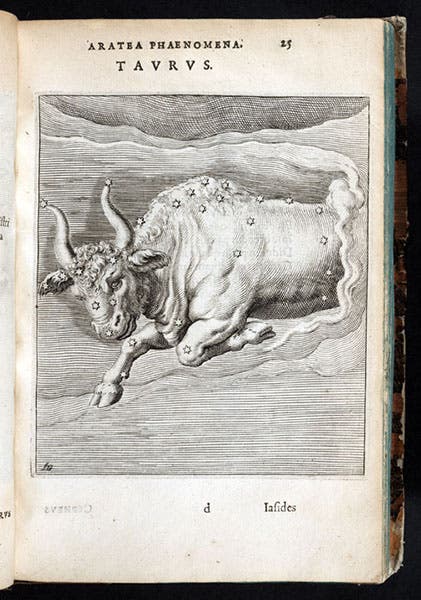
The constellation Taurus, engraving by Jacobus de Gheyn. In Arateorum, by Hugo Grotius, 1600 (The Linda Hall)
There is no portrait or bust of Aratus that survives, but Albrecht Dürer included an imagined portrait on his northern star map of 1515, in the upper left corner. Any portrait by Dürer, imagined or not, is a treat, and since we do not have the Dürer maps, we show a detail from a copy offered and sold by rare book dealer Daniel Crouch in 2015 (second image).
William B. Ashworth, Jr., Consultant for the History of Science, Linda Hall Library and Associate Professor emeritus, Department of History, University of Missouri-Kansas City. Comments or corrections are welcome; please direct to ashworthw@umkc.edu.