Scientist of the Day - John Tradescant the Younger

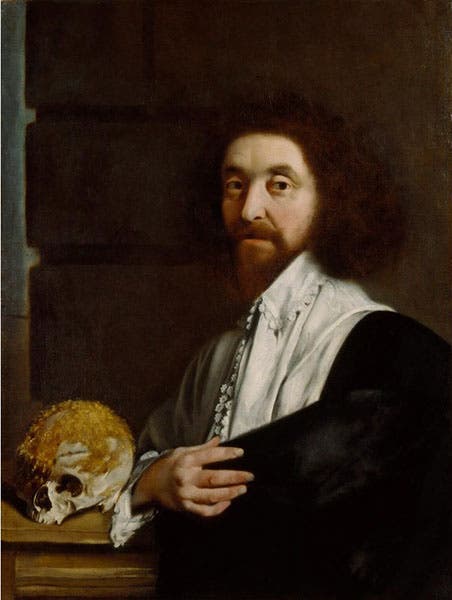
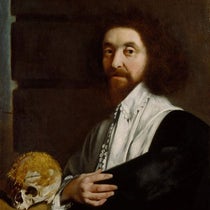
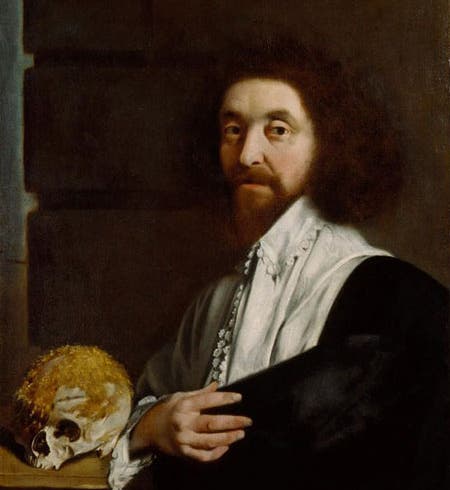
Portrait of John Tradescant the Younger, oil on canvas, 1652, attributed to Thomas De Critz, National Portrait Gallery, London, on display in The Garden Museum, Lambeth (npg.org.uk)
John Tradescant the Younger, an English traveler, gardener and collector, died Apr. 22, 1662, at age 53. His father, John the Elder, was also an explorer and collector, travelling to Russia, the Middle East, and Europe, bringing back seeds and plants for the gardens of his patrons and curios for a museum that would eventually be set up in his house in Lambeth in south London – the first public museum in England. John the Elder ended his years as gardener to King Charles I and his wife Henrietta Maria.

Powatan’s mantle, part of the original Tradescant collection, now in the Ashmolean Museum, Oxford (Wikimedia commons)
Young John continued the family practice of travelling and botanizing and being gardener for king and queen; his father was good friends with John Smith, the Virginia colonizer, and John junior travelled to Virginia and brought back a host of New World plants for English gardens, as well as mirabilia and curiosa, such as the supposed robe of Chief Powatan of Virginia (second image). One of the plants he discovered was the Virginia spiderwort, which he established in his own garden in Lambeth. Many years later, in 1718, the flower was named Tradescantia, in honor of both Johns, and Linnaeus made the name official in 1752 (third image).

Virginia spiderwort, Tradescantia virginiana, named after both Tradescants by Carl Linnaeus in 1752 (Wikimedia commons)
Before John the Younger died in 1662, he arranged for his and his father's collections to go to Elias Ashmole, a wealthy antiquary and alchemist; Ashmole in turn made the Tradescant treasures the heart of the Ashmolean Museum, founded at Oxford in 1683, where much of the Tradescant collection can still be seen, although now in a 19h-century building. The original Ashmolean building now houses the Museum of the History of Science, Oxford (fourth image).

The old Ashmolean Museum building, 1683, original home of the Tradescant collection, now housing the Museum of the History of Science, Oxford (Wikimedia commons)
Both John Younger and John Elder were buried in the churchyard of St. Mary’s Lambeth in London, on the south bank of the Thames, right next to Lambeth Palace. They share a marvelous carved tomb and monument that is apparently of some import in the history of grave markers, as it ostensibly marks the first large grave monument in London placed outside in the churchyard – all previous such monuments were erected inside churches. Or so it is said.

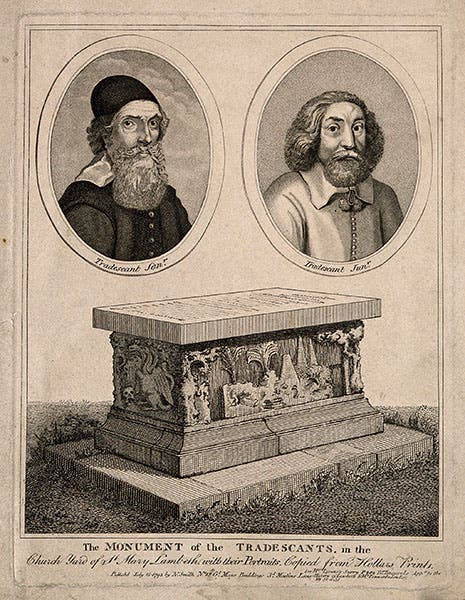
John Tradescant, Younger and Elder, with their tomb below, stipple engraving by N. Smith, 1793, after W. Hollar, Wellcome Collection, London (wellcomecollection.org)
The church was about to be demolished in 1976 when an admirer of the Tradescants stepped in and organized a salvage operation. The church was reincarnated as the Museum of Garden History (now shortened to The Garden Museum) – the first museum devoted to the history of the English garden – and the grounds were replanted to resemble one of the “knot gardens” that the Tradescant employers were so partial to back in Stuart England.

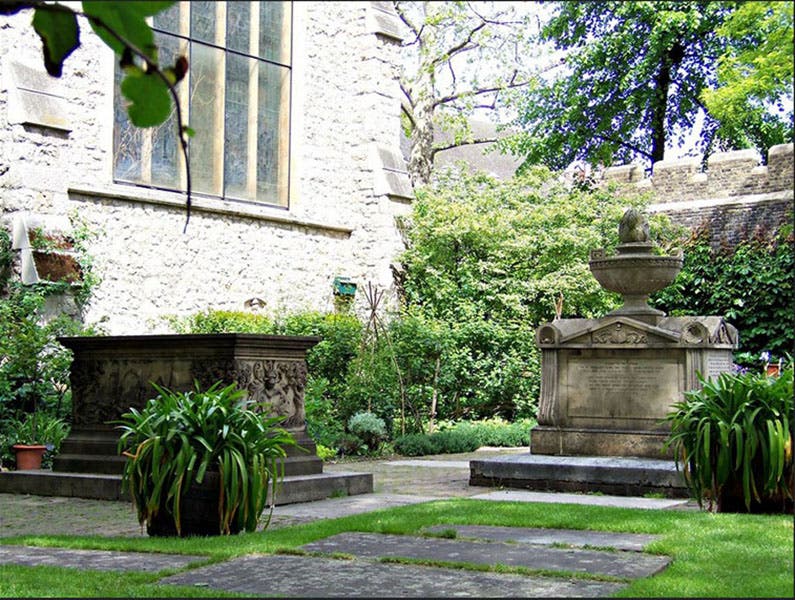
The tombs of John Tradescant, Elder and Younger (left) and Capt. William Bligh (right), The Garden Museum, old church of St. Mary’s at Lambeth, photo by Tere Sue Gidlof, Flickr (flickr.com)
The tomb of the Tradescants was originally all by itself in the Knot Garden, but it was later joined by the tomb of William Bligh, captain of HMS Bounty.
.jpg#/media/File:Garden_Museum_(4632736506).jpg)
Former church of St. Mary’s Lambeth, now housing The Garden Museum, and the tomb of John Tradescant the Younger (Wikimedia commons)
The lid of the Tradescant tomb has a long verse carved into it: The last six lines read as follows:
Those famous antiquarians that had been
Both gardeners to the Rose and Lily Queen
Transplanted now themselves, sleep here, and when
Angels shall with their trumpets wake men
And fire shall purge the world, these hence shall rise
And change this garden for a Paradise.
It looks like the trumpets have already done a good deal of their sounding, for the Paradise transformation seems well begun.

The Knot Garden in the courtyard of The Garden Museum, with the Tradescant tomb peeking out from behind the Bligh tomb at far left (Wikimedia commons)
William B. Ashworth, Jr., Consultant for the History of Science, Linda Hall Library and Associate Professor emeritus, Department of History, University of Missouri-Kansas City. Comments or corrections are welcome; please direct to ashworthw@umkc.edu.