Scientist of the Day - Andrey Nartov

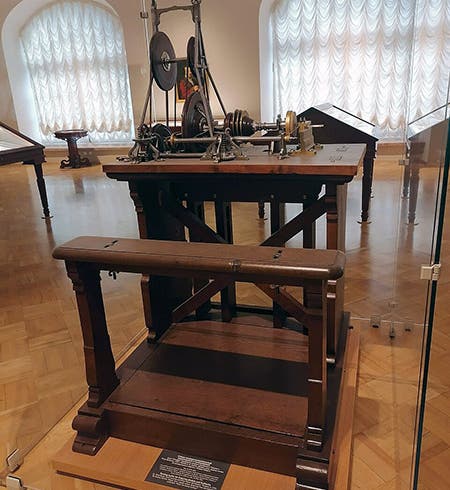
Copying lathe built by Andrey Nartov for Peter the Great, 1721, now in the Hermitage Museum (Wikimedia commons)
Andrey Konstantinovich Nartov, a Russian engineer and ornamental lathe designer, died on Apr. 27, 1756, at the age of 73. Nartov was an early enrollee in Peter the Great's School of Mathematical and Navigational Sciences in Moscow, with which the Tsar hoped to bring Russia out of the dark ages and make Russia a cultural and military force to be reckoned with in the West. Classes met in the Sukharev Tower, which Peter had built in the 1690s and which was tall enough that the students could easily use their navigational instruments. Nartov was smart and excelled in his classes, but he also took up turning on the lathe, a favorite recreation of Peter, and he set his mind to improving the machine. In 1712, he invented a copying lathe that incorporated a geared mechanical tool rest that Russian historians praise as the first of its kind. A 1721 copying lathe built by Nartov survives today in the Hermitage Museum. Indeed, quite a few seem to survive, but only one is regularly pictured.

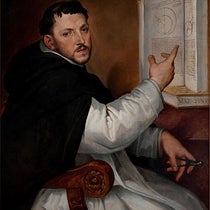
Portrait of Andrey Konstantinovich Nartov, oil on canvas, by Ivan Nitikin, undated, Hermitage Museum (Wikimedia commons)
Peter founded St. Petersburg in 1712 and Nartov moved to the palaces there to take charge of the tsar's lathe workshop, which was large. In 1718, Nartov was sent by Peter to England and France to learn about Western lathes and turning techniques, and he came back convinced that Russian techniques and equipment were superior, which no doubt pleased Peter. He left behind one of his own lathes, a gift to the French monarchy, and it is still there, on display in the Musée des Arts et Métiers in Paris (fourth image). I do not believe that England was a similar beneficiary of a Nartov lathe.

Sukharev Tower in Moscow, site of Peter the Great's School of Mathematical and Navigational Sciences, 1700, photograph, 1927; building destroyed in 1934 (Wikimedia commons)
After Peter died in 1725, Nartov moved into military engineering, an aspect of his career about which I know little. He did compile a manuscript, Theatrum machinarum, that was supposedly published in translation in the 1960s. But we do not have a copy. However, we do have a copy of A.K. Nartov: An Outstanding Machine Builder of the 18th Century, a scarce translation from the Russian, by A.S. Britkin and S.S. Vidonov, 1964, which I used in writing this post.

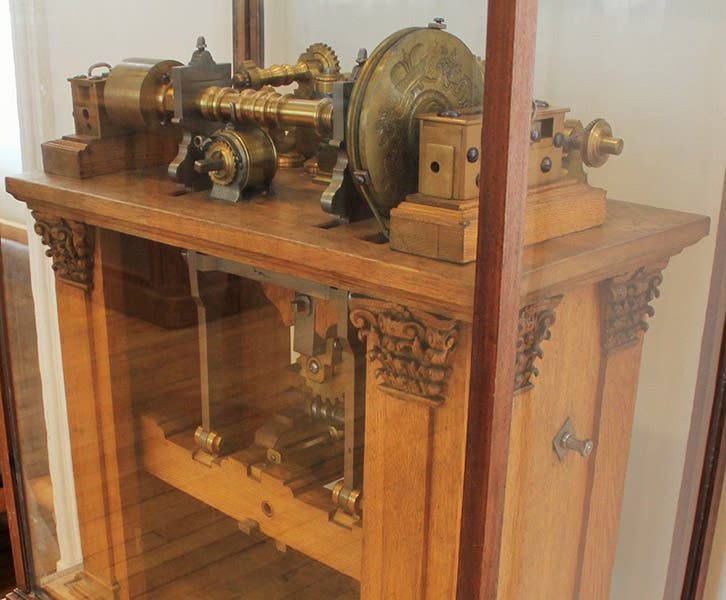
A copying lathe built by Andrey Nartov and presented to the King of France, 1719, on display in the Musée des Arts et Métiers, Paris (gracesguide.co.uk)
Nartov is important as one of Peter the Great's first success stories, one of the first instances where a Russian was better at his job than anyone west of the Urals. When the St. Petersburg Academy of Sciences (later the Imperial Academy of Sciences) was founded in 1725, just after Peter’s death, and populated with academics from France and Germany, such as Leonhard Euler and Daniel Bernoulli, Nartov was invited to join, and he held his own amid the imports. He continues to be a symbol of native-grown technological success in early modern Russia.
My thanks to Bill Robertson, Kansas City’s own master of ornamental turning, for calling my attention to Nartov some years ago.
William B. Ashworth, Jr., Consultant for the History of Science, Linda Hall Library and Associate Professor emeritus, Department of History, University of Missouri-Kansas City. Comments or corrections are welcome; please direct to ashworthw@umkc.edu.