Scientist of the Day - Frederick Law Olmsted

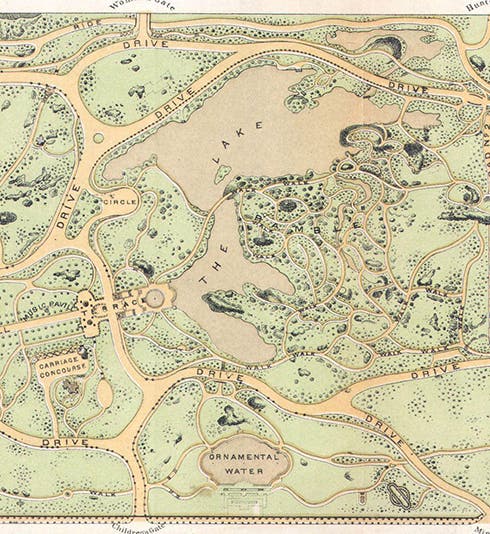
Modified ground plan of Central Park, New York City, by Frederick Law Olmsted and Calvert Vaux, 1868 (Wikimedia commons)
Frederick Law Olmsted, an American landscape architect, died on Aug. 28, 1903, at the age of 81. He was arguably America's first landscape architect. Born in Hartford, he was schooled by several tutors who were fond of gardening and who planted a love of nature in Olmsted. He avoided college, but somewhere he encountered the writings of Andrew Jackson Downing, who is the other candidate for America's first landscape architect, although he is usually called a landscape gardener. Downing founded and edited an influential magazine, The Horticulturalist. He also convinced an English architect, Calvert Vaux, to emigrate to the United States in 1852. Vaux would later collaborate with Olmsted.

Portrait of Frederick Law Olmsted, photograph, 1857 (Wikimedia commons)
Olmsted, for a few years, ran a farm on Staten Island that his father bought for him. He gave that up in the 1850s to work as a reporter for the New York Times, which sent him to the Deep South to examine the cultural effects of a slave-based economy, and he responded with a perceptive series of articles, which were turned into books. He also went to England, where he visited Birkenhead Park in Merseyside, near Liverpool, the world's first public park that was open to all social classes without exception. Olmsted loved the idea of a park for the people.

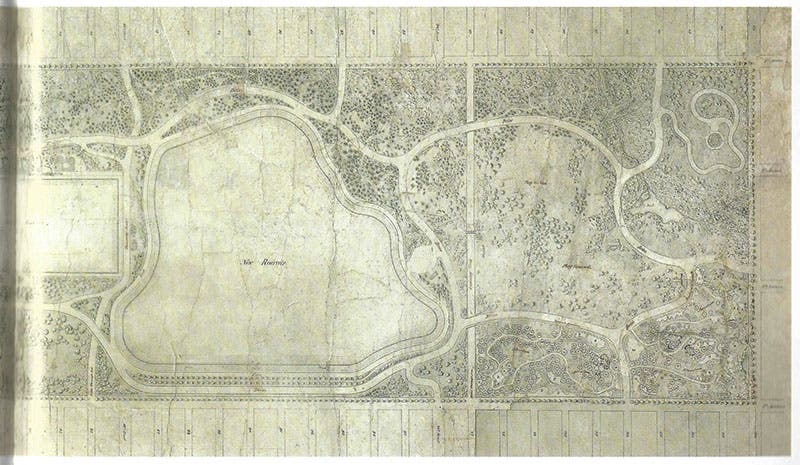
Detail of the north end of the 1858 ground plan for Central Park, New Yok City, by Frederick Law Olmsted and Calvert Vaux; note the new reservoir and the individual placement of trees (diannedurantewriter.com)
When he returned to the U.S, he found that New York City was taking bids for the design and construction of a park in central Manhattan. Although he had never designed a park in his life, Olmsted teamed up with Vaux, whom he had met at Downing's house in 1852 (just before Downing was killed in a steamboat explosion). Olmsted and Vaux came up with a novel plan for a Central Park, which they called the Greensward Plan, after the English word for a grassy meadow. It included many miles of hiking trails, bridle paths, and carriage ways, intricately weaving over and under each other via a multitude of bridges. The most ingenious feature was that the four crossroads, necessary because the park extended from 59th St. to 106th St., were open-air but sunken below park level, and spanned by archways, so that park users could hardly see them. There were also a myriad of trees, flowers, and rock outcrops, and very few formal structural elements, which made it unlike any other park in the world, except Birkenhead.

Six of the people involved in the design of Central Park, New York City, with Frederick Law Olmsted at far right, Jacob Wrey Mould next to him, and Calvert Vaux third from left, photograph, 1862 (Wikimedia commons)
The two men submitted their bid in 1857. To everyone's surprise, it was selected in 1858, with construction to begin immediately. It was a massive project. Olmsted was responsible for the design of the paths and roads, and for moving the thousands of yards of earth (poor soil out, topsoil in) needed to shape the contours and nourish the thousands of trees that were planted. The most visible features of the new Central Park, the 39 bridges and archways, were the work of Vaux and a third collaborator, Jacob Wrey Mould, but we can't resist showing one of them here, number 28, the Gothic Bridge (sixth image).

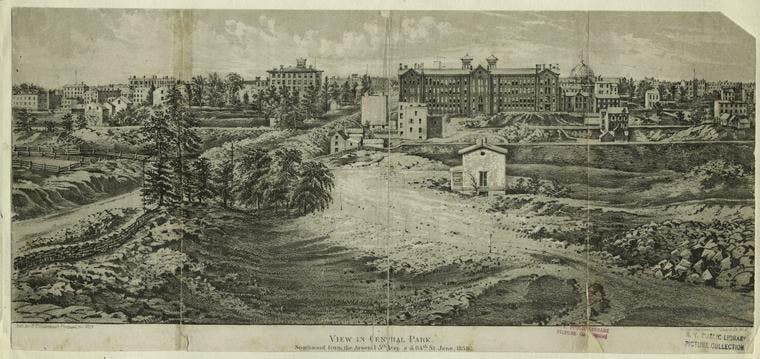
Central Park under construction, photograph, 1858 (diannedurantewriter.com)
Portions of the park were opened to the public in 1859, and it was an instant success, although it would not be completed until 1876. Olmsted was adamant that the park be open to everyone, and it was. The Civil War intervened, during which Olmsted served as head of an organization equivalent to the later Red Cross, and he spent some time in California, shaping Yosemite State Park and designing for Leland Stanford, but he was regularly rehired by the New York City Parks Department to supervise the completion of Central Park.

Gothic Bridge, no. 28, Central Park, designed by Calvert Vaux and Jacob Wrey Mould, recent photograph (Wikimedia commons)
After Central Park, Vaux and Olmsted began a formal collaboration that would last for almost two decades. They designed Prospect Park in Brooklyn, not quite as large as Central Park, but consided by many to be an even more successful design. The two designed many other parks: Jackson Park in Chicago, and the Emerald Parkway in Boston, and Olmsted alone was responsible for the layout of the World's Columbian Exposition that opened in Chicago in 1893. We might discuss some of this, with a focus on Prospect Park, in a future post. We should also write a post on Vaux, so we can present some more of those marvelous Central Park bridges, each of which is unique.

Frederick Law Olmsted National Historical Site, Brookline, Mass. (Wikimedia commons)
Olmsted moved the headquarters of his company, now involving his two sons, to Brookline, Mass., and about 1894, he began to lose his short-term memory. His condition worsened; he possibly had Alzheimer's disease, or at least severe senile dementia. He had to withdraw from business, and ultimately was confined to an institution. After his death in 1903, his ashes were buried in Old North Cemetery in Hartford. It is a family plot, and not my favorite tomb monument, so I do not show it here. You can seek it out, if you are interested, on Findagrave. Here we show a different kind of memorial, the Frederick Law Olmsted National Historical Site, Brookline, Mass. (last image)
There is an excellent collection of photographs of Central Park from the 1850s and 1860s on this webpage, from which we took two of our images.
William B. Ashworth, Jr., Consultant for the History of Science, Linda Hall Library and Associate Professor emeritus, Department of History, University of Missouri-Kansas City. Comments or corrections are welcome; please direct to ashworthw@umkc.edu.