Scientist of the Day - Jan Commelin

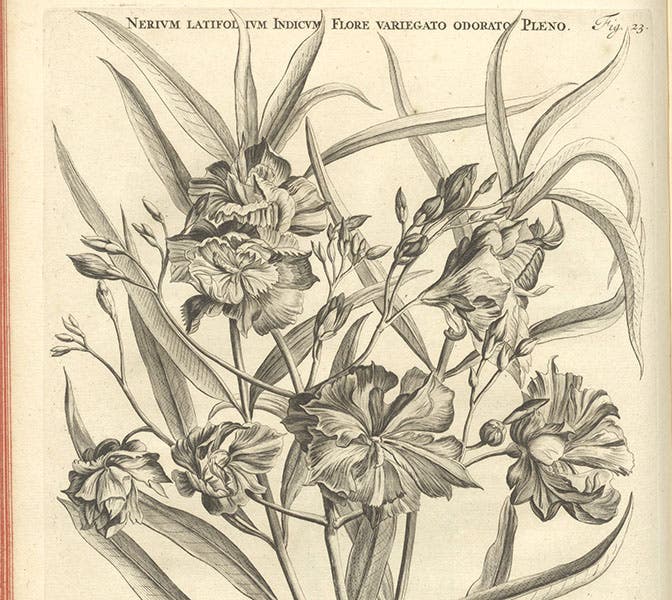
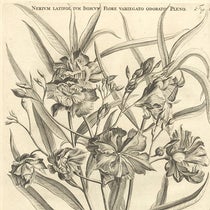
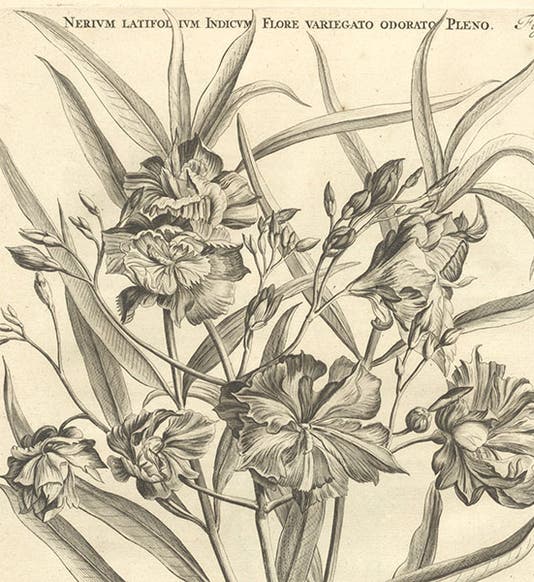
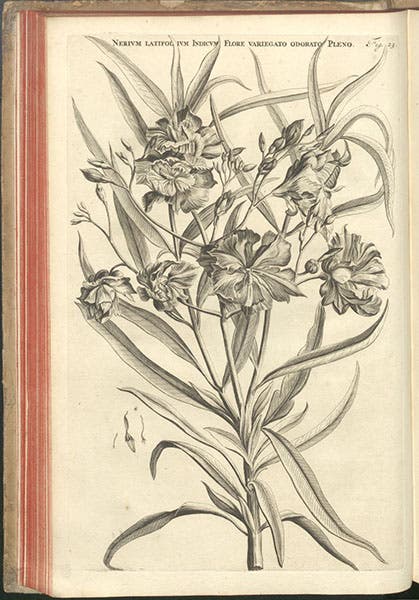
Nerium latifolium Indicum, an oleander, detail of an engraving after Jan or Maria Moninckx, Horti medici amstelodamensis, by Jan Commelin, vol. 1, fig. 23, 1697 (Linda Hall Library)
Jan Commelin, a Dutch botanist, was born on Apr. 23, 1629. In the mid-to-late 17th centuries, the Dutch were importing a tremendous variety of exotic plants, from South Africa, the Caribbean and Brazil, and the East Indies, thanks to their two great trading companies. Living plants went into gardens in Amsterdam, especially the Hortus Medicus, which would eventually expand into the Hortus Botanicus. Commelin was in charge of this garden. In addition, he had his own gardens where he raised plants to sell to apothecaries, which earned him quite a fortune.

Portrait of Jan Commelin, oil on canvas, by Gerard Hoet, ca 1680, Amsterdam Museum (Wikimedia commons)
Commelin wanted a pictorial record of all the plants in the Amsterdam garden, and he and the city authorities commissioned a set of paintings from various botanical artists, especially Jan Moninckx, and his daughter Maria. He then began preparing the text for an illustrated catalog of the Hortus Medicus. Commelin died, unfortunately, in 1692, before he could publish his masterwork. Fortunately, two of Amsterdam's leading citizens (one of which was Frederick Ruysch, father of Rachel Ruysch), stepped up and saw the work through publication in 1697, as the Horti medici amstelodamensis rariorum … plantarum … descriptio et icones ad vivum æri incisæ (Description and images drawn from life on copper of the rare plants of the Amsterdam Medical Garden). Jan's son Caspar finished a second volume in 1701. We have the two-volume folio set in our collections. The text is in both Latin and Dutch, and it accordingly has title pages in both languages. We show the Latin title page.

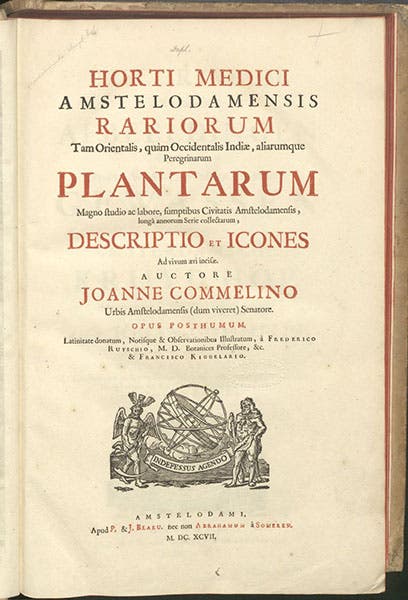
Title page, Horti medici amstelodamensis, by Jan Commelin, vol. 1, 1697 (Linda Hall Library)
Our set is uncolored – I am sure there are colored sets out there – but the absence of color allows one to appreciate the beauty of the engravings, which are impressed on thick wove paper in our copy. There are 112 of these full-page plates in volume 1, Jan's volume. I picked four of them to show here.

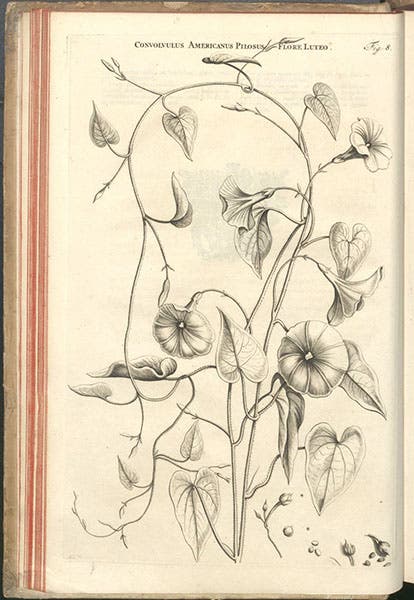
Convolvulvus Americanum, bindweed, engraving after Jan or Maria Moninckx, Horti medici amstelodamensis, by Jan Commelin, vol. 1, fig. 8, 1697 (Linda Hall Library)
The most ordinary is the American Convolvulvus, or bindweed (fourth image), scourge of the American garden, but isn't the plant beautifully laid out for engraving? The second is an African succulent, Euphorbium cerei, meaning it has yellow flowers, so it could be any of a half-dozen species (fifth image). But it looks very impressive on the printed page, which is why I chose it.
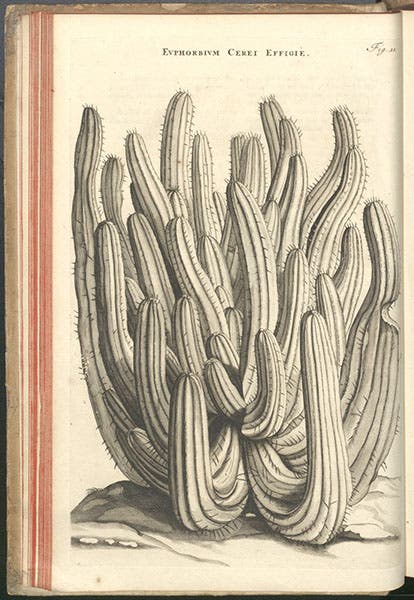
Euphorbium cerei, an African cactus, engraving after Jan or Maria Moninckx, Horti medici amstelodamensis, by Jan Commelin, vol. 1, fig. 11, 1697 (Linda Hall Library)
The third selection I display twice, in a detail as the opening Image, and in the full plate (sixth image). This is what Commelin calls Nerium latifolium Indicum, and we now call Nerium oleander, or just Oleander. It is such a gorgeous plate, my favorite of all 112 engravings. Perhaps it reminds me of Vincent Van Gogh's Oleanders at the Met.

The most famous illustration in Commelin's volume, or at least the one most widely reproduced, is Ananas – the pineapple (seventh image). It certainly is dramatic. But it is hard to love a pineapple.

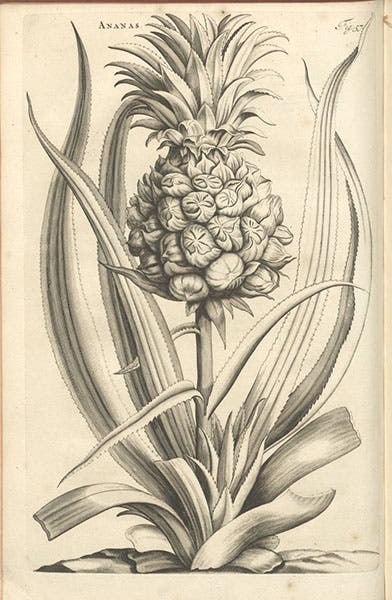
Ananas, pineapple, engraving after Jan or Maria Moninckx, Horti medici amstelodamensis, by Jan Commelin, vol. 1, fig. 57, 1697 (Linda Hall Library)
I assume that the engravings in the Hortus are by Jan and/or Maria Moninckx, because all the sources say so, but the fact is, none of the book engravings are signed, either by artist or engraver. So there is some further research to be done.
One of the nice features of being a famous person in 17th-century Amsterdam is that there were plenty of skilled painters around to fashion your portrait. Commelin has a nice one, by Gerard Hoet, now in the Amsterdam Museum (second image).

Commelina communis, a dayflower (Wikimedia commons)
A genus of flowering plants, the dayflowers, is named after Commelin (last image). We have a few in our garden, and you probably do as well.
William B. Ashworth, Jr., Consultant for the History of Science, Linda Hall Library and Associate Professor emeritus, Department of History, University of Missouri-Kansas City. Comments or corrections are welcome; please direct to ashworthw@umkc.edu.