Scientist of the Day - John Keill

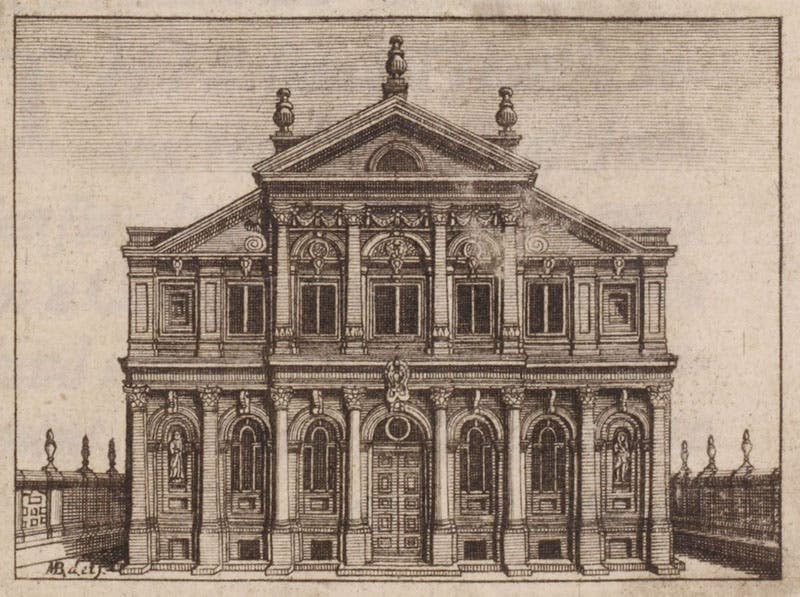
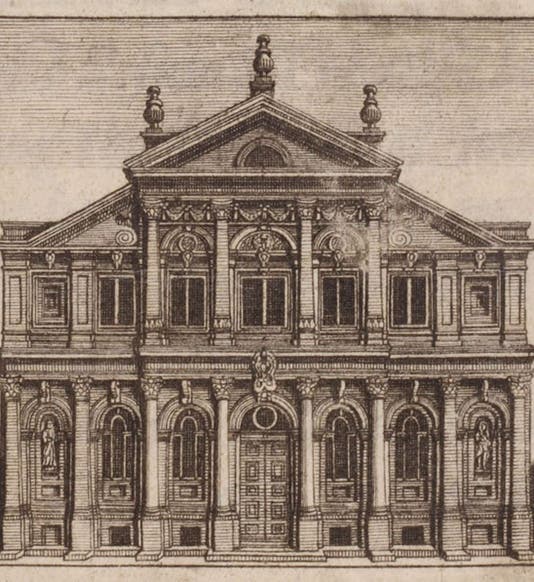
The Sheldonian Theatre at Oxford, title-page vignette by Michael Burghers, An Examination of Dr. Burnet's Theory of the Earth, by John Keill, 1698 (The Linda Hall)
John Keill, a Scottish physicist, astronomer, and mathematician, died on Aug. 31, 1721, at the age of 49. Keill attended Edinburgh University and studied under David Gregory, an eminent mathematician himself and a friend of Isaac Newton, who helped Gregory get a professorship at Oxford. When Gregory came down from Edinburgh, Keill followed, and received his MA at Oxford.

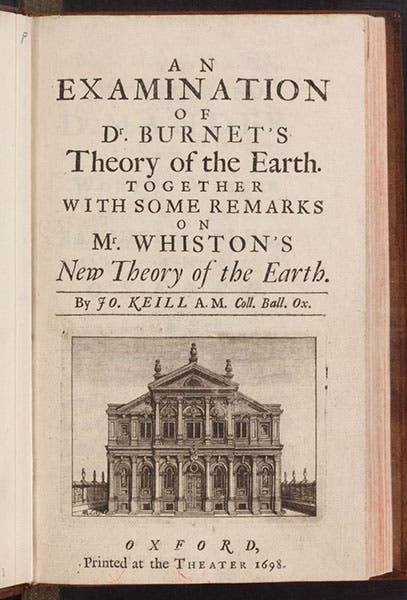
Title page, An Examination of Dr. Burnet's Theory of the Earth, by John Keill, 1698 (The Linda Hall)
Keill's first book was an odd one, An Examination of Dr. Burnet's Theory of the Earth (1698; second image), which was critical of Thomas Burnet, who wrote the first Theory of the Earth in 1681 and named the genre. Keill did not like the physics behind Burnet, which was based on that of René Descartes. Keill also took on the Newtonian New Theory of the Earth (1696) of William Whiston. Keill's own book was attacked in turn, and Keill published several defenses. We have all three of his treatises in our collections, although we did not have any when we conceived our exhibition, Theories of the Earth: The History of a Genre (1984). Incidentally, the man who made the engraving of the Sheldonian Theater at Oxford, which appeared on the title pages of nearly all of Keill’s books (first image), was Michael Burghers, who also engraved the three frontispieces discussed in our post on Gregory.

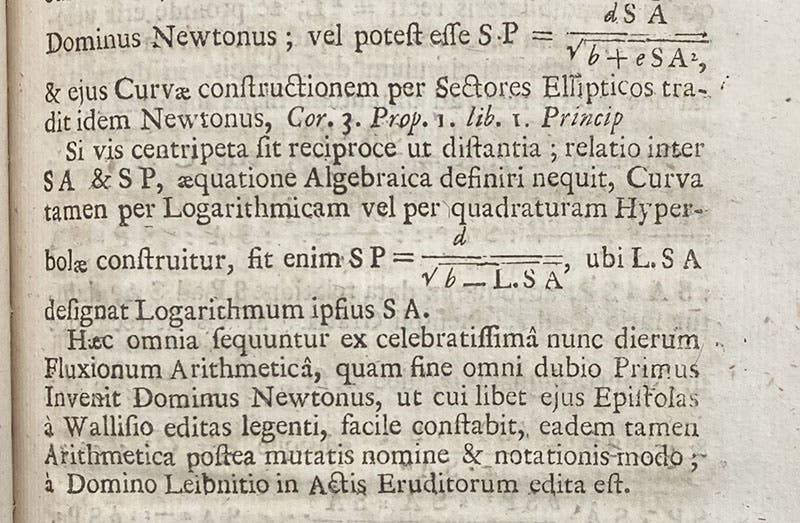
Paragraph where John Keill accuses Gottfried Leibniz of plagiarizing Isaac Newton’s calculus, changing the form, and publishing it as his own, Philosophical Transactions of the Royal Society of London, vol. 26, p. 185, 1708 (published 1710) (The Linda Hall)
But Keill is best known for defending the originality of Isaac Newton in the calculus controversy with Gottfried Leibniz. It had been pretty much accepted by the early 1700s that Newton and Leibniz had independently invented calculus (which Newton called fluxions), although Leibniz had published first (in 1684). But Keill argued that Leibniz had stolen the idea from some Newton correspondence when he visited London in 1676, and Keill said so in a paper read to the Royal Society in 1708, and published in the Philosophical Transactions in 1710 (for 1708). Leibniz took offense, as well he might have, and wrote to the Royal Society, demanding an apology. The result was the establishment of a committee to investigate the matter. Newton, however, was President of the Society, appointed the committee, chaired the committee, and wrote the report, which determined that Newton was the sole inventor of calculus. Since Newton's name appeared nowhere in the report, this was a scandalous affair, and Leibniz was justifiably outraged. The brouhaha died down only when Leibniz died in 1716. The whole contretemps was really Keill's fault.
Since I have never seen it done, we reproduce here the paragraph in Keill’s paper in which he praised Newton and accused Leibniz of changing the form and nomenclature and re-publishing it in the Acta Eruditorum in 1684 (third image). The text is in Latin, but you can make out Newton’s name at the top and that of Leibniz at the bottom.

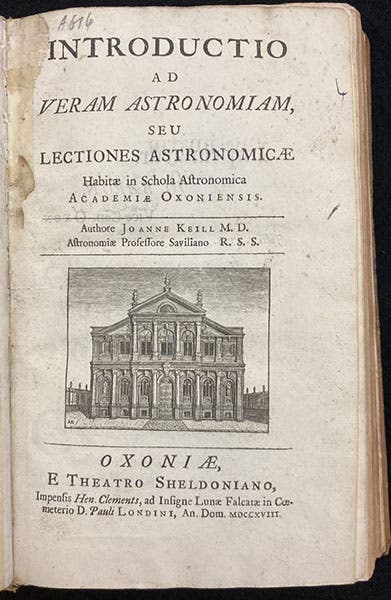
Title page, Introductio ad veram astronomiam, by John Keill, 1718 (The Linda Hall)
On the flip side, Keill was apparently a gifted teacher, expounding experimental Newtonian physics in the classroom, and inspiring his own student, John Theophilus Desaguliers, to go forth and do likewise, which Desaguliers did very successfully, first at Oxford, then in London. Keill had another pupil, Brook Taylor, who also became an important mathematician.
Keill published several textbooks on astronomy that were successful and often reprinted. We have first editions and some of the later printings (and translations) in our collections. Keill left Oxford for several political appointments in 1709 (including one as decypherer for the Queen), but returned to Oxford to become Savilian Professor of Astronomy (succeeding Gregory) in 1712. Keill’s early death in 1721 is attributed to "food poisoning," but I have no idea what that means in the context of 18th-century medicine. It is also often said that Newton eventually tired of Keill's strident ways and parted company with his former friend. I do not know what the evidence is for that statement.

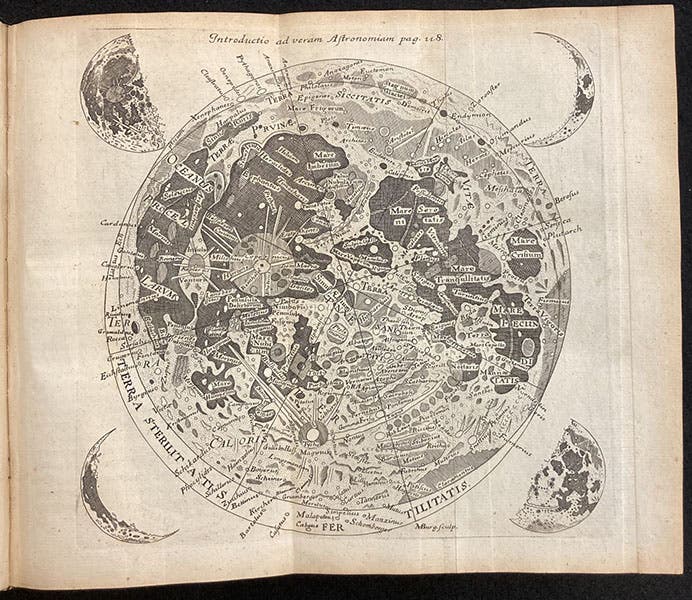
Nomenclature map of the Moon, based on that of Giovanni Battista Riccioli in 1651, engraving by Michael Burghers in Introductio ad veram astronomiam, by John Keill, p. 118, 1718 (The Linda Hall)
One of the interesting features of Keill’s astronomy textbook of 1718 is a foldout engraving of Giovanni Battista Riccioli’s nomenclature map of the moon (last image). Since there were two lunar nomenclatures in circulation at the time, those of Riccioli and Johannes Hevelius, I wonder if the continued reproduction of Riccioli’s in Keill’s textbooks contributed to the ultimate acceptance of Riccioli’s names for lunar features.
I have not located a portrait of Keill. There are none online, and I looked in all the posthumous editions of his works, where portraits are often included, and did not find any. That is odd.
William B. Ashworth, Jr., Consultant for the History of Science, Linda Hall Library and Associate Professor emeritus, Department of History, University of Missouri-Kansas City. Comments or corrections are welcome; please direct to ashworthw@umkc.edu.