
Scientist of the Day - Pluto


“Sad Pluto,” artwork by Luca Mendieta, Shutterstock (shutterstock.com)
On Aug. 24, 2006, exactly 20 years ago today, a solar system body named Pluto, a happy planet for 76 years, was demoted and reclassified as a "dwarf planet.” It was joined in its new class by Ceres and Eris, but they were promoted, Ceres from the minor planet level, and Eris from the realm of trans-Neptunian objects. Pluto, however, took a step down, and not everyone was okay with that.
Pluto had been discovered in February of 1930, by Clyde Tombaugh, a young astronomer working at the Lowell Observatory in Flagstaff, Arizona. It was not a "Lo!" kind of discovery, with lots of pointing at the sky. Pluto was barely visible from Earth, even through a powerful telescope. But it could make a blip on a photographic plate. And that was how Tombaugh found it, with an instrument called a blink comparator that made such blips visible, if they were moving, as Pluto was. Pluto was immediately declared a planet, the ninth and outermost planet in the Solar System, and Tombaugh was hailed as only the third person in all of recorded history to discover a new planet (the first six were noticed in prehistoric times).

Clyde Tombaugh, photograph, 1930, with a small telescope, not the one used to discover Pluto (Wikimedia commons)
But problems with Pluto arose, as we learned more about it, and about its orbit, which turned out to be quite elliptical, so that it regularly came closer to the Sun than Neptune, making it, for 30 years at a time, the eighth planet. Its orbit was also inclined some 20º to the orbits of all the other planets, which suggested it had a different origin. It was exciting when it was discovered (in 1978) that Pluto has a moon, Charon, but the motions of the two allowed us to calculate Pluto’s mass, which turned out to be much less than the mass of our Moon. It was much smaller by a huge factor than any other planet.
Pluto might have held onto its planetary status anyway, but around 2000, astronomers began to turn up all sorts of Pluto-like objects out in what is called the Kuiper Belt, a region beyond Neptune. The new bodies were given names like Sedna, and Waimea, and Makemake. The real problem came with the discovery of Eris in 2005, which was originally thought to be larger than Pluto, and thus seemed a good candidate to become planet no. 10. But how did one decide if some new object is a planet? There was no list of criteria, no formal definition of a planet, for astronomers, or for planetary geologists. So the International Astronomical Union (IAU) decided in 2005 to appoint a committee to come up with a definition of a planet.


Pluto, then a planet, and its largest moon Charon, photographed by the Hubble Space Telescope, Feb. 21, 1994 (esahubble.org)
The committee met and deliberated, like any good committee. It was chaired by a historian of astronomy, Owen Gingrich, a well-respected professor at Harvard who had compiled an annotated census of all the surviving copies of the De revolutionibis of Nicholas Copernicus. The committee's recommended definition of a planet was proposed at a General Session of the IAU in August of 2006. The definition was based on 3 criteria: an object is considered to be a planet if it: a) orbits the Sun, b) is large enough to be rounded by gravitational force, AND c) has swept out all the planetesimal debris on its path. Each traditional planet meets this definition, as do Uranus and Neptune. But Pluto does not. It is round, and it orbits the Sun. But it does not have enough mass to clean up its orbit. Nor does Eris, or Sedna, or any of the other trans-Neptunian objects. The committee proposed a new class of objects that were round and Sun-orbiting but failed as good housekeepers; they were to be called dwarf planets. Ceres, the first asteroid discovered, and the only one that has been rounded out by gravity, was added to the group. The committee's recommendation was debated – rather fiercely – at the IAU meeting, but it was approved on Aug. 24, 2006. Pluto was no longer a planet.

The dwarf planet Pluto, as photographed by the New Horizons spacecraft, July 14, 2015, NASA (Wikimedia commons)
I thought it was the right decision. There is little doubt that if Pluto had been discovered in, say 2001, it would never have been called a planet in the first place. The Hayden Planetarium in New York was one of the first public institutions to comply with the new definition, as they immediately removed the little globe representing Pluto from their walkway of hanging planets. Most other museums and planetaria have followed suit.
But lots of people were not happy, especially the entire team of the New Horizons spacecraft mission, which had just been launched with the mission of visiting the last unexplored planet, but now would be arriving at a dwarf planet. And many ordinary people on the street were angry that Pluto had been demoted. Memes were just becoming popular, and dozens of "Sad Pluto" and "Mad Pluto" memes were soon in circulation. And they still are.

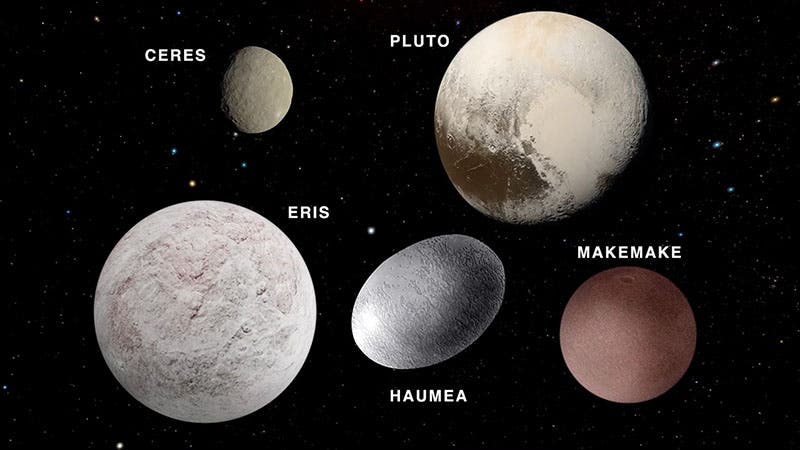
Five of the ten dwarf planets recognized as of this date, including Pluto, Ceres, Eris, Haumea, and Makemake, artist’s conception and photographs (science.nasa.gov)
If you are a member of a "We Love Pluto" group, that is fine. Pluto has a much richer history than any other dwarf planet, even Ceres, which has been known for 225 years, and especially round these parts, since Pluto was discovered by a Kansas farm boy. At least Pluto is now part of a group that will only grow and become more interesting. The eight planets (except Earth of course) are going to be stuck in their ways for a long, long time, at least until humans arrive, looking for a home, and wreaking their special magic.
William B. Ashworth, Jr., Consultant for the History of Science, Linda Hall Library and Associate Professor emeritus, Department of History, University of Missouri-Kansas City. Comments or corrections are welcome; please direct to ashworthw@umkc.edu.