Scientist of the Day - William Herschel

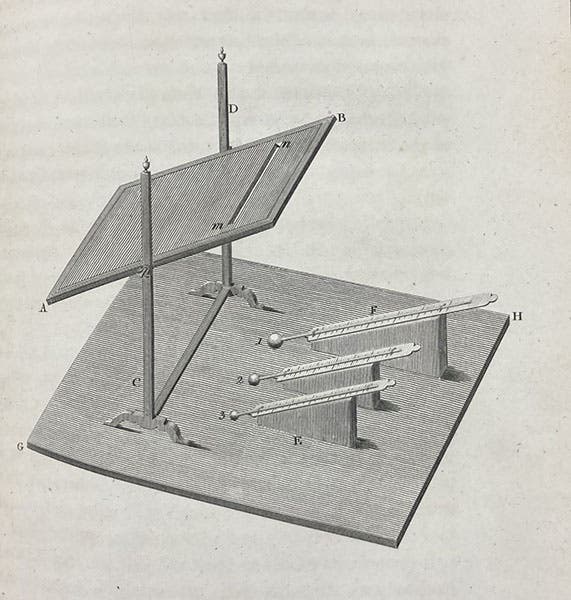
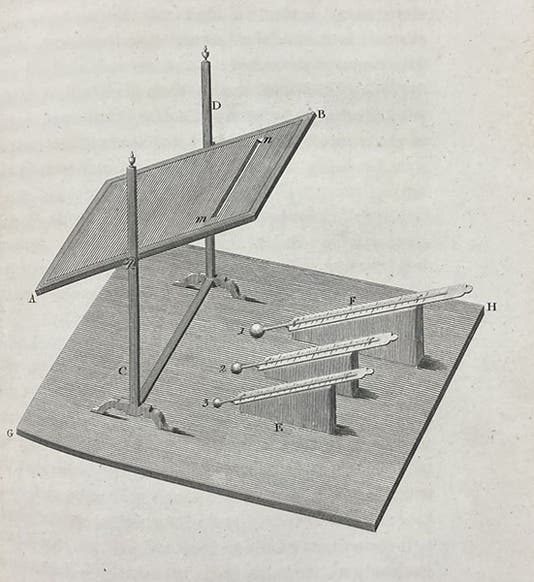
Diagram for experiments on prismatic light and heat, “Investigation of the powers of the prismatic Colours to heat and illuminate Objects…,” by William Herschel, Philosophical Transactions of the Royal Society of London, vol. 90, plate X, p. 282, 1800 (The Linda Hall)
William Herschel, a German/English astronomer, died on Aug. 25, 1822, at the age of 83. In the year 1800, Herschel was certainly the most famous astronomer in England, and probably in all the world, with due respect to Pierre-Simon Laplace and Johann Hieronymus Schroeter. After all, he had discovered a new planet, Uranus, in 1781, something no other person in all of recorded history had done (see our first post on Herschel). He had constructed some of the largest and most powerful reflecting telescopes in the world, including one with a four-foot mirror (which he ground himself) mounted in a 40-foot tube, which you can see in our second post on Herschel.

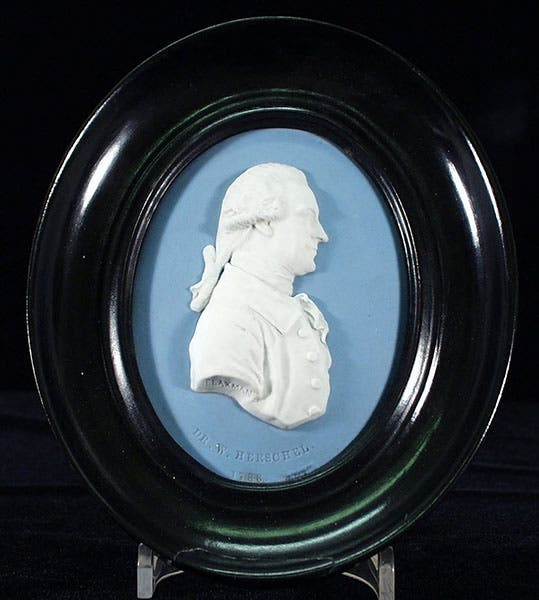
Portrait of William Herschel, Wedgwood porcelain relief by John Flaxman, from life, 1783, Victoria Art Gallery, Bath (artuk.org)
With his massive telescopes, Herschel proceeded to look at nebulae, 103 of which had been catalogued by Charles Messier in 1781. Herschel found and catalogued over 2300 more, finding that many of them were actually clusters of stars, easily resolved by his giant mirrors. He even offered a plausible structure for the Milky Way Galaxy, a statistical byproduct of his sweeps of the heavens. We discussed his work on nebulae in a third post on Herschel just last year
So what was this acclaimed astronomer, who had accomplished so much, doing in 1800? He was working in the light of day, hanging prisms in his window to catch the rays of the Sun, and observing the effect of the refracted, now-colored rays on a bank of thermometers. He wanted to know whether different colors of light carried different amounts of heat.
Light and heat were considered different entities in 1800, heat thought to be a fluid (caloric) and light either particles or waves, depending on whether you followed Isaac Newton or Christiaan Huygens. But heat and light were clearly related, since the Sun emitted oodles of both. Herschel knew that direct sunlight would raise the temperature of a thermometer. But did red light convey more heat than yellow light? Or blue light? He wondered.
This led to his first set of experiments, the setup of which he showed in a diagram in a paper he published in the Philosophical Transactions of the Royal Society in March of 1800 (first image). Rays from the Sun came through a slit in a window shade, were refracted (spread out) into the spectral colors, each of which could then be directed through a second slit to the bulb of a thermometer. Herschel found that red light produced the greatest temperature increase, and violet the least. Some of the thermometers in the diagram were controls, registering room temperature.

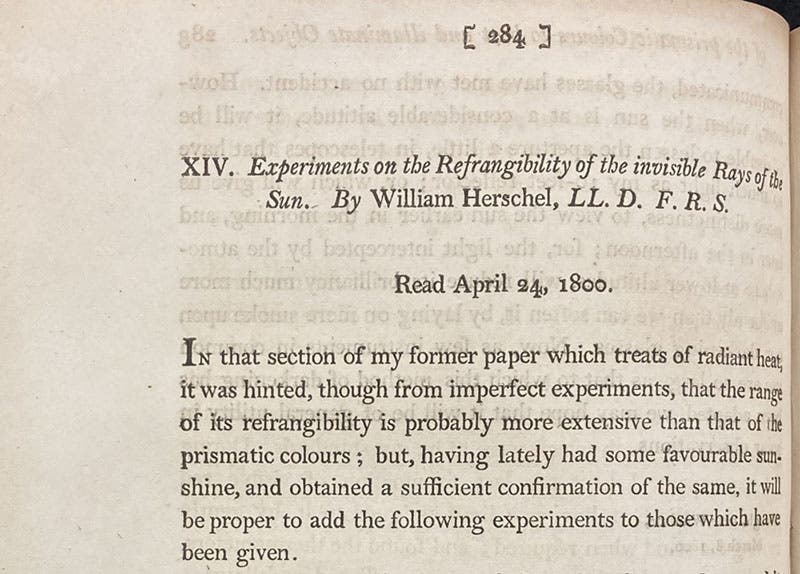
First paragraph, “Experiments on the Refrangibility of the invisible Rays of the Sun …, by William Herschel, Philosophical Transactions of the Royal Society of London, vol. 90, p. 284, Apr. 24, 1800 (The Linda Hall)
But Herschel noticed something else, which turned out to be much more interesting. Sometimes the temperature rose on a thermometer scale even when there was no light falling directly on the bulb of the thermometer, but only nearby. What was going on.

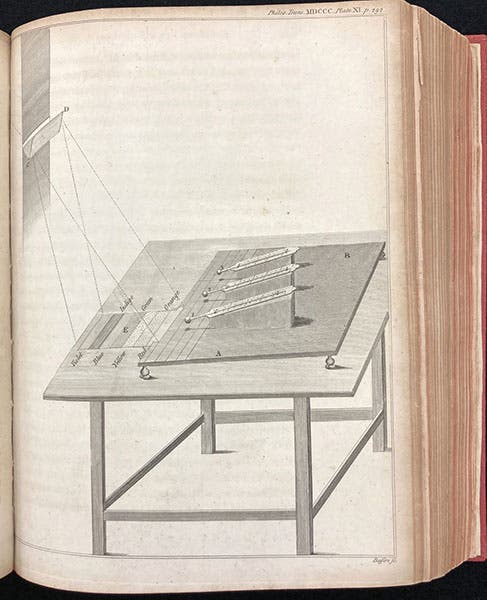
Experimental setup for revealing the presence of infrared radiation, “Experiments on the Refrangibility of the invisible Rays of the Sun …,” by William Herschel, Philosophical Transactions of the Royal Society of London, vol. 90, plate XI, p. 292, Apr. 24, 1800 (The Linda Hall)
This led to a second set of experiments, the results of which were announced in a second paper, published in the Philosophical Transactions the next month, on April 24, with a new diagram (third, fourth, and fifth images). This time, the thermometer bulbs were placed just beyond the red edge of the spectrum. And they registered even more heat than when subjected to red light directly. Apparently, there were some invisible rays beyond the red end of the spectrum. Herschel had discovered infrared radiation. It was one of the great moments in the history of optics.

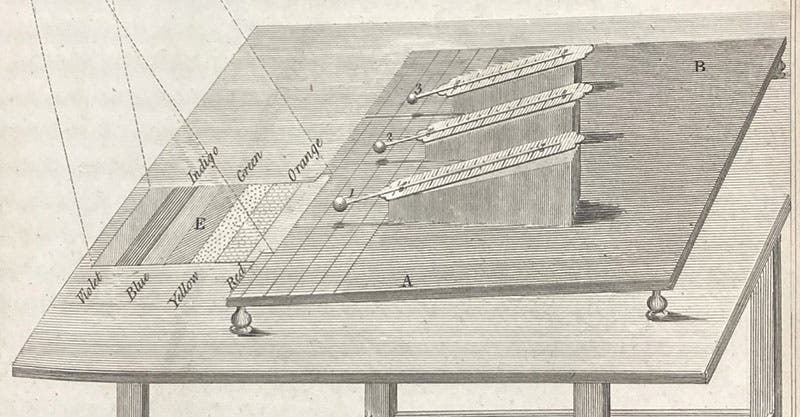
Detail of fourth image, showing placement of the visible spectrum and the thermometer bulbs, “Experiments on the Refrangibility of the invisible Rays of the Sun …,” by William Herschel, Philosophical Transactions of the Royal Society of London, vol. 90, plate XI, p. 292, Apr. 24, 1800 (The Linda Hall)
Herschel published one more paper in the Philosophical Transactions that year (in two parts, in May and November), a combined study of the heat produced by both visible and infrared radiation, which I mention mainly because it contained a third diagram, this one showing a heat spectrum of infrared light, an image strikingly out of place in a journal published in 1800, looking more like something Max Planck might have drawn in 1900 (last image). William Herschel was doing quite well for a doddering 61-year-old. And he had 22 years of scientific life still ahead of him.

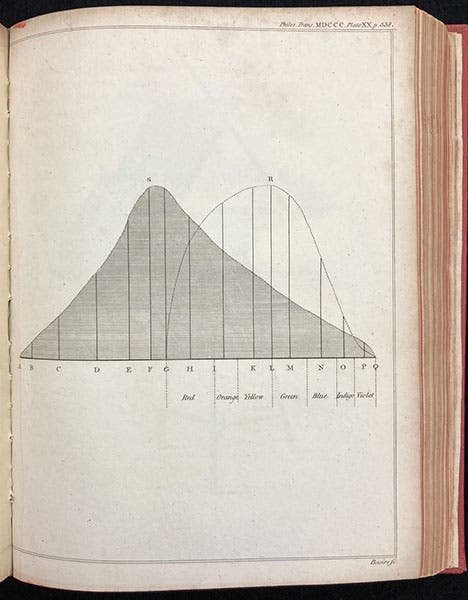
The spectrum of heat (shaded) and of light (faint and to the right), “Experiments on the solar, and on the terrestrial Rays that occasion Heat…, Part 2,” by William Herschel, Philosophical Transactions of the Royal Society of London, vol. 90, plate XX, p. 538, 1800 (The Linda Hall)
If you normally read vintage scientific papers online, let me suggest that you consult the print versions, should you pursue Herschel's studies on the infrared. Otherwise, you will miss the eerie experience of turning the pages after Herschel’s May paper and seeing an article of June 26, 1800, where Alessandro Volta announced his latest invention, the Voltaic pile, now known as a battery. The famous image of the Voltaic pile (see our post on Volta) was engraved by James Basire II, the same man who engraved all 3 of the Herschel diagrams we show today.
We displayed the two most famous portraits of Herschel in our earlier posts. For this occasion, we show a Wedgewood portrait relief in porcelain, modeled by John Flaxman and fired in 1783 (second image). It is in the Victoria Art Gallery in Bath, the same city where you will find the Herschel Museum of Astronomy.
William B. Ashworth, Jr., Consultant for the History of Science, Linda Hall Library and Associate Professor emeritus, Department of History, University of Missouri-Kansas City. Comments or corrections are welcome; please direct to ashworthw@umkc.edu.