Scientist of the Day - William Penny

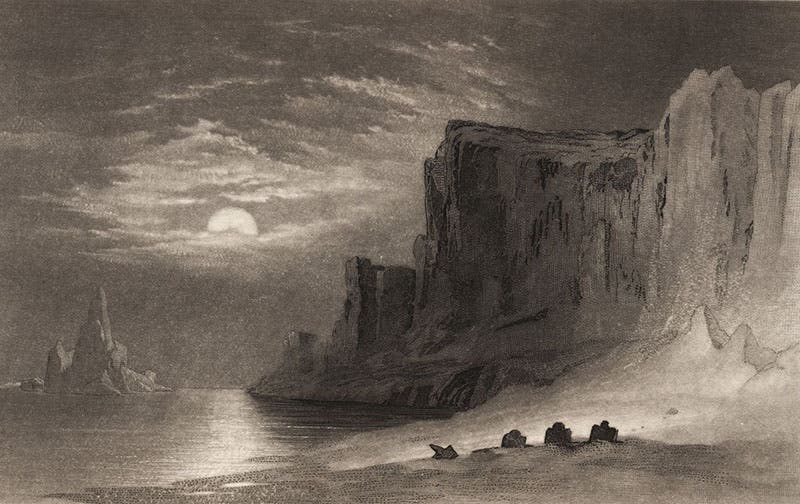
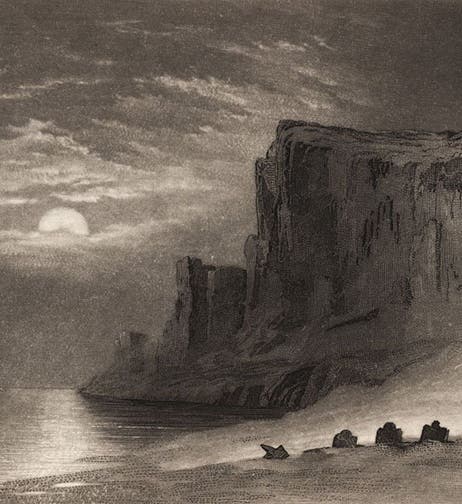
The graves of three of Franklin’s crew on Beechey Island, 1850, engraving in The U.S. Grinnell Expedition in Search of Sir John Franklin, by Elisha Kent Kane, p. 162, 1854 (The Linda Hall)
On Aug. 27, 1850, three graves were found on a remote icy stretch of Beechey Island in the North American Arctic archipelago. The headstones on the graves revealed that they contained the remains of three crew members of the Franklin expedition, whose ships had last been seen in Baffin Bay in 1845, five years earlier. The search for John Franklin, his ships, and his men had begun in earnest in 1850 (some thought it should have begun 2 years earlier), when some 15 ships were dispatched to the Arctic. The situation will probably make more sense if we have some feel for the geography of the area, so we show you first a moden map of the entire archipelago, a map that just happens to have superimposed upon it the track of Franklin's two ships, the Erebus and Terror, as we now reconstruct it (the track was not known to any of the searchers).

Moden map of the central region of the Arctic archipelago, with the known track of the Franklin expedition in blue and the inferred track in red (Wikimedia commons)
We now know that Franklin's ships entered Lancaster Sound, went past Devon Island, and reached Cornwallis Island (number 1 on the map), which they circled, before heading south, where they would be trapped in the ice, a frozen prison from which they would never break free. On the southwestern tip of Devon Island, but not marked on this first map, is a small island, Beechey Island, which is the first natural stopping point for a ship sailing or steaming through Lancaster Sound. On our second map, Beechey Island is labeled, as is Lancaster Sound (third image).

Another modern map of the central region of the Arctic archipelago, identifying Beechey Island, where the 3 graves were found (Wikimedia commons)
So on this 27th day of August, 1850, there were 5 ships anchored off Beechey Island, part of three different search expeditions, led by three different commanders. The three captains were an odd assemblage: a young American, a British whaler, and a Royal Navy officer who was in the permanent doghouse of the Admiralty. In reverse order, the RN officer was John Ross, who had been in his doghouse for fully 32 years, ever since, on the first attempt to discover a Northwest passage in 1818, he had failed to sail into Lancaster Sound, claiming it was blocked by mountains, and had returned home. He had not held another RN command since and was in the Arctic on his own. The whaler was William Penny, who was, like all whalers, a rough-hewn man not used to Navy ways, but who had befriended Lady Jane Franklin, John Franklin's widow (although she did not know that at the time), and she in turn financed Penny's search expedition on her own ship, the Lady Franklin. The third was an American surgeon, Elisha Kent Kane, on the ship Advance, part of a rescue expedition financed by a New York businessman, Henry Grinnell. The three men just happened to be together when a sailor came running in with the news that three graves had been discovered, and they all rushed to the site and identified the graves as those of Franklin crewmen. Kane made a sketch and later published it in his account of the first Grinnell voyage. It is one of the most evocative of all Arctic images (first image).

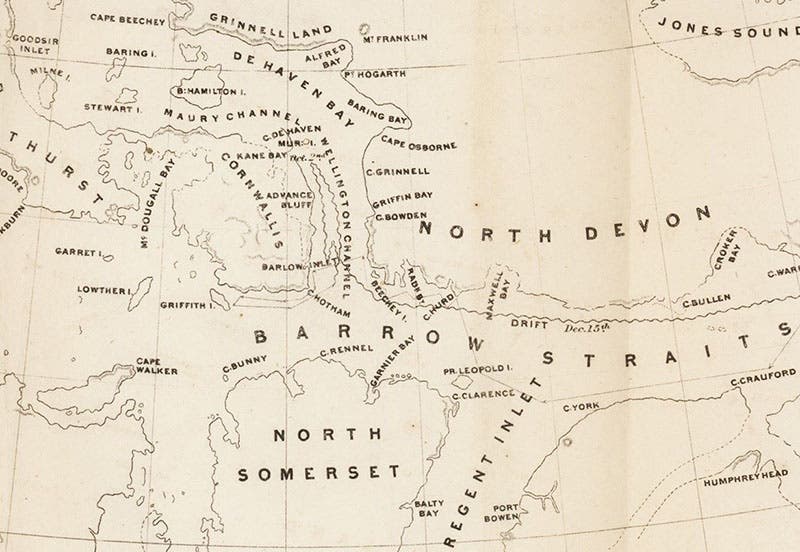
Detail of a contemporary map of the Arctic archipelago, showing the area around Beechey Island, engraving in The U.S. Grinnell Expedition in Search of Sir John Franklin, by Elisha Kent Kane, p. 17, 1854 (The Linda Hall)
The discovery of the graves was a big moment in the Franklin search: it showed that the ships had been this way and had gotten this far. But it also created a great mystery. Although Ross, Penny, and Kane subsequently found tin cans and other debris that indicated that the expedition had wintered on Beechey Island in 1845-46, there were no signs of where Franklin headed next – no cairns, nor markers, no arrows scratched in the ice, which was highly unusual – Arctic commanders nearly always left cairns with messages whenever possible, but not this time. It is a mystery not understood even to this day. So no one knew where to look next. It would not be for another 8 years that the final resting spot of the ships – at the end of the red dotted line in the first map – would be located, and the grim fate of Franklin and his crew determined.
The complete story of the search for Franklin is complex, and we devoted an entire section of our 2009 exhibition, Ice: A Victorian Romance, to the enterprise, if you would like to pursue it further. Kane’s drawing of the graves was displayed as part of item 38, and there is an excellent map of the area of search - this time an original map of 1854 at item 46. We include a detail of Kane’s map here, as our fourth image.

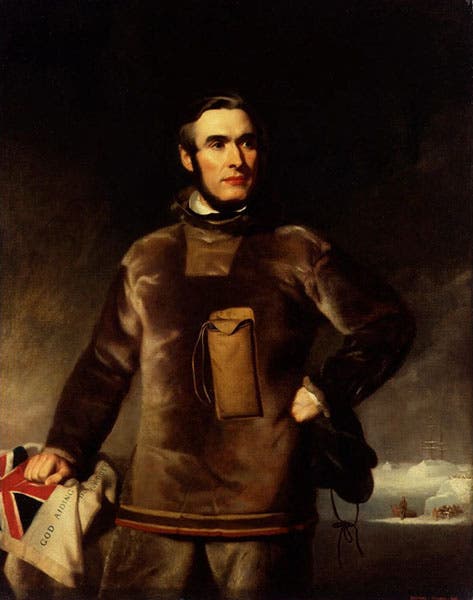
Portrait of William Penny, oil on canvas, by Stephen Pearce, 1853, National Portrait Gallery, London (npg.org.uk
We could have used John Ross or Elisha Kent Kane as our subject today (or the unnamed crewman who actually found the three graves on Beechey Island), but we have already written posts on Ross and Kane, so we chose William Penny, who probably gets the least attention of any searcher after Franklin. He was a whaler, not a Navy man, and somewhat in disgrace in Navy circles after he had a disagreement with commander Horatio Austin and returned home prematurely in 1851. But Lady Franklin always stood by him, and he did have his portrait painted by Stephen Pearce, just like his more famous Arctic counterparts (fifth image).

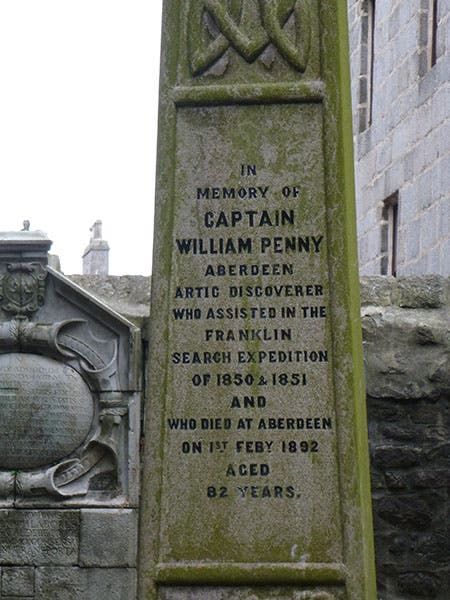
Tombstone of William Penny, describing his role in the search for Franklin, St. Nicholas Churchyard, Aberdeen (findagrave.com)
After his brief search for Franklin, Penny returned to whaling, and introduced several innovations, such as winter whaling, that allowed the whaling season to be extended. He even took his wife Margaret up to Baffin Bay on the Lady Franklin (which he bought and converted to a whaler), giving her some fame in Arctic circles. Penny retired to Aberdeen and lived to a reasonably ripe age, dying in 1892 at the age of 82. He is buried under a large tombstone that describes his role in the search for Franklin, in Saint Nicholas Churchyard in Aberdeen (last image).
There were a number of ships named after Lady Franklin, but for some reason, I have never found a visual record of the ship that Penny commanded in the Arctic and later purchased. If anyone knows of such an image, I would appreciate being informed.
William B. Ashworth, Jr., Consultant for the History of Science, Linda Hall Library and Associate Professor emeritus, Department of History, University of Missouri-Kansas City. Comments or corrections are welcome; please direct to ashworthw@umkc.edu.